Group Purchasing for Businesses: How It Works and Who It Helps
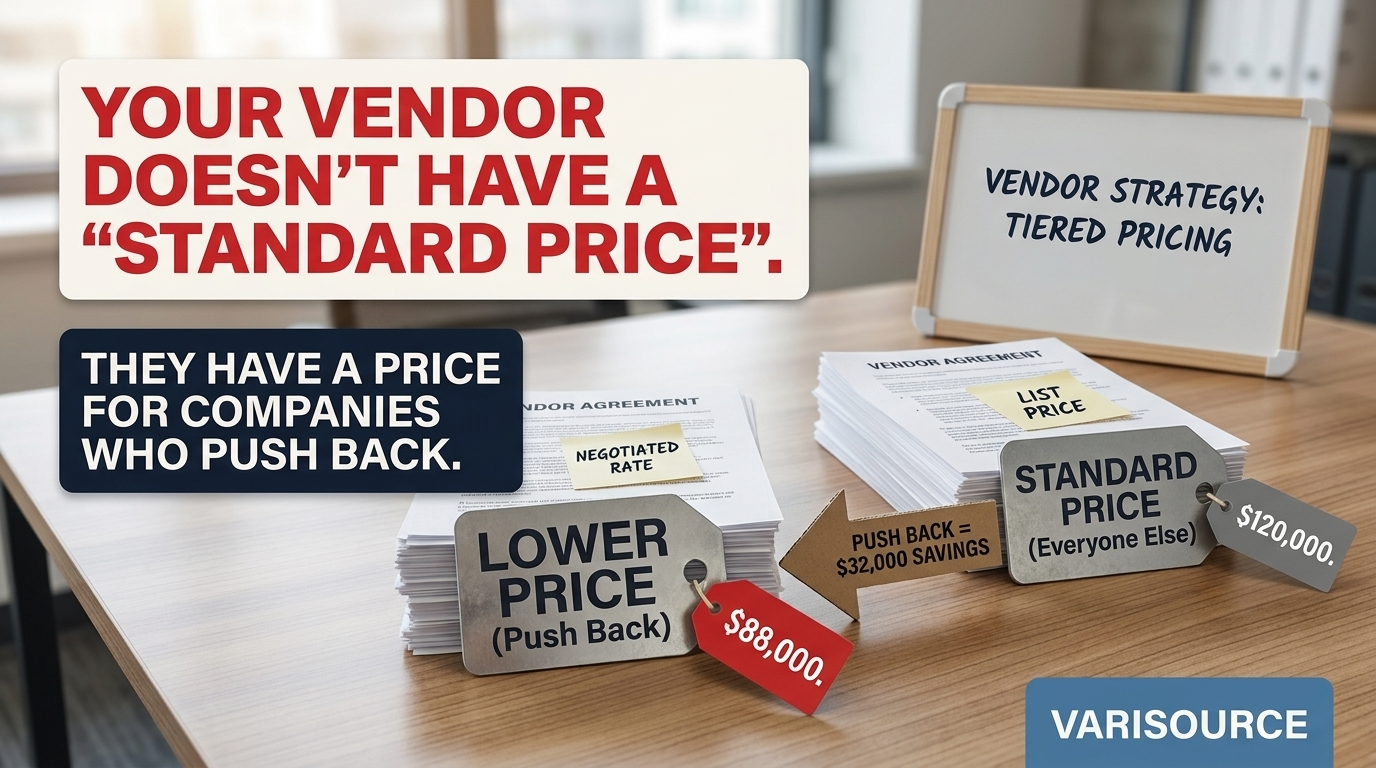
Group purchasing pools buying power across many companies so every member gets access to vendor pricing built on collective volume, regardless of their individual size. It is why a 50-person company can access the same software pricing as a 5,000-person one if both are in the same program. The US group purchasing organization market generates $7.3 billion annually because the model consistently delivers results. Adoption has grown to 56 percent of mid-market companies because negotiating alone costs more than it should.
What Is Group Purchasing for Businesses?
Group purchasing, also called cooperative purchasing or group buying, is a model where multiple companies pool their spending across the same vendor categories to collectively qualify for pricing, contract terms, and conditions that no single company could reach on its own.
The concept is straightforward. Vendors offer better pricing to larger buyers because volume represents more reliable revenue and less sales overhead per dollar of contract value. A company spending $200,000 per year on a platform is a meaningful account. A network of companies spending $80 billion collectively across thousands of vendors has a fundamentally different conversation with those same vendors.
Group purchasing organizations, commonly called GPOs, bridge this gap. They negotiate on behalf of all member companies, and every member gets access to those rates regardless of their individual spend. A company spending $200,000 in a category accesses the same pricing as one spending $20 million in the same category, because both are drawing from the same collective volume.
Who Benefits Most From Group Purchasing?
Group purchasing delivers the greatest advantage to companies that are too large to ignore vendor contracts but too small to reach enterprise pricing tiers independently. This typically means companies with $2 million to $100 million in annual revenue, with 20 to 1,000 employees, and with meaningful spend across software, cloud, telecom, managed services, and other indirect categories.
For these companies, individual negotiation consistently produces above-market pricing in categories where volume is the primary pricing driver. Their account managers are skilled. Their legal teams are thorough. But the vendor's pricing algorithm responds to volume, and no amount of negotiation skill overcomes insufficient volume at the high-leverage pricing tiers.
Group purchasing solves this structurally rather than tactically. It does not make a small company a better negotiator. It gives a small company the same leverage position as a large one.
What Does Group Purchasing Cover?
Group purchasing started in healthcare and manufacturing, where large organizations like hospitals and construction companies pooled materials purchasing to unlock volume pricing. In the technology and indirect spend market, the model now covers a broad set of categories relevant to every mid-market company.
Software and SaaS subscriptions, where per-seat pricing tiers favor high-volume buyers significantly. Cloud infrastructure, where committed spend agreements require minimum volumes most mid-market companies cannot reach independently. Telecom and connectivity, where carrier contracts reward consolidated volume across locations and users. Managed IT services, HR and payroll platforms, payment processing, shipping and logistics, and insurance.
The Varisource Savings Program covers 300-plus spend categories through group purchasing access, benchmarked against 50M-plus real contract data points and combined with rebate programs in each category. The collective buying power across the Varisource network exceeds $80 billion, which creates meaningful leverage in vendor categories where individual mid-market volume is insufficient.
How Is Group Purchasing Different From Negotiating a Better Deal Independently?
Individual negotiation and group purchasing are not competing approaches. They address different problems.
Individual negotiation improves outcomes within the pricing tier a company's individual volume qualifies for. A skilled negotiator can often close a significant portion of the gap between a vendor's initial offer and the best price available for that volume level. What individual negotiation cannot do is change the volume tier itself.
Group purchasing changes the volume tier. A company that individually qualifies for small-account pricing, regardless of how well it negotiates, accesses mid-market or enterprise pricing through a group program because it is drawing from the program's collective volume. The pricing floor is lower before the negotiation begins.
The most effective approach stacks both: group purchasing access to set the pricing tier, and benchmark data to set the specific target within that tier.
What Does Group Purchasing Actually Cost?
The best group purchasing programs for indirect spend operate on shared-savings models. The program earns a percentage of verified savings delivered. There is no membership fee, no subscription, and no upfront cost. If the program does not deliver savings, the company owes nothing.
This is a meaningful differentiator from many enterprise procurement tools that charge significant subscription fees before delivering any savings. On a shared-savings model, the program's financial interest is directly aligned with the member's financial outcome. The program only makes money when the member saves money.
The Varisource Savings Program operates on this model, providing group purchasing access across 300-plus spend categories for free, with savings delivered typically within 30 days of a company sharing its vendor spend file.
Learn more about how the Varisource Savings Program works.
Read more in the Spend Value Tips series at Varisource Blogs.
Frequently Asked Questions
Does group purchasing require a company to change vendors?
No. Group purchasing typically improves pricing with existing vendors. Most members find that their current vendors participate in the group's negotiated pricing structures. Switching is an option when the market benchmark shows a significant gap, but it is never required.
How large does a company need to be to benefit from group purchasing?
Any company with recurring vendor spend can benefit. The smallest companies often see the largest percentage savings because their individual volume sits furthest below the pricing tiers that group purchasing unlocks. A 20-person company has as much access to group-negotiated pricing as a 2,000-person company within the same program.
Is group purchasing legal and compliant for corporate procurement?
Yes. Group purchasing is a standard, widely used procurement strategy across industries. It is the operating model behind most major hospital purchasing programs, federal cooperative purchasing programs, and a rapidly growing share of technology procurement. The Hackett Group found 56 percent of mid-market companies now use group purchasing tools, up significantly from prior years.
About the Author
.jpeg)
Victor Hou
Victor Hou is the founder of Varisource, the first ever Savings Automation Platform that automates Savings for Your Business. Victor helps companies access discounts, rebates, benchmark data, savings for renewals and new purchases across 100+ spend categories automatically to increase your company's margins and equity value by at least 15-20%. Victor is active and passionate about using AI + automation to help your business save time, money and run more efficiently.
%201.svg)

Varisource’s Savings Automation Platform guarantees savings and maximized leverage on every dollar spend across 100+ spend categories


