How Private Equity Firms Use Category Strategy to Drive EBITDA Fast
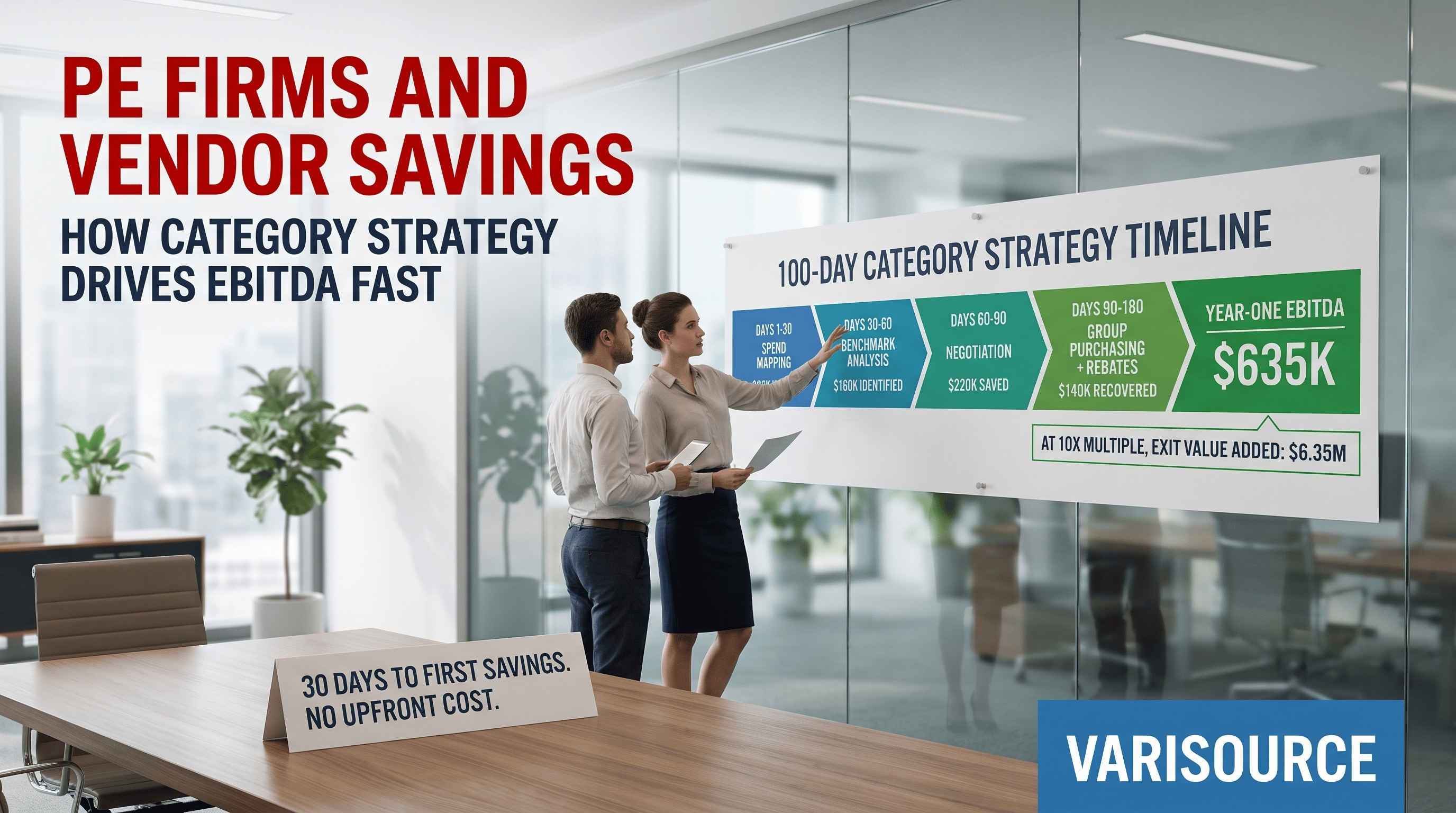
Indirect vendor spend is one of the fastest EBITDA levers available to PE firms after an acquisition. Unlike revenue initiatives that take 12 to 24 months to show results, vendor cost savings can materialize in under 30 days when the right category strategy is in place. The firms doing this most effectively use benchmark data, group purchasing access, and a structured category approach to identify and capture savings within the first 100 days of ownership, before operational initiatives are even fully planned.
Why Do PE Firms Prioritize Indirect Procurement After an Acquisition?
Private equity returns are built on a combination of revenue growth, margin expansion, and multiple arbitrage. Of the three, margin expansion through cost reduction is typically the fastest to implement and the most predictable in outcome. It does not depend on market conditions, competitor behavior, or customer adoption. It depends on having better information than the current vendor relationship reflects, and acting on it before the next renewal cycle.
Indirect vendor spend is the most common source of immediate margin improvement because it is almost universally underoptimized at the time of acquisition. Portfolio companies, particularly founder-led businesses and middle-market companies, typically sign vendor contracts when they are smaller and never renegotiate as they grow. They accept auto-renewals with price increases because nobody has time to review them. They pay above-market rates in every major spend category because nobody has ever run a benchmark comparison.
The result is a cost base that looks like operating expense but functions like avoidable overpayment. A PE firm with the right tools and approach can systematically identify and close that gap within 90 to 180 days of closing a deal.
What Is the PE Category Strategy Approach to Vendor Cost Reduction?
Day 1 to 30: Spend visibility and category mapping. The first step is building a complete picture of what the portfolio company spends on vendors across every indirect category. This is typically done through an AP spend file analysis, which surfaces every vendor, every contract amount, every renewal date, and every spend category in a format that supports prioritization. Most acquisitions reveal more vendor fragmentation and more duplicate categories than the diligence process surfaced. The spend map is the foundation for everything that follows.
Day 30 to 60: Benchmark analysis by category. With the spend map complete, each major category is benchmarked against real market contract data to identify where pricing is above market and by how much. A PE firm with access to 50M-plus real contract data points across 100K-plus vendors can produce a category-by-category gap analysis showing, for example, that the portfolio company's AWS contract is 28 percent above what comparable companies pay, that the telecom agreement has not been renegotiated in four years and is now 22 percent above market, and that three SaaS tools are available through group purchasing at 15 to 20 percent below the current rates.
Day 60 to 90: Category prioritization and negotiation execution. With the benchmark data in hand, the category strategy identifies which contracts to address first based on spend volume, gap size, and renewal timing. The largest gaps on the largest contracts get tackled first. For contracts approaching renewal, negotiations start immediately with benchmark data as the primary tool. For contracts mid-term, the benchmark is used to request pricing reviews, which vendors often accommodate when the buyer can demonstrate clearly that current pricing is above market.
Day 90 to 180: Group purchasing activation and rebate capture. For categories where individual spend volume does not reach enterprise pricing tiers, group purchasing programs activate pricing built on collective volume. Portfolio companies joining a group purchasing network immediately access pricing their individual spend could not unlock, regardless of whether that spend is $2 million or $20 million. Rebate programs are simultaneously activated across eligible categories, converting previously unclaimed cash back into recurring annual income that compounds across the hold period.
What Results Do PE Firms Typically See From Category Strategy?
The financial profile of vendor cost reduction for PE is attractive on multiple dimensions. First, the savings are immediate and recurring. A vendor contract renegotiated at 15 percent below the previous rate saves that amount every year for the remaining term, not just in year one. Second, the savings are clean: they drop directly to EBITDA with no cost of revenue, no capital requirement, and no execution risk beyond the negotiation itself. Third, the savings compound at exit: in a company valued at 8 to 10 times EBITDA, $500,000 in annual vendor savings is worth $4 to $5 million in exit valuation.
Companies implementing structured indirect procurement programs for the first time typically see 8 to 12 percent savings on managed spend in year one, per Hackett Group and Ardent Partners research. For a portfolio company with $10 million in annual indirect spend, that is $800,000 to $1.2 million per year in EBITDA improvement, worth $6.4 to $12 million in exit value at an 8x to 10x multiple.
What Does Varisource Offer PE Firms Specifically?
The Varisource Savings Program is built for exactly the PE deployment model. A free savings estimate across the full portfolio company vendor base is delivered within 48 hours of receiving an AP spend file, making it viable to run as part of the 100-day plan without delaying operational priorities. The program covers 300-plus spend categories with vendor-level benchmark data from 50M-plus real contract data points, applies group buying power from $80B-plus in collective purchasing across 100K-plus vendors, captures rebates across all eligible categories, and assigns a dedicated Savings Project Manager to qualifying projects to ensure savings are realized, not just identified.
For PE firms managing multiple portfolio companies, the program can be deployed systematically across the entire portfolio, with each company benefiting from the same collective buying power regardless of its individual size.
Read more in the Spend Value Tips series at Varisource Blogs.
Frequently Asked Questions
How quickly can a PE firm expect vendor savings to show up in EBITDA after an acquisition?
First savings typically materialize within 30 days when a savings program is activated as part of the 100-day plan. The largest single-category savings, usually from the highest-spend vendor with the largest benchmark gap, often close within 60 to 90 days. Group purchasing and rebate programs begin contributing within 30 to 60 days of activation.
Does vendor cost reduction require the portfolio company to change operational vendors?
Rarely. The majority of savings come from improving pricing with existing vendors through benchmark-driven negotiations and group purchasing access. Vendor changes are occasionally the right outcome when the market benchmark shows a significant gap that the current vendor cannot close, but they are not required and are never the starting point.
How does vendor cost reduction affect a portfolio company's exit multiple?
Every dollar of recurring annual savings that reduces EBITDA costs increases exit value at the applicable multiple. At an 8x EBITDA multiple, $1 million in annual vendor savings adds $8 million to exit valuation. At 10x, it adds $10 million. This return profile makes vendor cost reduction one of the highest-ROI initiatives available within the first 100 days of ownership.
About the Author
.jpeg)
Victor Hou
Victor Hou is the founder of Varisource, the first ever Savings Automation Platform that automates Savings for Your Business. Victor helps companies access discounts, rebates, benchmark data, savings for renewals and new purchases across 100+ spend categories automatically to increase your company's margins and equity value by at least 15-20%. Victor is active and passionate about using AI + automation to help your business save time, money and run more efficiently.
%201.svg)

Varisource’s Savings Automation Platform guarantees savings and maximized leverage on every dollar spend across 100+ spend categories


