Indirect Category Strategy: How to Build One That Saves Money Across Every Spend Area
A category strategy is the difference between procurement that responds to what vendors ask for and procurement that controls what the business pays.
Most companies do not have a real indirect category strategy. They have renewal responses — reacting to vendor invoices, handling requests from department heads, and managing one contract at a time without a structured view of the category those contracts belong to. This reactive approach is why indirect spend, which typically represents 50 to 80% of total operating costs, consistently underperforms on savings compared to direct spend where category management is more established.
Building an indirect category strategy changes the dynamic. Instead of managing individual vendor relationships in isolation, you manage spend categories as a whole — understanding total category spend, identifying the market structure, benchmarking pricing across the category, and negotiating with a complete picture of your options. The result is sustained savings, not one-time wins.
What Is Indirect Category Strategy — and Which Categories Should You Prioritize?
Indirect category strategy is the organized approach to managing a group of related purchases — software, telecom, cloud infrastructure, managed services, logistics, insurance, or any other indirect spend category — as a single managed area rather than as a collection of individual vendor relationships.
The categories worth prioritizing first are determined by three factors: total spend volume (higher spend means larger absolute savings potential), fragmentation (categories split across many vendors offer the fastest consolidation savings), and market dynamics (categories where pricing has moved significantly since contracts were last reviewed offer immediate benchmark-driven savings).
In most mid-market companies, the highest-priority indirect categories in 2026 are software and SaaS (where vendor prices rose 8% in a single year while portfolios barely grew), cloud infrastructure (where 29% of spend is wasted on idle or over-provisioned resources per Flexera 2026), and telecom and connectivity (where multi-year contracts set in different market conditions are routinely 15 to 25% above current pricing).
What Are the Core Elements of an Indirect Category Strategy?
Spend visibility and categorization. A category strategy begins with a complete, categorized view of what you spend in each area. This means going beyond the vendor list to understand spend by category, subcategory, and vendor — so you can see total category spend, identify the largest vendors, and spot the fragmentation patterns that indicate consolidation opportunity. Most organizations discover they have more vendors in key categories than they realized, and more overlap between those vendors than anyone has previously mapped.
Market analysis and benchmark pricing. Every category strategy requires a current understanding of market pricing — what comparable organizations pay for the same services. This is the intelligence layer that makes category strategy financially effective rather than administratively interesting. Without benchmark data, a category strategy can organize spend and identify vendors but cannot answer the most important question: are we paying a fair price?
The benchmark should go to the vendor level, not just the category average. Knowing that "cloud services" average X per unit is useful context. Knowing that your AWS contract is 22% above what comparable companies pay for equivalent AWS configurations is actionable. Category-level averages are directional. Vendor-level benchmarks are negotiating tools.
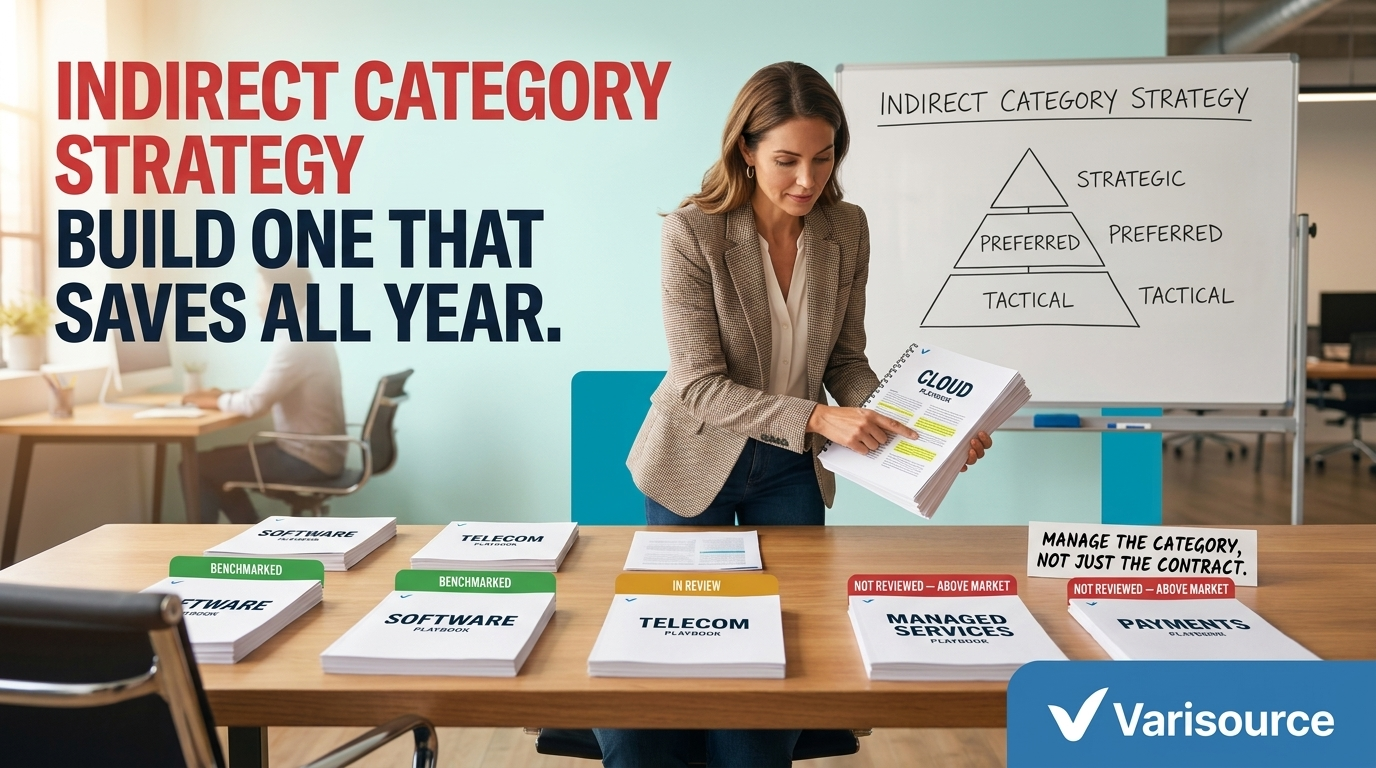
Sourcing strategy by segment. Not every vendor in every category warrants the same management approach. A useful framework divides category spend into three tiers: strategic vendors (high spend, high business impact, warrant active relationship management and annual benchmark reviews), preferred vendors (medium spend, vetted quality, managed through standard renewal processes), and tactical vendors (low spend, commodity services, candidates for consolidation or replacement based purely on pricing).
This segmentation allows procurement and finance teams to allocate management attention proportionally — spending the most time and analysis on the relationships where the financial impact of good management is largest.
Renewal calendar and forward planning. A category strategy is operational, not just analytical. The practical output is a forward-looking renewal calendar for every significant contract in the category, with benchmarking and competitive review scheduled 90 to 180 days before each expiration. This converts category management from a periodic review exercise into a continuous process that catches every savings opportunity before the leverage window closes.
Group purchasing access for categories where individual volume is insufficient. Many indirect categories — particularly software, telecom, and managed services — have pricing structures where the best rates require volumes that most mid-market companies cannot reach independently. A category strategy that includes access to a group purchasing program fills this gap, giving members access to pricing built on collective volume regardless of their individual spend. This is particularly relevant for CPG companies and mid-market manufacturers managing indirect material sourcing, where category fragmentation and insufficient individual volume are both common challenges.
How Do You Measure Whether Your Indirect Category Strategy Is Working?
Three metrics tell most of the story. Savings rate on managed category spend — what percentage of spend in the category came in at or below current market pricing. Category spend compliance — what percentage of spend in the category flowed through contracted vendors versus outside them. And renewal lead time — whether your team is consistently starting category renewal reviews 90 days or more before expiration.
World-class procurement organizations achieve savings rates above 9% of managed spend. Industry average is below 3%. The gap is almost entirely explained by whether the organization has a structured category strategy with benchmark data, or is managing renewals reactively without one.
The Varisource Savings Program covers 300+ indirect spend categories with benchmark data from 50M+ real contract data points — providing the market intelligence layer that makes category strategy financially effective rather than just organizationally tidy. A free category spend analysis is delivered within 48 hours.
Learn more about how the Varisource program works across spend categories.
Read more in the Spend Value Tips series at Varisource Blogs.
About the Author

Victor Hou
Victor Hou is the founder of Varisource, the first ever Savings Automation Platform that automates Savings for Your Business. Victor helps companies access discounts, rebates, benchmark data, savings for renewals and new purchases across 100+ spend categories automatically to increase your company's margins and equity value by at least 15-20%. Victor is active and passionate about using AI + automation to help your business save time, money and run more efficiently.
%201.svg)

Varisource’s Savings Automation Platform guarantees savings and maximized leverage on every dollar spend across 100+ spend categories


