Indirect Procurement: What Every CFO Needs to Own in 2026
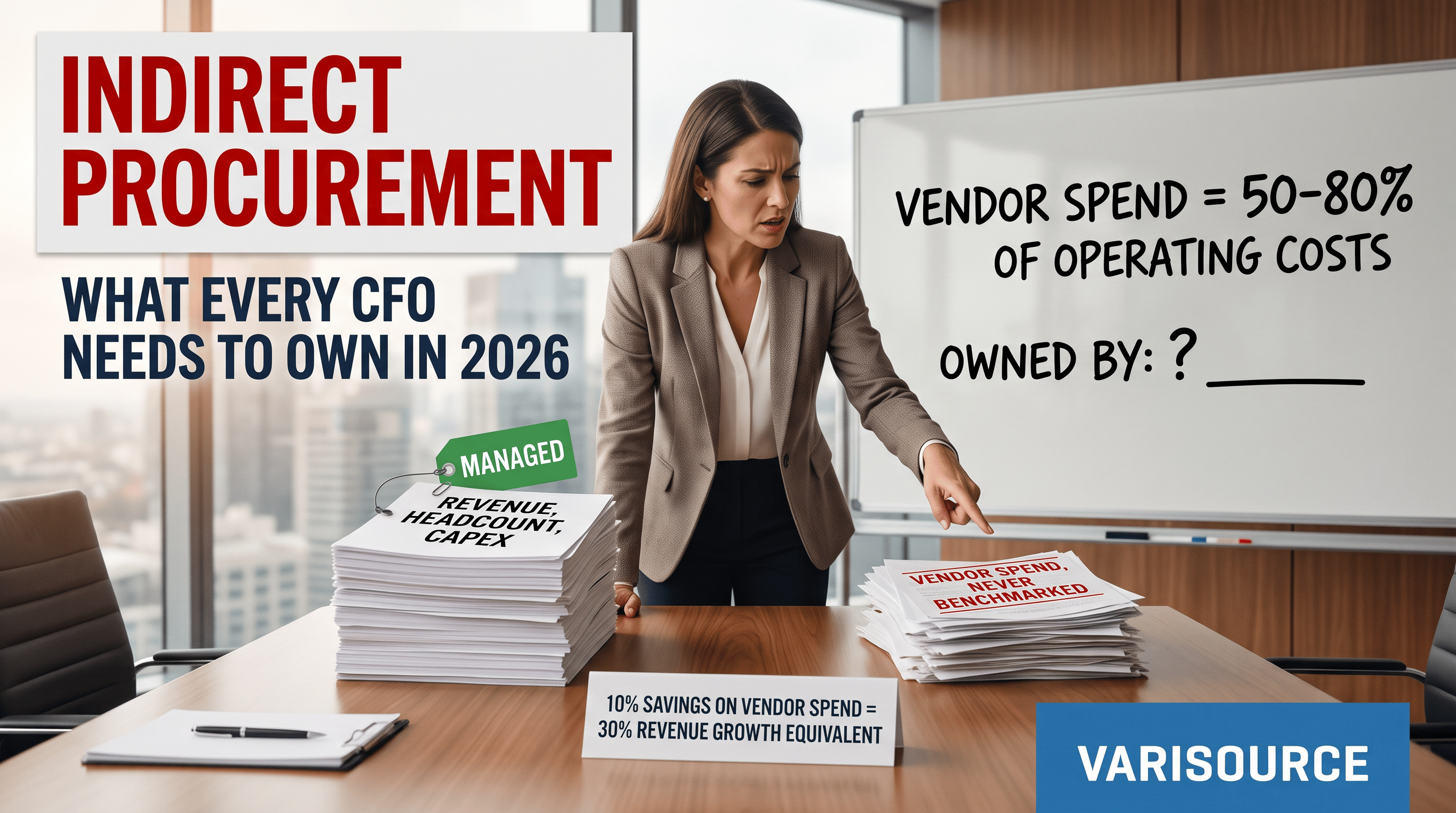
Indirect spend is 50 to 80 percent of total operating costs in most companies, and almost no CFO actively manages it. The result is a cost base that drifts above market year after year without triggering any of the financial controls that would catch the same drift in headcount or capital. The CFOs who do own it, through benchmark data, early renewal involvement, and a structured rebate process, consistently find millions in savings that never appeared in any budget review.
Why Does Indirect Procurement Rarely Land on the CFO Agenda?
Most CFOs spend their time on revenue growth, headcount management, and capital allocation. These are the categories with the most visibility, the most stakeholder attention, and the clearest connection to short-term financial performance.
Indirect spend sits in a different category entirely. Software subscriptions renew automatically. Telecom contracts roll over with price increases that no single line item makes look alarming. Cloud costs grow with usage and nobody flags it until the quarterly review. Managed services contracts were signed three years ago at rates that made sense then and have not been reviewed since.
None of these show up as a single line in any budget that triggers action. Each one looks like a routine operating expense. Together, they represent 50 to 80 percent of total operating costs and, per Vertice's 2025 research, the average company overpays by 26 percent across that entire base.
A 26 percent overpayment on a cost category representing 60 percent of operating costs is a 15 percent drag on the entire P&L. No CFO would accept that number if it appeared as a single line item. Most accept it without knowing it exists because it is spread across 200 vendor relationships that nobody owns in aggregate.
What Happens When a CFO Actually Engages With Indirect Spend?
The pattern across companies where CFO involvement shifts is consistent. The first thing that happens is visibility. When a finance leader asks for a complete vendor spend report, most companies discover their portfolio is larger, more fragmented, and more expensive than any internal estimate suggested. Duplicate tools, contracts for former employees, auto-renewals that nobody reviewed, and pricing that has not been benchmarked since it was originally negotiated.
The second thing that happens is prioritization. Without CFO involvement, procurement teams manage individual renewals reactively as they come up. When the CFO sets the frame, the five to ten largest spend categories get treated as financial assets worth actively managing, not administrative tasks worth handling as they arrive. That shift in priority changes how much time and attention each renewal gets, and what data is available when the negotiation starts.
The third thing is accountability. When the CFO is tracking savings as a financial metric alongside revenue growth and cost control, the organization treats vendor cost management the same way it treats every other financial target: with milestones, reviews, and consequences for missing them.
What Are the Specific Indirect Procurement Practices CFOs Should Lead?
Own the renewal calendar, not just the P&L impact. Most CFOs see vendor costs on financial statements after the fact. The more impactful involvement is upstream: knowing what contracts are renewing in the next 90 to 180 days, which ones have not been benchmarked, and which represent the largest overpayment risk. The Hackett Group found that procurement workloads grow 8 percent annually with flat headcount. Without CFO-level attention to which renewals matter most, teams will manage the ones that are loudest, not the ones that are largest.
Require benchmark data before any renewal is signed. The single most impactful policy change available to any CFO is requiring that every major renewal includes a benchmark comparison showing what comparable companies pay for the same service. Published rate cards are not benchmarks. Actual negotiated contract data at the vendor level is. When this requirement exists, the negotiation starts from a specific market-rate target rather than from wherever the vendor's renewal quote happens to land.
Treat rebate capture as a finance function, not a procurement afterthought. Vendor rebates, money that returns to the company after a purchase across software, cloud, telecom, and managed services categories, are structurally identical to accounts receivable that nobody is billing for. Enable.com found that 4 percent of all eligible rebate money goes unclaimed annually. On a $10 million indirect spend base, that is $400,000 per year in money the company earned and never collected. A CFO who treats rebate tracking with the same rigor applied to collections typically finds meaningful sums that were previously invisible.
Connect vendor cost performance to margin targets explicitly. McKinsey's 2025 analysis found that a 10 percent improvement in vendor spend produces the same bottom-line effect as a 30 percent increase in revenue. That equivalency is one of the most powerful frames available for getting organizational attention on indirect procurement. When the CFO presents vendor cost savings in revenue-equivalent terms, it changes how the board, the CEO, and the leadership team think about the investment in managing it properly.
Use a program with execution support, not just intelligence. Deloitte's 2025 CPO Survey found that 34 percent of procurement leaders say the biggest barrier to savings is internal bandwidth, not the quality of the deals available. CFOs who want to capture the full value of indirect spend optimization without building a large internal procurement function should consider savings programs that handle execution, not just analysis. The right program identifies the savings, negotiates the contracts, tracks the rebates, and assigns a dedicated coordinator to qualifying projects. The CFO sees the financial result without the operational overhead of running each initiative.
What Should a CFO Expect in Terms of Results?
Companies that shift from reactive to active indirect spend management for the first time typically see 8 to 12 percent savings on managed spend in year one, per Hackett Group and Ardent Partners research. For a company with $8 million in annual indirect spend, that is $640,000 to $960,000 per year. For a company at $20 million, the range is $1.6 million to $2.4 million.
These are not projections from a vendor's marketing material. They are the consistent outputs of studies tracking actual procurement performance across hundreds of organizations. The companies at the high end of that range are the ones where the CFO is actively involved, where benchmark data is required before renewals, and where savings are tracked as a financial metric with the same rigor as headcount or capital.
The Varisource Savings Program is built for exactly this engagement model: a program that delivers the benchmark data, applies group buying power across 100K-plus vendors and 300-plus spend categories, captures rebates, and handles execution through a dedicated Savings Project Manager, with a free savings estimate delivered within 48 hours of receiving an AP spend file.
Read more in the Spend Value Tips series at Varisource Blogs.
Frequently Asked Questions
Should CFOs be involved in vendor negotiations directly?
Not in every negotiation, but in setting the standard that every major negotiation requires benchmark data, and in reviewing the results of the top 10 to 20 contracts by spend annually. The CFO's role is to set the frame and track the outcomes, not to sit in vendor calls.
What is the fastest way for a CFO to identify indirect spend savings opportunities?
An AP spend file analysis against real market benchmark data. Share the vendor spend file with a savings program, and within 48 hours receive a category-by-category view of where pricing is above market, where rebates are available, and which renewals are approaching the leverage window.
How does indirect spend management affect EBITDA?
Every dollar saved on vendor costs drops directly to the bottom line with no associated cost of revenue. On a company with a 15 percent EBITDA margin, $500,000 in vendor savings is equivalent to generating $3.3 million in new revenue. That equivalency is why indirect spend management is increasingly a CFO-level priority rather than a procurement department responsibility.
About the Author
.jpeg)
Victor Hou
Victor Hou is the founder of Varisource, the first ever Savings Automation Platform that automates Savings for Your Business. Victor helps companies access discounts, rebates, benchmark data, savings for renewals and new purchases across 100+ spend categories automatically to increase your company's margins and equity value by at least 15-20%. Victor is active and passionate about using AI + automation to help your business save time, money and run more efficiently.
%201.svg)

Varisource’s Savings Automation Platform guarantees savings and maximized leverage on every dollar spend across 100+ spend categories


