Procurement Benchmarking in 2026: Metrics, Steps, ROI

Procurement benchmarking is the practice of measuring your organization’s procurement performance and pricing against industry standards, peer organizations, or internal best practices. It matters because vendors almost always know more about what buyers pay than buyers know about each other, and benchmarking closes that gap. Top-performing procurement teams that benchmark consistently realize 2X greater cost savings than their peers. This guide covers the types of benchmarking, the metrics that matter, practical steps to get started, and how modern AI platforms are replacing static annual reports.
Quick Takeaway: Why Benchmark Procurement in 2026?
Procurement benchmarking identifies the gap between your current performance and market leaders. Key 2026 targets include:
Cost Savings: Top-tier teams achieve 2.03X greater savings than peers.
Efficiency: World-class organizations operate with 31% fewer FTEs and 58% faster cycle times.
Pricing Power: Real-time SKU-level benchmarking can reduce software and indirect spend by 20-30% by eliminating information asymmetry.
What Is Procurement Benchmarking?
Procurement benchmarking is the process of measuring an organization’s procurement performance (cost savings, supplier performance, cycle times, compliance) against industry standards or best practices. It answers two fundamental questions: Are we paying fair market prices? And is our procurement team operating efficiently?
This is broader than supplier performance measurement, which focuses narrowly on how individual vendors deliver. Benchmarking encompasses everything from the price you pay for a Salesforce license to how many days it takes your team to process a purchase order. It splits into two distinct halves:
- Price benchmarking: What are similar companies paying for the same products and services?
- Process benchmarking: How efficient, fast, and effective is our procurement operation compared to peers?
Most organizations need both, but conflating them leads to muddled analysis and wasted effort.
Feature
Price Benchmarking
Process Benchmarking
Primary Goal
Secure fair market pricing/rates.
Increase operational efficiency.
Data Source
Anonymized transaction/SKU data.
Internal KPIs vs. industry standards.
Key Metric
Purchase Price Variance (PPV).
PO Cycle Time; Spend under Management.
Best For
Contract renewals and negotiations.
Scaling teams and digital transformation.
Why Procurement Benchmarking Matters
There is a structural information asymmetry in every vendor relationship. Your sales rep knows exactly what hundreds of other companies pay for the same product. You don’t. You might know what one or two peers pay if you happen to ask at a conference. That imbalance gives vendors pricing power they shouldn’t have.
Omar Ghani, Reddit’s procurement leader, put it bluntly in an interview: “Are you going to contact 10 procurement people in your network to get that benchmark? No, you’re probably only going to contact one to two max. So, how credible even is that benchmark?” This is the core problem. Without reliable external data, negotiation is guesswork.
The numbers back this up. According to NPI Financial, companies overpay for 89% of IT purchases and renewals when they lack benchmark data. Research from Vertice suggests 90% of buyers are overpaying for software by 20-30%.
On the flip side, organizations that benchmark well see outsized results. The Hackett Group’s 2025 research found that Digital World Class procurement teams deliver 2.6X greater return on investment than peers, while operating with 31% fewer full-time employees and at 19% lower cost. Those same top performers execute 58% shorter requisition-to-purchase order cycle times and generate 2.03X greater cost savings as a percentage of spend.
Even basic measurement moves the needle. Procurify’s 2026 Benchmark Report, based on $30B in anonymized spend data, shows PO coverage across industries averaged 76.9% in 2025, up from 71.8% in 2023. Teams that measure, improve.
For finance leaders driving margin improvement, benchmarking provides the objective data needed to justify procurement investments and validate savings claims. For private equity operating teams, it’s a value creation tool that identifies savings opportunities across portfolio companies quickly.
Without benchmarks, you’re negotiating blindfolded. As practitioners in the CASME indirect procurement community put it: “One of the hardest parts of indirect procurement is knowing what ‘good’ looks like.”
Types of Procurement Benchmarking
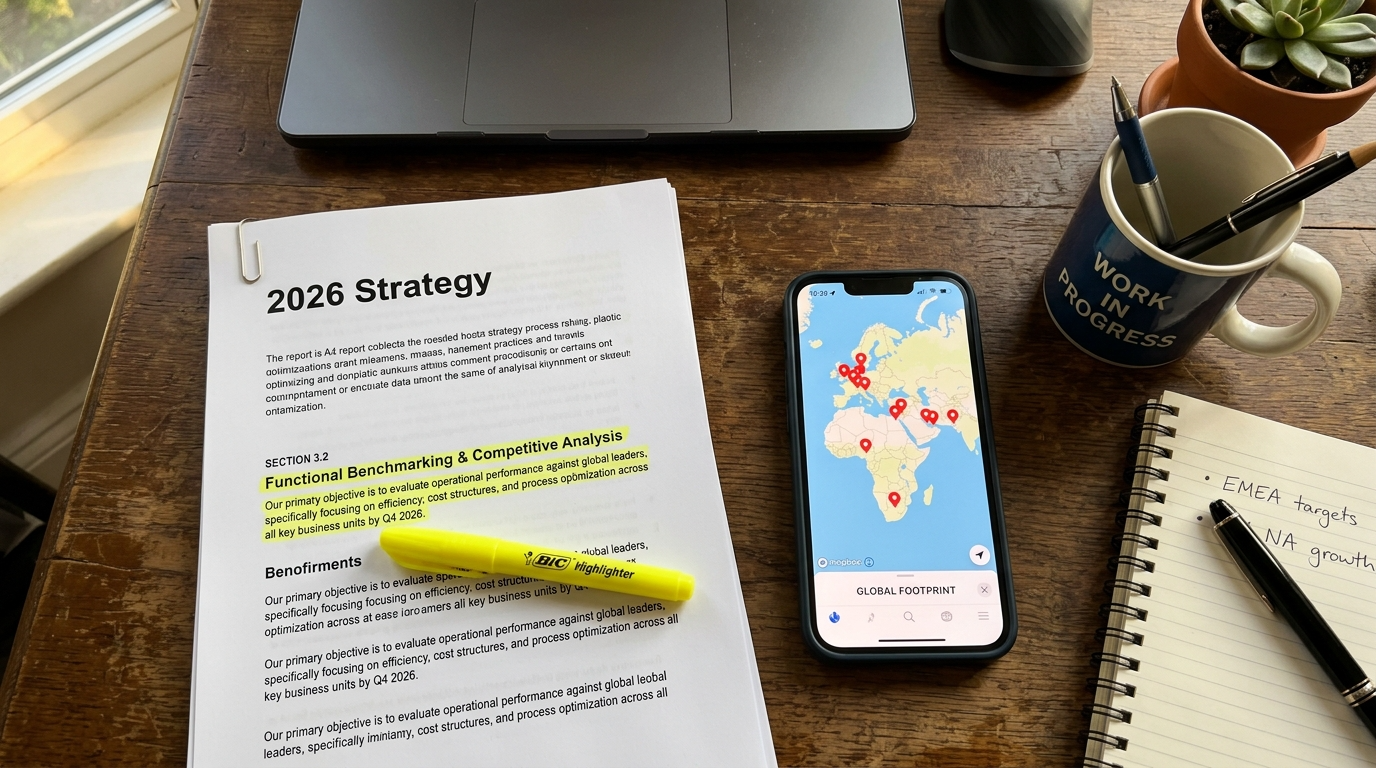
Not all benchmarking serves the same purpose. Understanding the types helps you pick the right approach for your situation.
Internal Benchmarking
Compares procurement performance across departments, business units, or regions within the same organization. If your EMEA team processes purchase orders in two days but your North American team takes five, internal benchmarking surfaces that gap. It’s the easiest type to execute because you control the data.
Competitive Benchmarking
Measures your procurement performance against direct competitors. This is harder (competitors don’t share data willingly) but more revealing. It answers whether your procurement function is a competitive advantage or liability.
Functional Benchmarking
Goes beyond your industry entirely, comparing procurement processes with high-performing organizations in other sectors. A healthcare company might learn cycle-time reduction techniques from an automotive manufacturer with a world-class supply chain.
Price Benchmarking
The type getting the most attention right now. Price benchmarking compares what you pay for specific products and services against what similar companies pay. This is where the distinction between pre-packaged and tailored benchmarks matters most.
Pre-packaged benchmarks offer general market averages and discount ranges. They’re useful for quick reference but lack the specificity needed for negotiation. Tailored benchmarks are customized to your business size, industry, and requirements. A category average for “CRM software” doesn’t help you negotiate a specific Salesforce Enterprise renewal. SKU-level data, what a company your size actually paid per seat, is what moves the needle.
Practitioners on Reddit’s r/procurement community confirm this. In discussions about SaaS benchmarking tools, the conversation centers almost entirely on data quality and relevance, not interface design. Real procurement professionals want benchmark data their legal and finance teams will trust.
Process and Performance Benchmarking
Focuses on measurable outcomes: cost savings percentages, cycle times, spend under management, and supplier performance scores. This type tells you whether your team is operating efficiently relative to peers.
Strategic Benchmarking
Takes a long-term view, evaluating procurement strategies, operating models, and supplier relationship approaches. Less about today’s numbers and more about whether your procurement function is positioned for the next three to five years.
2026 Industry Benchmarks: What 'Good' Looks Like
To understand your standing, compare your current metrics against these 2026 "World-Class" performance indicators:
- Spend Under Management: >90% (Top performers hit 92%).
- PO Coverage: >75% (Reflecting 2026 cross-industry averages).
- Cost of Procurement: <1% of total spend.
- Automated PO Rate: >80% (Using AI-powered workflows).
- Supplier Lead Time Deviation: <5%.
Key Procurement Benchmarking Metrics
Knowing what to measure matters as much as measuring it. Here are the metrics that top-performing procurement teams track, organized by category.
Cost Metrics
- Total cost savings (% of spend): Leading teams achieve 8-12% annual cost savings of total spend, per industry data cited by Nomitech. Hackett Group data shows top performers generate 2.03X greater cost savings as a percentage of spend.
- Cost avoidance: The savings you prevent from happening, like blocking a 15% price increase. Often undervalued but equally important. Understanding the difference between cost savings and cost avoidance is essential for accurate reporting.
- Purchase price variance: The difference between what you expected to pay and what you actually paid.
- Total cost of ownership (TCO): Goes beyond sticker price to include implementation, training, support, and switching costs.
- Cost per purchase order: A direct measure of administrative efficiency.
Efficiency Metrics
- PO cycle time (requisition to fulfillment): Top performers achieve 58% shorter cycle times according to Hackett Group research.
- Requisition-to-PO time: How quickly a request becomes an approved order.
- Spend under management: Top-performing teams manage 92% of spend, per Zycus research. If significant spend happens outside procurement’s visibility, savings opportunities are being missed.
Quality and Compliance Metrics
- Supplier defect rate: The percentage of deliveries or services that fail to meet specifications.
- On-time delivery rate: Reliability of your supply base.
- Contract compliance percentage: How often purchases follow negotiated terms versus maverick buying.
- Maverick spend percentage: Spend that occurs outside of approved contracts and channels. High maverick spend undermines every negotiation your team conducts.
A frequent mistake, as Ivalua’s procurement research notes, is focusing on activity-based metrics rather than impact-based ones. Counting the number of suppliers might look like growth, but without a supplier performance benchmark, you won’t know whether those suppliers are delivering quality.
How to Benchmark Procurement: Practical Steps
The methodology isn’t complicated. The hard part is getting good data fast enough to use it. Here’s a step-by-step approach.
1. Define Objectives and KPIs Tied to Business Goals
Start with what matters to your organization. If the CFO cares about margin expansion, prioritize cost savings metrics. If operations cares about speed, prioritize cycle times. Don’t benchmark everything at once.
2. Collect and Normalize Internal Data
Pull spend data, contract data, PO data, and supplier performance data into a consistent format. This is where most teams get stuck. Incomplete AP data, inconsistent categorization, and siloed systems make normalization painful. A solid spend analysis is the prerequisite.
3. Select Peer Groups and External Data Sources
Your benchmark is only as good as the comparison set. Options include:
- APQC Open Standards Benchmarking: Provides KPI benchmarks across cost effectiveness, cycle time, process efficiency, and staff productivity. Members-only access.
- Hackett Group: Deep research on world-class procurement performance. Typically involves 7-10 week engagements.
- Vendor platforms and benchmark databases: Tools like Tropic, Vendr, and others aggregate anonymized transaction data. Speed and specificity vary.
- Group purchasing networks: Aggregate buying power across organizations and provide pricing transparency as a byproduct.
4. Compare and Identify Gaps
Map your internal performance against external benchmarks. Where are you in the top quartile? Where are you lagging? The gaps are your opportunity list.
5. Prioritize Actions
Quick wins first, then strategic initiatives. If you discover you’re paying 25% above market on a SaaS contract renewing next quarter, that’s an immediate priority. If your PO cycle time is twice the industry average, that’s a process improvement project with a longer timeline.
6. Repeat Continuously
This is the step most organizations skip. Benchmarking as a one-time exercise produces a snapshot that’s outdated within months. As Ivalua’s research puts it: “By the time you publish a report, market conditions, supplier dynamics, and internal processes have already changed.” The organizations that benefit most from benchmarking treat it as a continuous discipline, not an annual project.
Common Pitfalls to Avoid
Knowing what not to do saves as much time as knowing what to do.
Relying on stale data. Static PDFs, annual surveys, and consultant-delivered reports from six months ago reflect a market that no longer exists. Pricing in SaaS and technology categories can shift quarterly.
Measuring activity instead of impact. Processing 500 POs per month means nothing if 40% of spend is maverick. Focus on outcomes.
Ignoring indirect spend categories. Most companies have optimized direct procurement reasonably well. Indirect spend (SaaS, telecom, insurance, office supplies, MRO) is where 20-30% savings typically hide, and it’s where benchmarking data is hardest to find.
Benchmarking in a silo. If procurement benchmarks one thing and finance measures another, the two teams will argue about whose numbers are right instead of acting on insights. Alignment matters.
Using generic averages instead of deal-level data. A “category average” for cloud spend tells you almost nothing useful when you’re negotiating a specific AWS or Azure commitment. SKU-level, deal-level data is what gives you negotiation power. This is a consistent theme in practitioner discussions: the barrier to effective benchmarking is data access, not methodology.
The Role of AI and Benchmark Data Platforms

The old model of procurement benchmarking (hire a consultant, wait two months, get a PDF) is being replaced. Modern benchmarking is real-time, continuous, and embedded directly in procurement workflows.
According to Coupa’s Benchmark Report, companies using AI-powered spend classification see a 24.4% increase in visibility into managing spend. That visibility is the foundation of effective benchmarking, because you can’t benchmark what you can’t see.
Several shifts are happening simultaneously:
- Automated data collection replaces manual surveys and spreadsheet consolidation
- AI-powered classification categorizes spend accurately without human tagging
- Anonymized transaction databases grow continuously, making benchmarks fresher and more granular
- Real-time alerts flag off-market pricing during renewals or new purchases, not months after the fact
Group purchasing networks and benchmark databases aggregate anonymized deal data at scale, giving buyers access to pricing intelligence that was previously available only to the largest enterprises with dedicated market intelligence teams.
Varisource’s Benchmark AI, for example, draws on 50M+ data points to provide SKU-level price transparency across 300+ indirect spend categories. Rather than waiting weeks for a consultant engagement, procurement teams can access benchmark data and use it in active negotiations. For a broader look at how AI is changing procurement economics, see this guide on AI procurement cost savings tools.
The 2026 Procurement Benchmarking Tech Stack
Transitioning from manual spreadsheets to automated intelligence requires three core technology layers:
- AI Spend Classification: Tools that automatically clean and categorize "dirty" ERP data.
- Real-Time Data Aggregators: Platforms that provide live SKU-level pricing rather than annual PDF reports.
- Predictive Analytics: Systems that flag when a contract is trending "above market" before the renewal window opens.
Procurement Benchmarking for Indirect Spend
Indirect spend is where benchmarking has the highest ROI, and where it’s hardest to do well.
Direct procurement (raw materials, components) benefits from structured supply markets, clear specifications, and decades of sourcing maturity. Indirect procurement is different. The specifications are subjective, the spend is dispersed across departments, and the categories are wildly diverse. SaaS pricing works nothing like telecom pricing, which works nothing like insurance pricing.
The Hackett Group notes that “measuring savings on indirect spending is deceptively difficult.” Yet indirect categories often represent 15-30% of an organization’s total spend, and they’re the categories most likely to be renewed on autopilot without competitive pressure.
Effective indirect spend benchmarking requires category-specific data. A platform that benchmarks SaaS but can’t help with telecom, hardware, or professional services leaves significant savings on the table. This is why breadth of category coverage matters. You can explore savings categories to understand how benchmarking applies differently across indirect spend types, from software and cloud to insurance and MRO.
For organizations looking at enterprise cost reduction strategies, indirect spend benchmarking is often the fastest path to material savings because the baseline is so poorly optimized.
Getting Started
Procurement benchmarking doesn’t require a six-figure consulting engagement or an 18-month platform implementation. The fastest path is to start with the spend categories where you suspect the biggest gaps, typically high-dollar SaaS renewals, cloud commitments, and telecom contracts, and get external pricing data before your next negotiation.
Varisource offers a free Savings Estimate Report, typically delivered within 48 hours, that benchmarks your current vendor spend against market data across 300+ categories. It’s a practical starting point that costs nothing and quantifies the opportunity. Request a demo to see how benchmark data translates into actual savings for your organization.
FAQ
What is the difference between procurement benchmarking and spend analysis?
Spend analysis organizes and categorizes what you’re spending and where. Procurement benchmarking takes that data and compares it against external standards to determine whether your spending is competitive and your processes are efficient. Spend analysis is a prerequisite for benchmarking, but it doesn’t tell you whether your prices are good or your team is fast. Benchmarking does.
How often should procurement benchmarking be done?
Continuously, or at minimum quarterly for price benchmarks on high-spend categories. Annual benchmarking is better than nothing, but market pricing shifts too quickly for yearly snapshots to stay useful. The most effective procurement organizations embed benchmarking into their renewal and sourcing workflows so it happens automatically rather than as a separate project.
What is SKU-level benchmarking?
SKU-level benchmarking compares the price you pay for a specific product (say, Salesforce Enterprise at 500 seats) against what other companies of similar size and industry pay for that same product. This is far more actionable than category-level averages, which might tell you the “average” CRM spend but can’t help you negotiate a specific deal. SKU-level data is what gives procurement teams real negotiation power.
Where can I find procurement benchmark data?
Common sources include APQC’s Open Standards Benchmarking (members-only), Hackett Group research (consulting engagement required), vendor-specific benchmark platforms (Tropic, Vendr, and others for SaaS), and group purchasing networks that aggregate anonymized transaction data across categories. The right source depends on what you’re benchmarking. For broad indirect spend coverage across 300+ categories, Varisource’s Benchmark AI draws on 50M+ data points for SKU-level pricing intelligence.
What are good procurement benchmarking KPIs to start with?
Start with five: total cost savings as a percentage of spend, spend under management percentage, PO cycle time, contract compliance rate, and maverick spend percentage. These five give you a balanced view of cost performance, operational efficiency, and governance. Expand from there based on organizational priorities.
Can small procurement teams benefit from benchmarking?
Yes, and arguably more than large teams. Small teams can’t negotiate from volume alone, so pricing intelligence becomes their primary source of negotiation power. Benchmark data lets a two-person procurement team walk into a vendor meeting with the same market visibility that a Fortune 500 sourcing department has. The key is accessing benchmark data through platforms or networks rather than trying to build it from scratch.
{
"@context": "https://schema.org",
"@type": "FAQPage",
"@id": "#faq",
"mainEntity": [
{
"@type": "Question",
"@id": "#faq-question-1",
"name": "What is the difference between procurement benchmarking and spend analysis?",
"acceptedAnswer": {
"@type": "Answer",
"text": "Spend analysis organizes and categorizes what you're spending and where. Procurement benchmarking takes that data and compares it against external standards to determine whether your spending is competitive and your processes are efficient. Spend analysis is a prerequisite for benchmarking, but it doesn't tell you whether your prices are good or your team is fast. Benchmarking does."
}
},
{
"@type": "Question",
"@id": "#faq-question-2",
"name": "How often should procurement benchmarking be done?",
"acceptedAnswer": {
"@type": "Answer",
"text": "Continuously, or at minimum quarterly for price benchmarks on high-spend categories. Annual benchmarking is better than nothing, but market pricing shifts too quickly for yearly snapshots to stay useful. The most effective procurement organizations embed benchmarking into their renewal and sourcing workflows so it happens automatically rather than as a separate project."
}
},
{
"@type": "Question",
"@id": "#faq-question-3",
"name": "What is SKU-level benchmarking?",
"acceptedAnswer": {
"@type": "Answer",
"text": "SKU-level benchmarking compares the price you pay for a specific product (say, Salesforce Enterprise at 500 seats) against what other companies of similar size and industry pay for that same product. This is far more actionable than category-level averages, which might tell you the \"average\" CRM spend but can't help you negotiate a specific deal. SKU-level data is what gives procurement teams real negotiation power."
}
},
{
"@type": "Question",
"@id": "#faq-question-4",
"name": "Where can I find procurement benchmark data?",
"acceptedAnswer": {
"@type": "Answer",
"text": "Common sources include APQC's Open Standards Benchmarking (members-only), Hackett Group research (consulting engagement required), vendor-specific benchmark platforms (Tropic, Vendr, and others for SaaS), and group purchasing networks that aggregate anonymized transaction data across categories. The right source depends on what you're benchmarking. For broad indirect spend coverage across 300+ categories, Varisource's Benchmark AI draws on 50M+ data points for SKU-level pricing intelligence."
}
},
{
"@type": "Question",
"@id": "#faq-question-5",
"name": "What are good procurement benchmarking KPIs to start with?",
"acceptedAnswer": {
"@type": "Answer",
"text": "Start with five: total cost savings as a percentage of spend, spend under management percentage, PO cycle time, contract compliance rate, and maverick spend percentage. These five give you a balanced view of cost performance, operational efficiency, and governance. Expand from there based on organizational priorities."
}
},
{
"@type": "Question",
"@id": "#faq-question-6",
"name": "Can small procurement teams benefit from benchmarking?",
"acceptedAnswer": {
"@type": "Answer",
"text": "Yes, and arguably more than large teams. Small teams can't negotiate from volume alone, so pricing intelligence becomes their primary source of negotiation power. Benchmark data lets a two-person procurement team walk into a vendor meeting with the same market visibility that a Fortune 500 sourcing department has. The key is accessing benchmark data through platforms or networks rather than trying to build it from scratch."
}
}
]
}
About the Author
.jpeg)
Victor Hou
Victor Hou is the founder of Varisource, the first ever Savings Automation Platform that automates Savings for Your Business. Victor helps companies access discounts, rebates, benchmark data, savings for renewals and new purchases across 100+ spend categories automatically to increase your company's margins and equity value by at least 15-20%. Victor is active and passionate about using AI + automation to help your business save time, money and run more efficiently.
%201.svg)

Varisource’s Savings Automation Platform guarantees savings and maximized leverage on every dollar spend across 100+ spend categories


