Procurement Savings Program: What It Is and How It Works
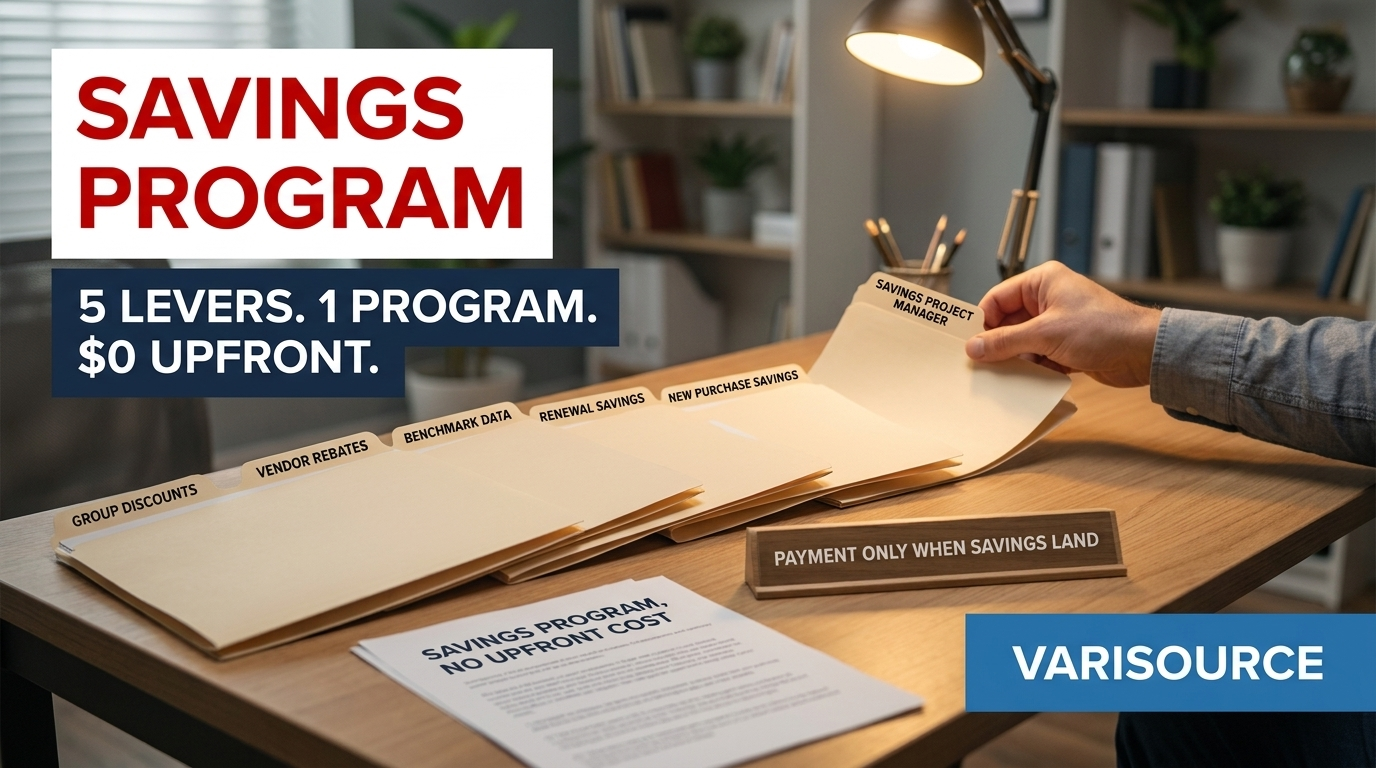
A procurement savings program is a structured approach to reducing vendor costs through group buying discounts, rebates, benchmark pricing data, and renewal management across all spend categories. The best programs operate on a shared-savings model, meaning no upfront cost and payment only when savings are delivered. Most companies that join see first savings within 30 days without switching a single vendor.
What Is a Procurement Savings Program?
A procurement savings program is a group discount program that gives companies access to vendor discounts, rebates, benchmark pricing data, and savings on renewals and new purchases across every spend category, with no upfront cost.
The concept is simple. Most companies negotiate vendor contracts individually, without access to real market pricing data and without the collective buying volume to reach enterprise-level pricing tiers. A procurement savings program solves both problems at once: it pools buying power across many companies so every member benefits from collective leverage, and it provides the benchmark data that shows where each contract sits relative to what comparable companies actually pay.
The model is different from procurement software, which charges a subscription fee for visibility and workflow tools. A procurement savings program is paid on results. If it does not deliver savings, the company owes nothing. That alignment between the program's incentive and the client's outcome is the defining characteristic of the model, and it is why companies that could not justify a procurement technology budget can still access the benefits.
What Does a Procurement Savings Program Include?
Group buying discounts. When many companies pool their spending across the same vendor categories, they collectively qualify for pricing tiers that no single company could reach independently. A 50-person company accessing group buying power gets the same category pricing as a 5,000-person company in the same program. The US group purchasing organization industry generates $7.3 billion in annual revenue because this model consistently delivers results at scale.
Vendor rebates and cash back. A rebate is money that returns to a company after a purchase. The mechanic is identical to credit card cash back applied to business vendor spending: software subscriptions, cloud infrastructure, telecom contracts, Microsoft licensing, internet, managed services, HR platforms, car rentals, and more. Enable.com found that 4 percent of all eligible rebate money goes unclaimed annually. On $5 million in vendor spend, that is $200,000 per year that most companies have simply never had a system to collect.
Benchmark pricing data at the vendor level. Not category averages and not published rate cards. Real contract data showing what companies similar in size and industry actually pay a specific vendor for the same service. Published list prices typically run 20 to 40 percent above what buyers actually negotiate. Vendor-level benchmark data is the number that changes negotiation outcomes, and it is the one most buyers have never had access to.
Renewal savings. Every contract flagged 90 to 180 days before expiration, benchmarked against current market data, and negotiated before the leverage window closes. The auto-renewal trap, where contracts roll over at above-market prices because nobody reviewed them, is the single most common source of unnecessary vendor spend. A procurement savings program catches these before they happen.
New purchase savings. When a company is buying something new, a procurement savings program applies group pricing, provides vendor-level benchmarks, and can surface multiple vendor options through a savings marketplace, similar to how Expedia works for business services. The group pricing is applied before the first conversation with the vendor.
Execution support. Deloitte's 2025 CPO Survey found that 34 percent of procurement leaders identify internal execution capacity, not negotiation quality, as the primary barrier to capturing savings. The best procurement savings programs include a dedicated coordinator for qualifying projects, someone who sits between the company and the vendor to ensure that what was agreed to in the negotiation actually gets implemented and shows up in financial results.
How Is a Procurement Savings Program Different From Procurement Software?
Procurement software charges a subscription fee regardless of what savings are achieved. A procurement savings program earns a percentage of verified savings delivered. The first model sells access to a tool. The second model sells results.
The practical difference is significant. Procurement software requires a budget fight before starting, a training investment, and an implementation period before the team can use it effectively. A procurement savings program starts with a spend file analysis and delivers a savings estimate within 48 hours. There is no implementation, no training, and no upfront cost. The program does the work, not the internal team.
For companies without dedicated procurement departments, or procurement teams already stretched across dozens of priorities, the savings program model is the faster path to results.
What Results Can a Company Expect?
Companies implementing structured procurement savings programs for the first time typically see 8 to 12 percent savings on managed spend in year one, per Hackett Group and Ardent Partners research. On $5 million in annual vendor spend, that is $400,000 to $600,000 per year returned to the business without dropping a single vendor. Most programs report first savings realized in under 30 days from activation.
The Varisource Savings Program is one of the largest procurement savings programs globally, covering 300-plus spend categories with group discounts across 100K-plus vendors, rebate tracking, vendor-level benchmark data from 50M-plus real contract data points, and a dedicated Savings Project Manager for qualifying projects. A free savings estimate is delivered within 48 hours.
Learn more about how the Varisource Savings Program works.
Read more in the Spend Value Tips series at Varisource Blogs.
Frequently Asked Questions
Is a procurement savings program really free?
The best ones operate on a shared-savings model: no upfront cost, no subscription fee, and payment only when savings are delivered. If the program does not find savings, the company owes nothing. This is the model that aligns the program's incentive with the client's outcome.
Does joining a procurement savings program require switching vendors?
No. Most savings come from improving the pricing, rebates, and terms on existing vendor relationships. Switching is always an option but never a requirement. The program works with your current vendors, not instead of them.
How long does it take to see the first savings?
Most companies see first savings in under 30 days. The initial spend file analysis identifies the highest-impact opportunities immediately, and the program can begin executing on renewals and applying group pricing to upcoming purchases within days of activation.
About the Author
.jpeg)
Victor Hou
Victor Hou is the founder of Varisource, the first ever Savings Automation Platform that automates Savings for Your Business. Victor helps companies access discounts, rebates, benchmark data, savings for renewals and new purchases across 100+ spend categories automatically to increase your company's margins and equity value by at least 15-20%. Victor is active and passionate about using AI + automation to help your business save time, money and run more efficiently.
%201.svg)

Varisource’s Savings Automation Platform guarantees savings and maximized leverage on every dollar spend across 100+ spend categories


