Software Procurement Best Practices for the Age of AI in 2026

Squeeze 5% out of a vendor at renewal and you will call it a win. That number is precisely what keeps you from seeing how badly you are being beaten.
The vendor was overcharging you by 10%. The identical service sells on the open market for more than 50% less, and no one in your building was measuring against that number.
Competition sets the fair price, and you have spent years negotiating hard in the one room where that price never came up.
Key Takeaways
- MIT research indicates that 95% of organizations receive zero return from generative artificial intelligence investments due to brittle workflows and tools disconnected from core business operations.
- Zylo's 2026 benchmark reveals the average corporate software bill reaches $55.7 million across 305 applications, creating massive financial blind spots for decentralized procurement teams.
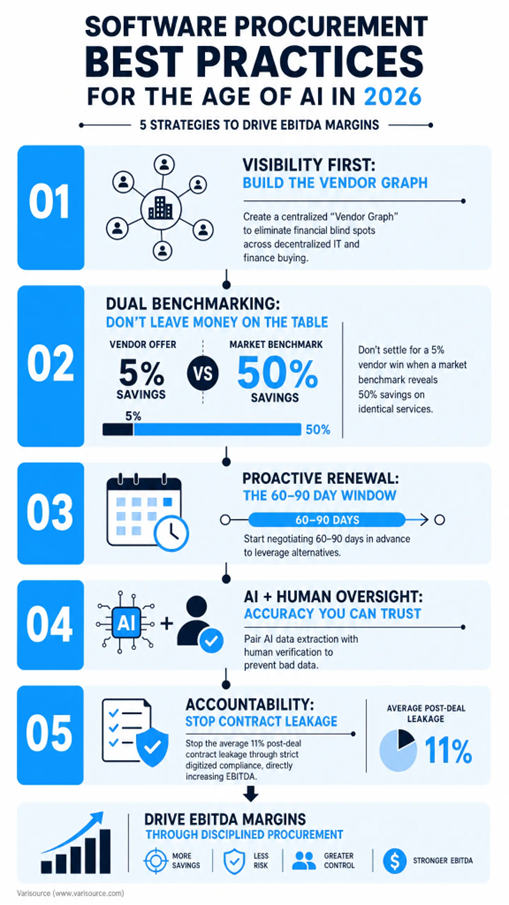
- Implementing a dual benchmarking framework that compares internal SKU-level spend against identical vendor customers and alternative market providers can reveal software cost savings exceeding 50%.
- With procurement workloads projected to climb 8% annually without additional headcount, teams must utilize automated alerts to initiate vendor renewal negotiations 60 to 90 days in advance.
- World Commerce and Contracting data shows companies lose an average of 11% of contract value to post-deal leakage caused by unverified software implementations and slipped features.
Why Is Centralized Vendor Spend Data Crucial Before Purchasing AI Procurement Tools?

Leaders hear "AI" and assume they can point a tool at their spend and watch the savings roll in.
But a tool is only as good as the data you feed it. And most companies have terrible vendor data.
They have no central database. They have no way to track their vendor history. When a contract is coming up for renewal, nobody knows. You can't answer the who, what, when, why, and how of what you're actually paying for. And you rarely have the benchmark data to know if the price is even fair.
I say this all the time. You can't optimize what you can't see. Visibility comes first, and everything else follows.
So before you buy any AI tool, ask a harder question. Can you actually see your vendor spend today? Every contract, every renewal date, every line item? If the answer is no, that's your first 100-day priority.
Why Do Generic AI Tools Fail in Software Procurement and Vendor Management?
Say you skip that step and point a generic AI tool at the problem anyway. Here's why it fails.
AI needs context. That's the whole game. A general model can analyze almost anything, but it can't analyze what it can't reach. And the ugly truth about vendor data is where it lives. It's buried in somebody's email. It's sitting on somebody's laptop. It's not centralized, and nobody is managing it.
Think about how companies treat sales data. Everybody tracks it religiously in a CRM. On the vendor side, almost nobody does. There's no system of record at all.
So the AI shows up blind. No history. No knowledge base. No idea what "normal" even looks like for your category. That's the first reason these tools fail.
The second reason is benchmarks. Generic AI is built to be generic. It isn't trained on the specific vendor and market benchmarks you need to judge a price. Without that data, it's guessing. And guessing is not a strategy for EBITDA.
The research proves it. MIT recently found that 95% of organizations were getting zero return from their GenAI investments. The failures had little to do with model quality. They came from brittle workflows and tools with no real connection to how the business runs.
How Does Decentralized Vendor Ownership Create Financial Blind Spots in Software Procurement?
The dollars leak out in a place most people never look. The root cause is ownership. Who uses a vendor, who manages it, and who pays for it are almost never the same person.
IT or HR owns the relationship. They handle the emails, the demos, the renewal talks. But finance is the one who actually cares about vendor management. And finance is the one writing the check.
As a CFO or operating partner, you don't have access to your IT person's inbox. You can't see the vendor emails. You don't see a renewal coming until it has already auto-renewed for another year.
That's the disconnect. One person uses the tool. Another manages it. A third department pays for it. And none of them talk to each other or share the data. When responsibilities are split that far apart, things get missed every single time.
The data backs this up. BetterCloud found that SaaS buying is now spread across IT, finance, operations, and procurement in 63% of companies. Still 40% still track renewal dates by hand on a spreadsheet, and only 30% believe their renewal process actually works.

Now multiply that mess across every business unit in a company you just bought, one whose systems you barely know still. The average company already runs on a sprawling stack. Zylo's 2026 benchmark puts the average SaaS bill at $55.7 million a year across 305 applications. Plenty of those auto-renew whether anyone is using them or not.
How Does Building a Vendor Graph Improve Software Procurement Visibility?
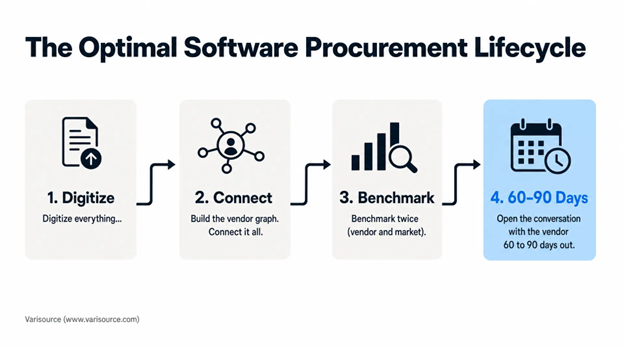
So how do you fix it? You digitize everything. Contracts, invoices, inventory. Then you connect it all in one place.
I call this building out the vendor graph.
The vendor graph tracks your total obligations with each vendor across the full lifecycle. What you have. What you're paying. When it renews. What you were promised. It becomes your single source of truth for spend, the CRM you never had for the vendor side of the house.
Here's where the AI hype gets it wrong. People assume the hard part is reading the documents. It isn't. AI is genuinely good at using OCR and language models to pull information out of a messy pile of PDFs. That part is basically solved.
The hard part comes next. Extracted data is useless unless you have a database built to store it and connect it. You have to link that contract to the right vendor, the right invoice, and the right inventory. That's the real engineering challenge, and it's what separates a tool that spits out text from a system that creates real leverage.
Most companies aren't close. Flexera found that only 36% of organizations have complete visibility into their IT assets, and just 31% can clearly see their AI software. You can't build leverage on top of a blind spot.
Why Is Dual Vendor and Market Benchmarking Essential for Software Procurement?
Once you can see everything, you can finally answer the question that matters most. Are we paying a fair price?
Most finance leaders think they've won when they talk a vendor down. They squeeze 5% out of a renewal and call it a victory. Here's the truth. That "win" usually means they walked away from a fortune.

So install this discipline in every portfolio company. Benchmark twice.
The first one is the vendor benchmark. It looks at your SKU-level spend against other companies using the same vendor. Say you're on DocuSign. We can look at your contract and see you're overpaying by around 10% compared to other DocuSign customers. Good to know. Worth fixing.
The second one is the market benchmark. It compares that same service against other vendors offering the exact same thing. So you look at DocuSign, then you look at Dropbox Sign, HelloSign, and Adobe Sign. Same service. And the market is offering it for over 50% less.
See the gap? Your vendor was "only" overcharging you 10%. But the market says the identical service costs half as much. That is the difference between a 5% win and a 50% win. Competition drives the market, and the market sets the fair price, as long as you're comparing like-for-like services.
This is what almost everyone misses, because it takes data most companies simply don't have. Not just your internal spend, but what everyone else pays, both for your vendor and for its alternatives. Run both benchmarks on every category, not just software, and you'll find EBITDA hiding in places you never thought to look.
And if you're running a portfolio, there's a second layer of leverage most sponsors ignore. Every portfolio company buys the same categories. The same software, the same cloud, the same connectivity. Pool that spend together and you unlock group buying power no single company could get on its own. Size stops being a limit, and the leverage scales across the whole portfolio.
Why Should Procurement Teams Negotiate Software Renewals 60 to 90 Days in Advance?
Timing is leverage, and most companies throw it away. They wait until 30 days before a renewal to start the conversation. Sometimes they wait until after it has already auto-renewed. By then the vendor holds every card. You have no time, no alternative lined up, and no way to walk.
Flip it around. Once you've built your vendor graph, set up the automation so you get notified early. You decide when the alert fires. The moment it does, you do the work. Run your vendor benchmark. Run your market benchmark. Then open the conversation with the vendor 60 to 90 days out, or earlier if you can.
That one change rewrites the power dynamic. Now you're the one with time. You're the one with alternatives already priced and ready. You're negotiating from strength instead of scrambling from behind.
This matters more than ever, because your teams are stretched thin. The Hackett Group projected procurement workload would climb 8% in a single year with almost no new headcount to absorb it. Automation is how a lean team covers hundreds of renewals without drowning.
Why Must AI Be Paired with Human Oversight in Software Procurement Workflows?
Here's where I break from the crowd. The industry wants to sell you pure, self-serve AI software. I don't think that gets you results.
Why not? Because the real world is messy. PDFs are inconsistent. Some are half-scanned. Terms don't match from one document to the next. Let AI run loose on all of that, and it will confidently link the wrong vendor or scramble the terms. Now your entire savings analysis sits on top of bad data.
The fix is straightforward. Combine the AI with people. The technology does the heavy lifting, and a team makes sure it's accurate and drives it home. That combination is what actually delivers.
And delivering is the whole point. What people are buying in the AI world are results. They want the outcome, not the features and functions anymore. Your sponsor doesn't care how clever the model is. They care about dollars coming off the P&L. Automation gets you speed. People get you certainty. You need both.
This is also why the smartest procurement models are performance-based. When a partner is confident enough to get paid only when you save, they've tied themselves to the one number you care about. No upfront cost. No long budget fight. Just results.
How Can AI Enforce Vendor Accountability and Prevent Post-Deal Contract Leakage?
When you buy new software, does the vendor actually deliver what they promised? Most of the time, nobody checks. The implementation drags. Features slip. The value case you approved quietly disappears.
The money leaks here too. World Commerce & Contracting found companies lose an average of 11% of contract value to leakage, and a big chunk of that happens after the deal is signed, once procurement and legal have already moved on.
Let me be straight about what AI can and can't do here. AI won't magically shrink your implementation time, because every rollout is different. But it can enforce best practices you might not know to ask for. It can build checklists that hold both sides accountable. And it can digitize exactly what the vendor promised, so when it's time to deliver, there's a record.
You stop trusting a handshake and start holding your team and the vendor to what was actually bought.
How Do AI Software Procurement Best Practices Directly Increase Margins and EBITDA?

You don't have months. You don't have spare headcount. And you can't afford a six-month software rollout just to find savings you needed yesterday. The waste is real, and it's growing. Companies were recently wasting an average of $21 million a year on unused SaaS licenses alone, and that number keeps climbing.
So here's the playbook for the age of AI. Get visibility first, because you can't optimize what you can't see. Build the vendor graph so your data is centralized and connected. Benchmark twice, vendor and market, so you capture the 50% win and not just the 5%. Attack renewals 60 to 90 days early. And pair the automation with real people, so what lands on your desk is a result and not just another report.
Do that across every category, indirect and direct, and you go from trimming a few line items to building real financial discipline. The kind that shows up in your margins. And when it's time to exit, it shows up in your multiple.
The best procurement leaders already know this. Deloitte found cost reduction is now the top priority for 72% of them, and the ones who lean into digital tools hit their savings targets far more often than the ones who don't.
The old way was to hire people and hope. The new way is to see everything, benchmark everything, and hold everyone accountable. That's what software procurement looks like in 2026, and it's how you turn a messy pile of vendor contracts into the fastest EBITDA win of your first 100 days.
Frequently Asked Questions
How do unmanaged software licenses trigger vendor audit penalties?
Unmanaged licenses are a massive financial liability. Vendors use audits to claw back revenue. According to recent data, 48% of organizations were audited last year, with 44% paying over $1 million in penalties. Centralized procurement prevents these surprise hits to your EBITDA.
How is the explosion of AI tools complicating post-merger technology spend?
AI is the fastest-growing source of SaaS cost volatility. Business users are swiping credit cards for unvetted tools. Zylo data shows spend on AI-native apps rose 108% last year. Without centralized procurement, this unchecked shadow IT dilutes margins and creates immediate operational blind spots.
Should PE operating partners treat public cloud spending the same as SaaS?
No. Cloud infrastructure requires dynamic, consumption-based oversight. While SaaS bleeds money through unused seats, cloud bleeds through over-provisioning. In fact, 29% of IaaS/PaaS cloud spend is completely wasted. You must implement continuous monitoring alongside your SaaS vendor graph to stop the bleeding.
Does aggressive software vendor consolidation actually yield immediate EBITDA improvements?
Yes, if executed ruthlessly. Companies currently juggle an average of 106 SaaS applications. Consolidating redundant tools eliminates overlapping fees and reduces administrative overhead. It gives you the aggregate buying power necessary to force deeper discounts from remaining vendors, instantly lifting your bottom line.
How do lean finance teams manage rising procurement workloads post-acquisition?
You cannot hire your way out of M&A volume. Procurement workloads are projected to rise 8% with flat headcounts. You bridge this efficiency gap by automating vendor discovery and contract extraction, then pairing that tech with performance-based negotiation partners to deliver immediate scale.
About the Author
.jpeg)
Victor Hou
Victor Hou is the founder of Varisource, the first ever Savings Automation Platform that automates Savings for Your Business. Victor helps companies access discounts, rebates, benchmark data, savings for renewals and new purchases across 100+ spend categories automatically to increase your company's margins and equity value by at least 15-20%. Victor is active and passionate about using AI + automation to help your business save time, money and run more efficiently.
%201.svg)

Varisource’s Savings Automation Platform guarantees savings and maximized leverage on every dollar spend across 100+ spend categories


