The True Cost of Indirect Procurement Software (Most Buyers Miss This)
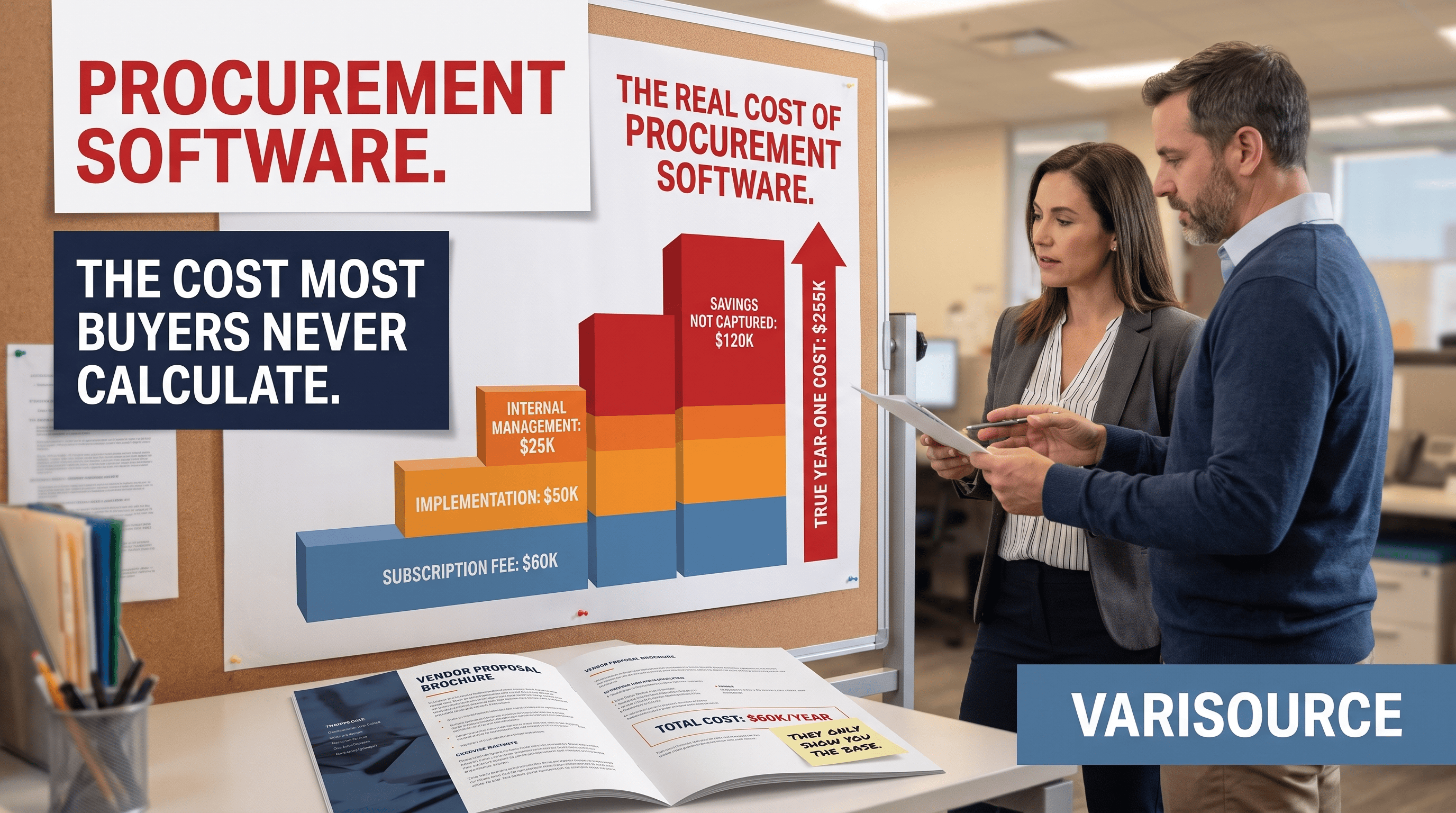
The subscription price of procurement software is the smallest part of what it actually costs. Implementation, data normalization, training, internal management, and the savings it does not deliver are the numbers most buyers never calculate before signing. This article walks through the complete cost picture and compares it to a shared-savings model where the provider earns only when savings are delivered.
Why Do Most Procurement Software Purchases Underperform?
The procurement software market is built around a purchase decision that almost always looks reasonable on paper. A platform costs $40,000 to $80,000 per year. The demo shows impressive dashboards. The references check out. The contract gets signed.
Twelve months later, the team has better visibility into vendor spend than they did before. They also have the same vendor pricing they had before, because the software showed them the problem without providing the mechanism to fix it.
This is the core tension in the procurement software market: most tools are built around visibility and workflow, not savings delivery. The subscription fee buys access to the platform. What happens to vendor costs after access is purchased depends entirely on what the internal team does with the information, and most internal teams do not have the time, benchmark data, or negotiating infrastructure to act on everything the platform surfaces.
What Does Indirect Procurement Software Actually Cost in Total?
The subscription fee. This is the number in the vendor's proposal: typically $30,000 to $120,000 per year for mid-market platforms, with enterprise tiers running higher. Most buyers evaluate the subscription fee against an expected savings number and conclude the math works. The problem is that the subscription fee is the most predictable cost in the entire picture, not the largest one.
Implementation and data normalization. Procurement software requires clean, structured data to function. Most companies' vendor spend data is scattered across AP systems, department credit cards, multiple ERP instances, and individual spreadsheets. Normalizing this data into a format the platform can use typically takes 60 to 180 days and requires significant internal project management time or external consulting fees. Implementation costs that are not built into the subscription price regularly add 50 to 100 percent of the annual subscription cost in the first year.
Training and change management. A platform that the team does not use consistently produces the same outcome as a platform nobody bought. Getting procurement, finance, IT, and department stakeholders to route purchasing through a new system requires training, process documentation, and sustained change management over several months. These costs are almost never included in a software vendor's proposal and almost never calculated by the buyer before signing.
Internal management overhead. Procurement software does not manage itself. Someone needs to own the platform, maintain the data quality, configure the alerts, review the outputs, and act on the recommendations. For most mid-market companies, this is a portion of an existing employee's time. At a fully-loaded cost of $100,000 per person, even 25 percent of one FTE's time is $25,000 per year in internal management cost that does not appear in the vendor's pricing.
The cost of savings not delivered. This is the number that almost nobody calculates, and it is typically the largest one. If a procurement software platform costs $60,000 per year, requires $40,000 in implementation, adds $20,000 in internal management overhead, and the team achieves $150,000 in savings in year one, the net benefit is $30,000. If the team achieves $80,000 in savings because they ran out of bandwidth to act on everything the platform surfaced, the net benefit is negative $20,000. The difference between those two outcomes is entirely in the execution capacity the internal team has available, which the software vendor cannot control and the buyer rarely accounts for.
What Is the Alternative Cost Model?
The shared-savings model structures the provider's compensation around savings delivered rather than access provided. There is no subscription fee, no implementation charge, and no internal management overhead for the platform itself. The provider earns a percentage of verified savings that land in the client's financial results. If savings are not delivered, the client owes nothing.
Under this model, the total cost calculation is fundamentally different. Instead of calculating subscription plus implementation plus training plus management overhead against expected savings, the buyer asks one question: are the savings net of the program's fee better than what I would achieve managing this independently?
For most mid-market companies, the answer is clearly yes, because the shared-savings program provides vendor-level benchmark data from 50M-plus real contract data points, group buying power across 100K-plus vendors, rebate tracking across all eligible categories, and dedicated execution coordination for qualifying projects, all without requiring internal infrastructure to run.
How Do You Evaluate Procurement Software Versus a Savings Program?
The comparison should be done on net savings delivered, not on feature lists. The relevant question is: after all costs, including implementation, internal management, and the savings not captured due to bandwidth constraints, what does each option deliver to the P&L?
For organizations with dedicated procurement teams and the internal infrastructure to act on everything a platform surfaces, a well-chosen subscription tool can be cost-effective. For organizations that need savings without building internal procurement infrastructure, a shared-savings program with built-in execution support typically delivers better net results at lower risk.
The Varisource Savings Program operates on the shared-savings model, covering 300-plus spend categories with no upfront cost. A free savings estimate is delivered within 48 hours of receiving an AP spend file, so the comparison against any alternative is based on actual numbers rather than estimates.
Read more in the Spend Value Tips series at Varisource Blogs.
Frequently Asked Questions
What is the average total cost of ownership for procurement software?
Subscription fees typically run $30,000 to $120,000 per year. When implementation, internal management, and change management costs are included, the first-year total is often 1.5 to 2.5 times the annual subscription price. Buyers who calculate only the subscription fee systematically underestimate what the platform actually costs.
How long does it take to get value from procurement software?
Most mid-market platforms require 60 to 180 days of implementation before delivering useful output. Shared-savings programs that have the benchmark data infrastructure already built can deliver a meaningful savings estimate within 48 hours.
What questions should you ask before purchasing procurement software?
What is the total first-year cost including implementation? What is the expected savings amount in year one, and what case studies support that number? Who handles the negotiation and execution after the platform identifies an opportunity? And, the most revealing question: are you willing to be paid on savings delivered rather than on subscription access?
About the Author
.jpeg)
Victor Hou
Victor Hou is the founder of Varisource, the first ever Savings Automation Platform that automates Savings for Your Business. Victor helps companies access discounts, rebates, benchmark data, savings for renewals and new purchases across 100+ spend categories automatically to increase your company's margins and equity value by at least 15-20%. Victor is active and passionate about using AI + automation to help your business save time, money and run more efficiently.
%201.svg)

Varisource’s Savings Automation Platform guarantees savings and maximized leverage on every dollar spend across 100+ spend categories


