Vendor Benchmarking: The Complete Guide for 2026
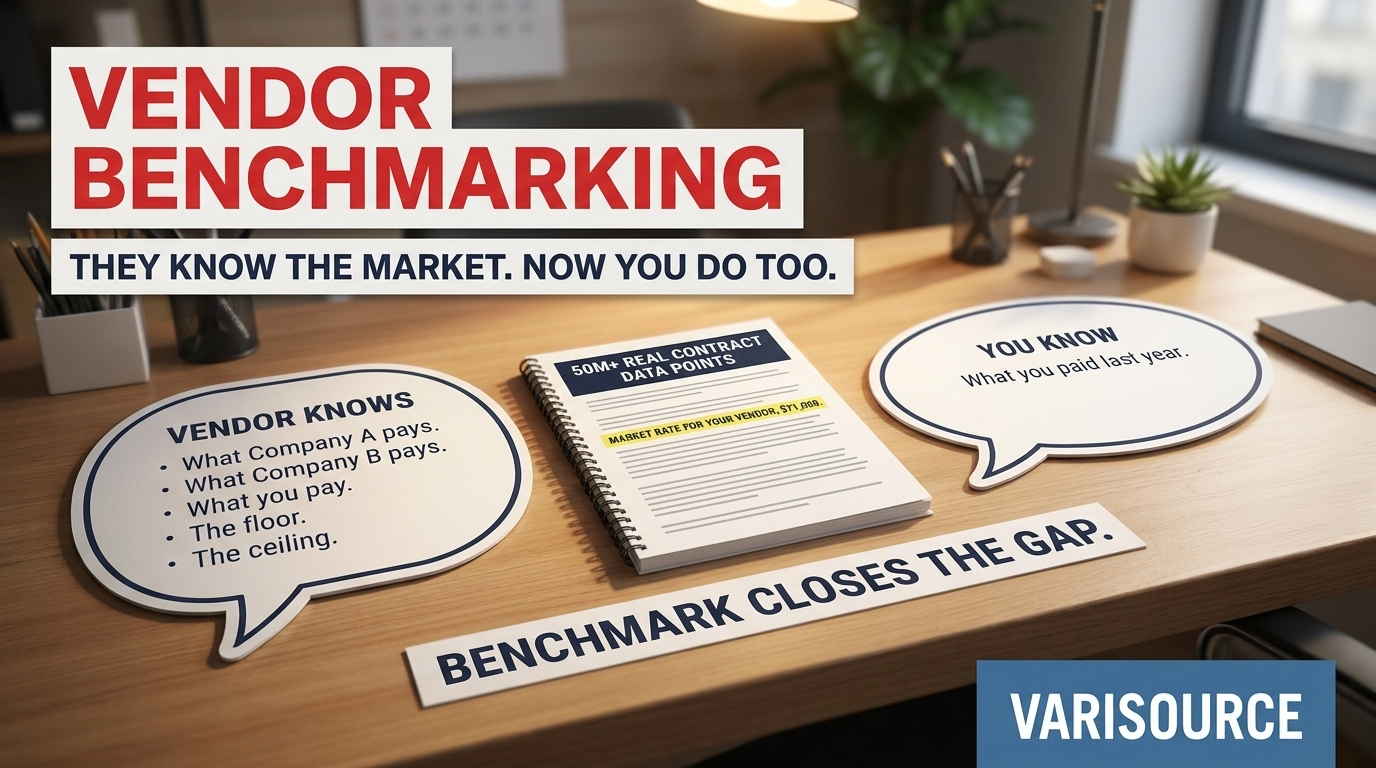
Vendor benchmarking is the process of comparing what you pay a vendor against what comparable companies actually pay for the same service. The data that matters is real contract data at the vendor level, not published rate cards or category averages. Companies that benchmark before every renewal consistently achieve 15 to 30 percent better outcomes than those that do not. It is the single most impactful change available to any procurement or finance team.
What Is Vendor Benchmarking and Why Does It Matter So Much?
Vendor benchmarking is the process of comparing your vendor pricing against verified external data showing what similar companies pay for the same products and services. It answers the question that should precede every vendor negotiation: what is a fair price for this, and how far away from it are we?
Vertice's 2025 research found that 9 in 10 companies overpay their vendors by an average of 26 percent. The reason is not that procurement teams are unsophisticated. The reason is that vendors have complete pricing data across every deal they close, and most buyers are negotiating against only one reference point: what they paid last time. Vendor benchmarking closes that information gap.
Think of it the way a homebuyer thinks about comparable sales data. You would not make an offer on a house without knowing what comparable homes sold for on the same street. Without that data, you are guessing. With it, you have a defensible position. Vendor pricing works the same way. The benchmark is the comparable sales data for your vendor contract.
What Types of Benchmark Data Actually Exist and Which Ones Matter?
Not all benchmark data is equal. Understanding the difference determines whether you are building a negotiating position on solid ground or on a reasonable-sounding estimate.
Published list prices. Vendor rate cards and published pricing pages. These are the vendor's preferred starting position. Almost nobody pays list price. Actual negotiated rates typically run 20 to 40 percent below published prices. Using list prices as a benchmark tells you roughly where the vendor wants to start the conversation. It does not tell you where deals actually close.
Survey-based industry averages. Research from analyst firms and industry associations that aggregates reported pricing across respondents. More useful than list prices, but lagging by 12 to 18 months in fast-moving categories like software and cloud. Also typically reported at the category level rather than the vendor level, which means "average SaaS pricing per seat" rather than "what companies your size pay Salesforce for Sales Cloud at 150 seats."
Real contract data at the vendor level. Actual transaction data from companies similar to yours paying the same vendor for the same service. This is the benchmark that changes outcomes. It tells you specifically what DocuSign charges companies your size at your usage tier, what AWS charges for configurations comparable to yours, what your telecom carrier offers companies of your profile. That specificity is what makes a benchmark a negotiating tool rather than a directional estimate. Varisource's benchmark database contains 50M-plus real contract data points across 100K-plus vendors built from this type of data for exactly this reason.
How Do You Use Vendor Benchmarking in an Actual Negotiation?
The benchmark is only valuable if it changes how you show up in the conversation. Here is how to use it effectively.
Run the dual benchmark before any renewal conversation. The reference article on Varisource's blog describes this well: the vendor benchmark compares your pricing against what other customers of the same vendor pay. The market benchmark compares that service against what alternative vendors charge for equivalent capabilities. The vendor benchmark tells you whether you are overpaying relative to the vendor's own range. The market benchmark tells you whether the vendor's entire pricing tier is above market. You need both numbers. A 10 percent discount from an already-inflated price is a smaller win than knowing the market offers the same service for 40 percent less.
Lead with the data, not with emotion. The benchmark changes the conversation from "we think you're too expensive" to "our data shows companies similar to ours pay X for this service, and we'd like to get our contract to that level." The first is a complaint that can be dismissed. The second is a fact-based request with a specific target. A 2021 McKinsey study found vendors rate data-driven buyers 24 percent higher on relationship satisfaction than buyers who use pressure tactics. The benchmark is not adversarial. It is professional.
Use the benchmark as the floor, not the ceiling. The benchmark shows the market rate. Your goal is to match it, or beat it. Do not accept the market average as the best you can do. Use it as the starting point for the negotiation and work from there.
Document the gap before the conversation starts. Any difference of more than 10 percent between your current pricing and what the benchmark shows for a meaningful spend category is worth addressing. Ardent Partners' 2024 research found world-class procurement teams achieve 74.9 percent contract compliance, meaning nearly 75 percent of their purchases go through properly benchmarked, negotiated contracts. The industry average is 59.5 percent. That 15-point gap is the difference between organizations that consistently save and organizations that consistently overpay.
How Often Should You Benchmark Your Vendors?
Every major contract before renewal, and every significant new purchase before signing. For strategic vendors representing significant spend, an annual benchmark review is worth running even mid-contract, because market pricing moves and knowing where the gap has grown tells you what to negotiate at the next renewal.
The practical challenge is capacity. Most finance and procurement teams do not have time to run vendor-level benchmarks across dozens of contracts while managing everything else. That is where a savings program with benchmark data built in changes the economics of the exercise: instead of building benchmark capability internally, you access it through a program that already has the data and applies it across your full portfolio continuously.
The Varisource Savings Program benchmarks every renewal against current market data from 50M-plus real contract data points across 100K-plus vendors. Every client sees their current pricing compared to what the market actually looks like right now, with the gap quantified and the negotiating target identified. A free benchmark analysis is delivered within 48 hours of receiving your vendor spend file.
Read more about how benchmark data works in vendor negotiations.
Read more in the Spend Value Tips series at Varisource Blogs.
Frequently Asked Questions
What is the best source of vendor benchmark data?
Real contract data from companies similar to yours paying the same vendor. Published list prices and survey averages are useful context but not sufficient for negotiation. The closer the benchmark is to your specific vendor, usage tier, and company profile, the more useful it is as a negotiating tool.
How much does vendor benchmarking typically save?
Companies that benchmark before renewals consistently achieve 15 to 30 percent better outcomes than those who do not, per multiple procurement research sources. The range depends on how long the contract has been unreviewed and how far above the market rate the current pricing sits.
Can you benchmark categories beyond software?
Yes. Benchmark data exists for cloud infrastructure, telecom, managed services, HR platforms, payment processing, shipping, and more. The categories where buyers have historically had the least access to real pricing data, telecom and managed services in particular, often show the largest gaps between current contracts and market rates.
About the Author
.jpeg)
Victor Hou
Victor Hou is the founder of Varisource, the first ever Savings Automation Platform that automates Savings for Your Business. Victor helps companies access discounts, rebates, benchmark data, savings for renewals and new purchases across 100+ spend categories automatically to increase your company's margins and equity value by at least 15-20%. Victor is active and passionate about using AI + automation to help your business save time, money and run more efficiently.
%201.svg)

Varisource’s Savings Automation Platform guarantees savings and maximized leverage on every dollar spend across 100+ spend categories


