Vendor Consolidation Strategy: How to Cut Your Vendor Count Without Cutting What Works
Most companies have more vendors than they need. Not because someone made a series of bad decisions, but because vendor count grows naturally — each team solving a specific problem with the best available tool at the time, with nobody responsible for seeing the full picture.
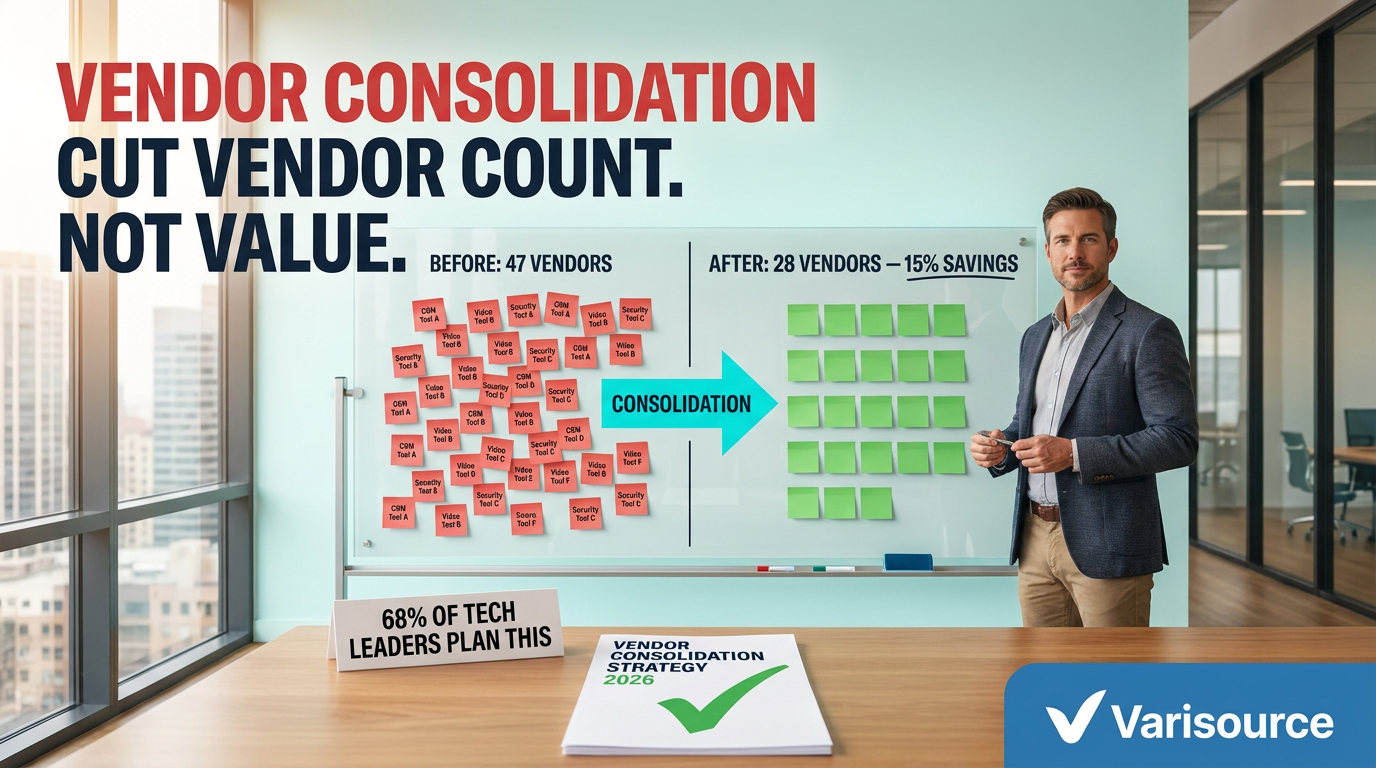
The result, over time, is a vendor portfolio that is fragmented, expensive, and increasingly difficult to manage. The average organization now runs 305 SaaS applications, per Zylo's 2026 SaaS Management Index. Research from Gartner found that 68% of technology leaders plan to consolidate vendors, targeting a 20% reduction in vendor count. The motivation is straightforward: fragmented spending gives every vendor the impression you are a small customer, and small customers get small-customer pricing.
But vendor consolidation done poorly — cutting vendors without understanding what each one actually does, or consolidating on a platform that does not fully replace what was removed — creates operational disruption that costs more than the savings it was supposed to generate. This guide covers how to do it right.
What Is Vendor Consolidation — and What Are the Real Benefits?
Vendor consolidation is the strategic process of reducing the number of suppliers your organization uses in a given category or across your portfolio, consolidating spending with fewer vendors to increase leverage and reduce management complexity.
The financial case is clear. When you split $2 million in annual software spend across 40 vendors, each vendor sees you as a small account. When you consolidate that same spend with 25 vendors, your larger average account size puts you in a better tier for pricing, support priority, and contract flexibility. Research consistently shows 10 to 15% savings in categories where vendor consolidation is applied, with some studies citing up to 20% in highly fragmented categories.
Beyond price, consolidation reduces the administrative overhead of managing dozens of vendor relationships simultaneously — fewer renewal dates to track, fewer invoices to reconcile, fewer security reviews to run, and fewer points of failure in your vendor management process.
How Do You Identify Which Vendors to Consolidate?
Start with a complete spend map. You cannot consolidate what you cannot see. Pull every vendor, every category, every contract, and every spend amount into a single view. Most companies discover significant surprises in this step: duplicate tools in the same category, licenses still running for employees who left months ago, and subscriptions that were "temporary" two years ago and never canceled.
Once you have the full picture, analyze by category. The consolidation opportunities almost always fall into one of three patterns:
Functional overlap. Multiple tools doing the same or similar jobs across different departments. Video conferencing is the clearest example — many organizations simultaneously pay for Zoom, Microsoft Teams, and Google Meet. Project management is another: Asana, Monday.com, and Jira all coexisting in the same organization, bought by different teams without coordination. These overlaps are immediate consolidation candidates because the savings require no sacrifice of capability.
Category fragmentation. Spending on the same category split across too many vendors, none of whom see you as a significant account. IT managed services, security tools, and cloud infrastructure are common examples. Consolidating to one or two primary vendors per category creates the volume that unlocks better pricing tiers.
Tail spend. The long tail of small vendors — typically accounting for 20% of vendor count but only 2 to 5% of spend — that consume a disproportionate amount of management time relative to their value. These are consolidation candidates not primarily for cost savings but for operational simplification.
What Are the Biggest Mistakes in Vendor Consolidation?
Consolidating without utilization data. Before cutting any vendor, know exactly who uses it and how often. Zylo's 2026 SaaS Management Index found average license utilization across organizations sits at 54% — which means nearly half of purchased licenses are unused. But the ones that are used might be critical to specific workflows that are not visible to procurement. A tool with 40% overall utilization might have 100% utilization in one team whose work would be significantly disrupted by removal. Always map active users before any consolidation decision.
Moving too fast. Gartner and independent research consistently find that vendor consolidation roadmaps take 18 months longer than planned. The data migration, workflow adjustment, and user retraining involved in replacing a tool is almost always more complex than it appears upfront. Building a realistic timeline — and communicating it to stakeholders before expectations are set incorrectly — is one of the most important steps in consolidation planning.
Consolidating without benchmarking first. Vendor consolidation should not happen in isolation from pricing strategy. Before consolidating to a preferred vendor, benchmark their current pricing against market alternatives. Consolidating more spend with a vendor who is already 25% above market price does not improve your position — it increases your exposure. The right sequence is benchmark first, negotiate the consolidated price, then consolidate.
How Does a Savings Program Support Vendor Consolidation?
The Varisource Savings Program supports vendor consolidation in two specific ways. First, the initial spend analysis identifies category overlap and fragmentation across 300+ spend categories — giving you the complete picture that makes consolidation decisions data-driven rather than intuitive. Second, the benchmark pricing data ensures that consolidation targets are priced correctly before you commit more volume to them.
The program also applies group buying power to consolidation decisions — meaning that even after consolidation, your pricing reflects the collective volume of the full Varisource network rather than just your individual spend. This combination — fewer vendors, lower prices on each one — is where vendor consolidation delivers its full financial value.
Read more in the Spend Value Tips series at Varisource Blogs.
About the Author

Victor Hou
Victor Hou is the founder of Varisource, the first ever Savings Automation Platform that automates Savings for Your Business. Victor helps companies access discounts, rebates, benchmark data, savings for renewals and new purchases across 100+ spend categories automatically to increase your company's margins and equity value by at least 15-20%. Victor is active and passionate about using AI + automation to help your business save time, money and run more efficiently.
%201.svg)

Varisource’s Savings Automation Platform guarantees savings and maximized leverage on every dollar spend across 100+ spend categories


