How to Drive Vendor Cost Reduction in 2026: Proven Levers

TL;DR
Vendor cost reduction is the measurable decrease in what you pay an external vendor for the same scope of goods or services, achieved through price negotiation, usage rightsizing, contract optimization, and process improvements. World-class programs reduce purchasing costs by 8 to 12 percent, and structured indirect spend programs achieve 10 to 15 percent savings. This guide covers the precise definition, how to calculate and report savings, the fastest levers by category (SaaS, cloud, telecom, payments, MRO), and a practical renewal checklist you can start using this week.
What is the most effective way to drive vendor cost reduction in 2026? The most effective way to drive vendor cost reduction in 2026 is through usage rightsizing and AI-assisted benchmark negotiations. By eliminating "shelfware" (unused licenses)—which accounts for 20-30% of average SaaS spend—and using real-time market data to cap annual price escalations at the lesser of CPI or 3%, organizations can achieve hard-dollar savings of 8% to 15% across indirect spend categories.
What Vendor Cost Reduction Actually Means
Vendor cost reduction is a hard-dollar decrease in the total price you pay an external supplier for an equivalent scope of goods or services over a defined period. The decrease comes from unit price improvements, rebates or credits, usage rightsizing, and contract term optimization, all without degrading the service levels you need.
That last part matters. General “cost cutting” often means slashing scope or accepting lower quality. Vendor cost reduction keeps scope intact. You pay less for the same thing, or you stop paying for things you never needed in the first place.
It sits within procurement’s broader value creation toolkit, alongside cost avoidance and risk management. But it’s the one that shows up directly on the P&L.
Related Terms You Should Know
These terms get confused constantly, and the confusion causes real problems when reporting savings to Finance.
Cost avoidance is the prevention of a future price increase that would have occurred if you took no action. Useful to track, but not “bookable” savings in most finance organizations. Yale’s procurement glossary draws this line clearly: avoidance prevents a cost from rising, while reduction lowers an existing cost. For a deeper comparison, see our breakdown of cost savings vs. cost avoidance.
Purchase Price Variance (PPV) measures the difference between the standard or expected price and the actual price paid. It’s one of the cleanest ways to isolate the price component of vendor cost reduction and prove it to Finance. Simfoni’s PPV explainer covers the formula and failure modes well.
Total Cost of Ownership (TCO) goes beyond acquisition price to include operating, maintenance, support, and end-of-life costs. In IT and cloud categories, TCO often dominates, meaning a low unit price with expensive support tiers or overage fees can cost more than a higher sticker price with better terms.
Why Vendor Cost Reduction Matters Right Now
Cost reduction retook the top spot on the CPO agenda in 2024, driven by margin pressure and a high-rate environment, according to Hackett Group research. This isn’t a cyclical blip. CFOs expect hard savings, not dashboards showing “potential.”
The numbers back up the urgency. Bain research shows world-class procurement programs reduce purchasing cost bases by 8 to 12 percent. McKinsey finds that structured indirect spend programs achieve 10 to 15 percent savings when managed seriously, with the potential to lift return on sales by 1 to 2 points.
Process savings add up too. Tail-spend automation (guided buying, catalogs, AI-assisted sourcing) can cut transaction costs by 50 to 70 percent, freeing team hours for higher-value negotiations. Meanwhile, the average invoice processing cost sits at about $9.40 with a 9.15-day cycle time, per Ardent Partners’ 2024 benchmark. There’s clear room to improve.
For procurement teams under pressure to demonstrate value, vendor cost reduction is the most direct and measurable path. And for private equity operating teams, it’s often the fastest margin lever across a portfolio.
The Savings Math: How to Measure Vendor Cost Reduction
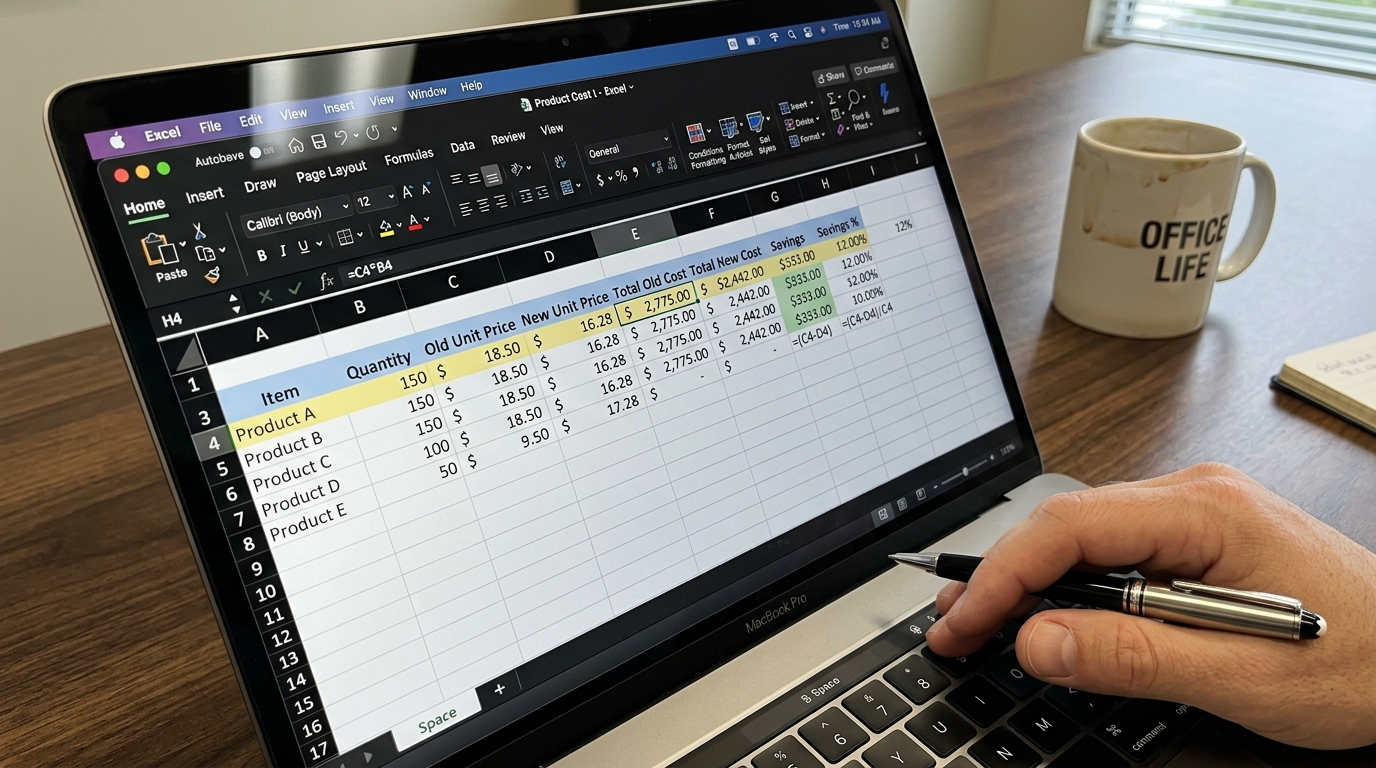
Getting the math right matters more than most people think. Poorly defined savings create friction with Finance and undermine credibility for future negotiations.
Core Formula (Price Effect)
Savings ($) = (Old Unit Price − New Unit Price) × Like-for-Like Quantity
Use PPV to isolate true price improvement from scope or volume changes. If you renegotiated a lower rate but also doubled your license count, those are two separate events. Don’t blend them.
Contract and Term Effect
Negotiated rebates, credits, waived fees, improved escalation caps, and rate locks each deserve their own savings line. Recording them separately prevents double counting and makes it easier to defend the numbers during budget reviews.
Process Effect
Reductions in process cost (lower cost per invoice, lower cost per purchase order) are real savings but belong in an “operating savings” category. Benchmark against Ardent Partners’ $9.40 average invoice cost and keep these separate from price savings. Finance teams will respect the distinction.
TCO Effect
Quantify downstream cost changes like support tier rationalization, overage avoidance, or reduced integration complexity. This matters most in IT, cloud, and payments, where operating costs can dwarf the initial contract price.
Reporting Hygiene
Stamp every line item as either cost reduction or cost avoidance. Agree on definitions with Finance at the start of the fiscal year, not at close. Bain’s research on why procurement savings get lost shows that the handoff between procurement and finance is where most “savings” evaporate. Early alignment prevents this.
2026 Vendor Savings Benchmarks by Category
Category | Avg. Savings Potential | Primary Cost Reduction Lever |
SaaS / Software | 12% – 22% | License rightsizing & auto-renew cancellation |
Cloud (AWS/Azure) | 10% – 18% | Reserved Instances (RI) & Savings Plan coverage |
Telecom / SD-WAN | 15% – 25% | Competitive re-sourcing & MPLS to DIA conversion |
Payment Processing | 5% – 12% | Interchange-plus pricing & fee audits |
MRO / Indirect | 8% – 15% | Tail-spend automation & SKU rationalization |
The Fastest Vendor Cost Reduction Levers
Not all levers require the same effort. Some deliver results in weeks, others take quarters. Here’s how they break down.
Price and Terms Levers
Renewal renegotiation with time leverage. Open every renewal 90 or more days before expiration to maximize your options. Practitioners on Reddit’s r/ITManagers consistently stress that timing and data matter more than clever phrasing. One IT manager noted that simply starting conversations early, with usage data in hand, shifted the dynamic entirely.
External benchmarks and group buying. Use external price benchmarks and volume aggregation to reset anchor prices. Without market data, you’re negotiating blind. IBM and SAP procurement guides list renegotiation with benchmarks as the first-line tactic for a reason.
Competitive alternatives in hand. Run a light-touch RFP or at least build a credible shortlist before renewal. Practitioners on r/sysadmin report that even a documented comparison (not a bluff, an actual evaluation) changes the conversation. Vendors can tell the difference between a real alternative and an empty threat.
Rebates and credits. Add or increase rebates on renewals and new purchases. Record them separately to avoid masking higher unit prices underneath.
Demand and Usage Levers
Rightsize licenses and usage. Many companies overpay for unused seats and add-ons. One analysis shared on Reddit’s r/SaaS found that companies routinely carry 20 to 30 percent unused licenses. Usage validation before renewal is, as multiple practitioners put it, “half the battle.”
Standardize specs and rationalize SKUs. MRO and professional services benefit from standard specifications and role-based bundles. McKinsey’s research on indirect procurement highlights how siloed, spec-driven purchasing creates persistent waste. Explore broader indirect spend management strategies to address this systematically.
Contract Structure Levers
Cap price escalation. Negotiate “lesser of CPI or 3%” caps and eliminate mid-term repricing triggers. SaaS contracts commonly allow 5 to 25 percent annual uplifts if left unchecked, according to Tropic’s SaaS contract guide. A CPI-linked cap protects you without being unreasonable to the vendor.
Here’s sample contract language for an escalation cap:
“Annual price adjustments shall not exceed the lesser of (a) the percentage change in the Consumer Price Index for All Urban Consumers (CPI-U) over the prior twelve months or (b) three percent (3%).”
Remove auto-renew traps. If you can’t eliminate auto-renewal entirely, widen the notice window to at least 90 days. A 30-day window is barely enough time to get internal alignment, let alone negotiate.
Early-pay economics. The classic 2/10 net 30 discount equates to roughly 36 to 37 percent annualized. If your cost of capital is well below that, trade early payment for rate relief or dynamic discounting.
Process and Control Levers
Tail-spend automation. Guided buying, catalogs, and AI sourcing agents cut cycle time and reduce maverick spend. JAGGAER research shows these tools can slash transaction costs by 50 to 70 percent.
AP automation. Moving from manual invoice handling to e-invoicing and straight-through processing cuts cost per invoice significantly against the $9.40 average baseline. Monthly tracking of AP metrics keeps the gains visible.
Leveraging Agentic AI for Cost Recovery
In 2026, manual spend analysis is being replaced by Agentic AI. Unlike traditional dashboards, these agents autonomously:
Audit Invoices in Real-Time: Flagging "price creep" where vendors increase unit costs by stealthy increments (often 1-2%) across billing cycles.
Predict Renewal Risk: Identifying vendors with high churn or declining service scores to give you leverage 120 days before a contract expires.
Automate Tail-Spend: Directing unmanaged spend to "guided buying" catalogs, which reduces transaction costs by up to 70%.
Category Mini-Playbooks
Each vendor category has its own dynamics. Here’s what works in the five most common indirect spend areas.
SaaS and Software
Start renewal conversations 90 or more days out. Pull usage data first: how many seats are active, which add-ons are actually used, what shelfware can be swapped for value adds. Negotiate escalation caps tied to CPI. Remove or extend auto-renew notice windows.
SaaS founders on Reddit are open about pricing strategy. One thread on r/SaaS described raising prices 35 percent with only a 2 percent increase in churn. The takeaway for buyers: vendors will push aggressive increases because the math works in their favor. Your leverage comes from timing, competition, and clean usage data.
For IT teams managing software portfolios, the combination of license rightsizing and term renegotiation typically yields the fastest wins.
Cloud (AWS EDP as Example)
Build a forensic spend and coverage model that separates on-demand usage from Savings Plans and Reserved Instances. Size commitments conservatively. Open talks 4 to 6 months ahead. Develop credible Azure or GCP alternatives.
Independent guides cite 8 to 15 percentage-point discount improvements at structured EDP renewals when buyers prepare properly. Don’t forget AWS Enterprise Support pricing tiers (10%, 7%, 5%, 3%), which factor into TCO and serve as a negotiation lever themselves.
Telecom and SD-WAN
Use market re-sourcing at circuit renewal. Convert MPLS to DIA where performance allows. Pursue multi-carrier aggregation and benchmark access loop pricing.
A Tangoe case study showed seven-figure savings when a manufacturer modernized to SD-WAN while renegotiating legacy MPLS contracts. But TechTarget correctly warns that SD-WAN savings hinge on underlying WAN choices, not the overlay technology alone. Don’t assume the savings come automatically.
Card Processing (Payments)
Move to interchange-plus pricing. Compress processor markup. Remove junk fees. Optimize your MCC and data levels for lower interchange. Audit chargebacks regularly. The markup is the most directly negotiable lever, and most businesses have never actually negotiated it.
MRO and Indirect Services
Standardize specifications, rationalize the supplier base, and enforce catalogs with guided buying. McKinsey shows persistent 10 to 15 percent savings potential when indirect spend is managed as a program rather than left to individual departments.
To see the full range of categories where vendor cost reduction applies, explore Varisource’s savings categories.
Common Pitfalls That Erode Vendor Cost Reduction

Savings That Never Reach the P&L
This is the most common failure mode. Finance disputes savings when baselines, scope definitions, and timing aren’t reconciled. Bain’s research finds that procurement teams often claim savings that finance never sees in actual spending. The fix is joint sign-off on methodology before negotiations start, not after.
Confusing Cost Avoidance with Cost Reduction
Avoiding a 10 percent increase is valuable. But it’s not a 10 percent saving. Label each line clearly and don’t count avoidance as hard-dollar reduction. This distinction matters for credibility and for accurate budgeting.
Over-Consolidation Risk
Fewer vendors can mean better pricing, but too few creates concentration risk. If your sole-source vendor raises prices or has a service outage, you have no fallback. Treat supplier consolidation as optimization, not minimization. Data-led rationalization beats mass culling.
Chasing Unit Price While Ignoring TCO
A cloud contract with a great per-instance rate but expensive support tiers, overage penalties, and rigid commitment terms can cost more than a higher sticker price with better protections. Always run TCO, especially in IT, cloud, and payments categories.
Vendor Renewal Negotiation Checklist
This timeline works across SaaS, cloud, telecom, and most indirect categories.
120 days out: Confirm your asset and usage baseline. Identify unused licenses, underutilized services, and shelfware. Pull contract terms, noting auto-renew dates and notice windows.
90 days out: Collect peer benchmarks and market pricing data. Build a shortlist of credible alternatives. Set negotiation targets by lever: price, cap, term length, rebates, credits.
60 days out: Open renewal conversations with the vendor. Present usage data and benchmark findings. Make your first counter-proposal on pricing and terms.
45 days out: Negotiate specific contract language. Push for escalation caps (CPI or fixed percentage), extended notice windows (90 days minimum), renewal price-lock periods, and rebate or credit structures.
30 days out: Finalize terms. Confirm Finance alignment on how savings will be recorded. Document everything for next renewal cycle.
Post-signature: Redirect low-value purchases to catalogs. Enforce PO coverage. Track AP metrics monthly. Set a calendar reminder to begin the next renewal cycle at 120 days.
For teams that want to run this process across dozens or hundreds of vendors simultaneously, Varisource offers a free savings program that combines group buying discounts, SKU-level benchmark data (50M+ data points), negotiation support, and renewal automation across 300+ categories. There’s no upfront cost, and savings are typically realized in under 30 days. Get a free Savings Estimate Report, usually delivered within 48 hours.
What Real Buyers Say About Vendor Cost Reduction
Practitioner perspectives from procurement, IT, and finance forums paint a consistent picture.
“Timing beats tactics.” IT managers on Reddit repeatedly emphasize starting renewals early and never accepting “list price plus standard uplift” as a default. Caps, term swaps, and alternative quotes are routine wins for teams that plan ahead.
“Usage data is leverage.” Teams overpay when they can’t prove seat utilization to their own organization, let alone to a vendor. Getting clean usage data before entering any negotiation is the single most cited piece of advice.
“Microsoft renewals are shifting.” Partners are pushing CSP and NCE models, and practitioners on r/sysadmin recommend evaluating model changes early. Some teams lock in pricing by renewing ahead of announced increases when terms allow.
“Don’t confuse threats with negotiation.” Procurement professionals stress evidence-based counteroffers and structured concessions over vendor-switch bluffs. Vendors respond to data and credible alternatives. They ignore empty threats.
Real-World Savings Examples
SaaS renewal: A company performed a seat true-up and negotiated a 3% annual cap against a proposed 12% uplift. That’s a 9 percentage-point price improvement in year one, compounded by removing shelfware licenses. Practitioners in r/ITManagers report similar outcomes when they start early and bring usage data.
AWS EDP: A structured renewal with a commit model and documented Azure alternative yielded a 5 to 12 percentage-point discount improvement over the first offer.
SD-WAN modernization: Renegotiating legacy MPLS while transitioning to SD-WAN delivered seven-figure annual savings in a documented case study, though results depend heavily on circuit mix and site count.
AP automation: Moving from manual invoice handling to e-invoicing consistently cuts per-invoice costs well below the $9.40 industry average.
Frequently Asked Questions
Is vendor cost reduction the same as switching vendors?
No. Most vendor cost reduction comes from improving terms, optimizing usage, and fixing process inefficiencies with your current suppliers. Switching is sometimes the right move, but it’s usually a last resort, not the starting point. The majority of savings come from renegotiation, rightsizing, and contract structure changes.
How do I prove savings to Finance?
Use PPV math for price improvements. Separate rebates and credits into their own line items. Benchmark AP costs against industry averages. Most importantly, agree on savings definitions and baselines with Finance at the start of the fiscal year. Bain’s research shows that savings disputes almost always trace back to misaligned methodology.
What’s a realistic timeline for vendor cost reduction?
In renewal-heavy categories like SaaS and cloud, 30 to 90 days is enough to capture meaningful wins if you start early. For broader supplier base optimization or multi-year resets, budget one to two quarters. Quick wins (removing unused licenses, capping escalation clauses) can happen in weeks.
How is vendor cost reduction different from cost avoidance?
Cost reduction lowers what you’re currently paying. Cost avoidance prevents a future increase from taking effect. Both have value, but only cost reduction shows up as a hard-dollar improvement on the P&L. Learn more about the distinction in our guide to cost savings vs. cost avoidance.
What categories have the highest vendor cost reduction potential?
SaaS, cloud infrastructure, telecom, and payment processing consistently offer the highest percentage savings because pricing is opaque, renewals are frequent, and usage often doesn’t match what’s contracted. MRO and professional services follow closely when managed as a program rather than ad hoc.
Do I need a procurement team to pursue vendor cost reduction?
It helps, but it’s not required. Many mid-market companies run vendor cost reduction through IT or finance teams. The key ingredients are usage data, market benchmarks, and structured renewal timing. Programs like Varisource’s free savings program complement existing teams by providing benchmark data, negotiation support, and renewal automation across 300+ categories, with no upfront cost and a shared-savings model.
What contract terms should I prioritize in negotiations?
Focus on price escalation caps (CPI-linked or fixed percentage), auto-renewal notice windows (90 days minimum), renewal price-lock periods, rebate structures, and overage protections. These terms compound in value over multi-year relationships and prevent the slow price creep that erodes initial savings.
How do I avoid “savings on paper” that don’t hit the budget?
Three things: define baselines before negotiating, separate cost reduction from cost avoidance in all reporting, and get Finance sign-off on methodology upfront. Track actual spend against the new contract monthly for at least one quarter. If the numbers don’t match, investigate scope changes or maverick purchasing before claiming victory.
About the Author

Victor Hou
Victor Hou is the founder of Varisource, the first ever Savings Automation Platform that automates Savings for Your Business. Victor helps companies access discounts, rebates, benchmark data, savings for renewals and new purchases across 100+ spend categories automatically to increase your company's margins and equity value by at least 15-20%. Victor is active and passionate about using AI + automation to help your business save time, money and run more efficiently.
%201.svg)

Varisource’s Savings Automation Platform guarantees savings and maximized leverage on every dollar spend across 100+ spend categories


