Vendor Renewal Management: Stop Losing Money at Renewal Time
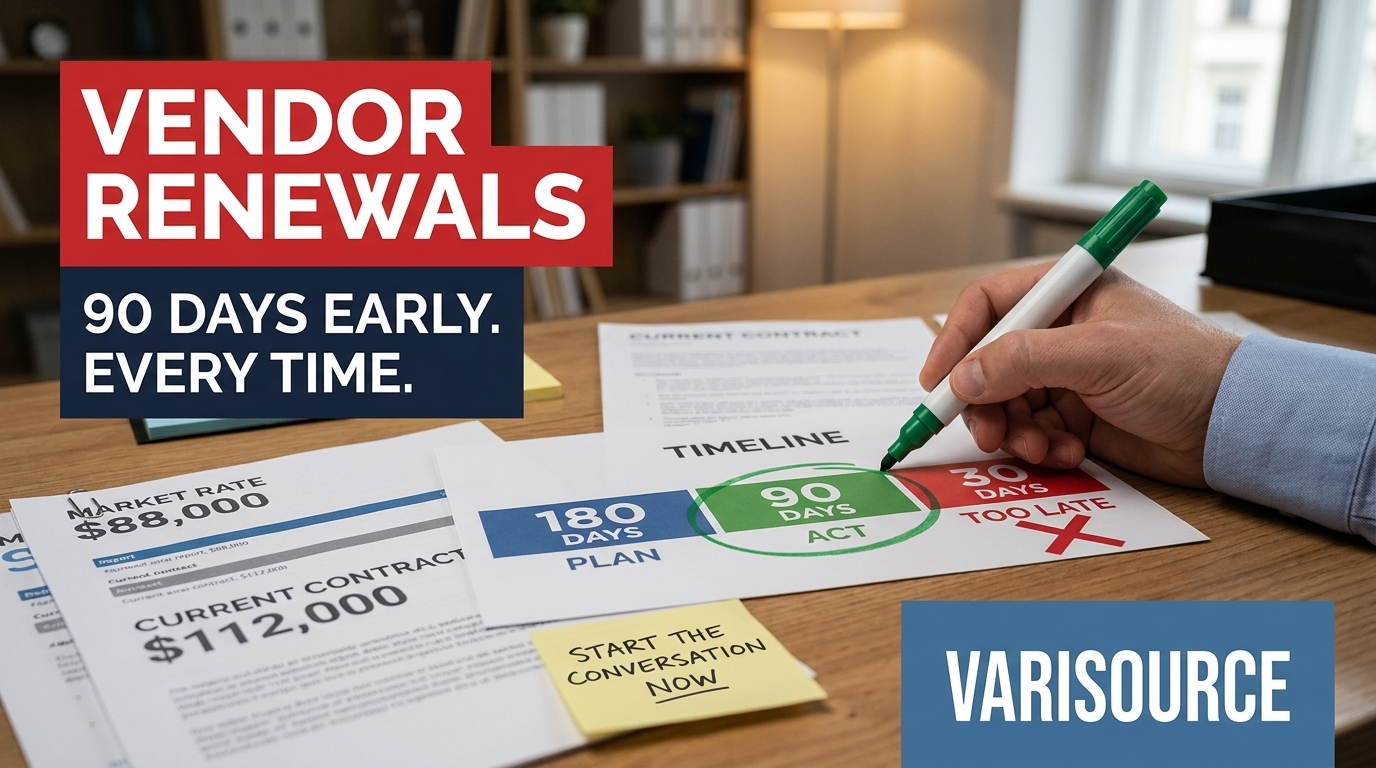
Most vendor renewals are lost before the first conversation because teams start too late. At 30 days out, the vendor holds all the leverage. At 90 days, you do. Build a renewal calendar, audit utilization before every renewal, benchmark pricing against real market data, and never let a contract auto-renew without a review. Companies that manage renewals proactively cut renewal costs by 5 to 15 percent annually with no other changes to their vendor relationships.
Why Do Most Vendor Renewals Cost More Than They Should?
The renewal is the most predictable negotiation in business. The date is known months in advance. The vendor is known. The pricing is known. And yet most companies consistently come out of renewals paying more than they should, often significantly more.
The reason is structural. Software contracts almost universally include auto-renewal clauses with cancellation windows of just 30 to 90 days. Miss that window and the contract rolls over, usually with a price increase baked in, and there is nothing to do about it until the next cycle. BetterCloud's 2025 State of SaaS report found that 85 percent of companies say they have a formal renewal process, but only 30 percent say it works. The gap between those two numbers is where the money goes.
The vendor understands this better than the buyer does. Their account manager has a calendar alert for your renewal date. They know when your window closes. They are not going to remind you to start early, because a rushed buyer has no real options, and a buyer with no real options accepts whatever is offered.
What Does Good Vendor Renewal Management Actually Look Like?
A renewal calendar that catches everything early. Every contract, every renewal date, every cancellation notice deadline, in one place with automated alerts at 180 days and 90 days. At 180 days, flag it for planning. At 90 days, start active work: utilization audit, benchmark pricing, competitive quote if appropriate. The Hackett Group projected procurement workloads would climb 8 percent annually with essentially flat headcount, which means a manual process fails at scale. Automate the calendar or accept that some renewals will slip through on bad terms.
A utilization audit before every renewal conversation. Before you talk to the vendor about price, find out what you are actually using. How many licenses are active? Which features are in regular use? Which users have not logged in for 90 days? Zylo's 2026 SaaS Management Index found average license utilization sits at 54 percent across organizations, meaning nearly half of purchased licenses are underused or unused entirely. That utilization data is a negotiating position before the price conversation even starts. You are not asking for a discount. You are asking for pricing that reflects actual usage, which is a fundamentally more defensible request.
Benchmark pricing for that specific vendor. Not a category average, not a published rate card, and not what you paid last year. Real contract data showing what comparable companies, similar size, similar industry, similar usage profile, actually pay that specific vendor for the same service right now. Published list prices typically run 20 to 40 percent above what buyers actually negotiate. The gap between your current contract and what the benchmark shows is your opening position. Varisource's benchmark database covers 50M-plus real contract data points across 100K-plus vendors for exactly this reason.
A competitive quote, or the credible appearance of one. You do not have to switch vendors. But the vendor needs to know you could. Running a competitive quote, or at minimum being able to speak specifically to what alternatives cost, changes the conversation from a vendor announcing a price to two parties actually negotiating. A 2021 McKinsey study found that vendors rate data-driven buyers 24 percent higher on relationship satisfaction than buyers who use pressure tactics. A competitive benchmark is not pressure. It is professional due diligence, and vendors respect it differently than emotional complaints about price.
Price escalation caps negotiated into the contract. This is the renewal practice that prevents the problem from recurring. When you renegotiate a contract, push for a CPI-based escalation cap or a fixed percentage cap on annual increases, an extended cancellation notice window of at least 90 days, and a price-lock period for multi-year agreements. These terms are negotiable at renewal, especially when the vendor is trying to retain your business. Most buyers accept the price and never touch the structural terms, then wonder why costs keep creeping up three years later.
What Is the Financial Impact of Proactive Vendor Renewal Management?
Research from multiple 2024 to 2025 procurement studies consistently shows that proactive renewal processes reduce contract costs by 5 to 15 percent annually compared to reactive or auto-renewal approaches. On $5 million in annual vendor spend, that range represents $250,000 to $750,000 per year. On $10 million, it doubles.
The math compounds. A contract that auto-renews at a 7 percent annual increase for three years grows 23 percent from its original value. A contract renegotiated at 90 days with benchmark data and a utilization-based right-sizing often comes in below the original price, with an escalation cap that limits future drift. The difference between those two outcomes over a three-year term on a $500,000 contract is more than $200,000.
The Varisource Savings Program manages vendor renewals across 300-plus spend categories, flagging contracts 90 to 180 days early, providing vendor-level benchmark pricing, and handling negotiations on behalf of clients. No upfront cost. A free savings estimate is delivered within 48 hours of receiving your vendor spend file.
Read more in the Spend Value Tips series at Varisource Blogs.
Frequently Asked Questions
When should vendor renewal management start for each contract?
At 90 days minimum before expiration, with a planning flag at 180 days. At 30 days, the cancellation window in most contracts is already closed or closing, which means the vendor controls the outcome. 90 days gives you time to audit utilization, benchmark pricing, get a competitive quote, and negotiate from a position with real options.
What is vendor auto-renewal and why is it a problem?
An auto-renewal clause automatically extends a contract for another term, usually a year, unless the buyer provides written notice of cancellation within a defined window, typically 30 to 90 days before expiration. The problem is that vendors benefit from buyers missing the window, and the window is often short enough that it passes before anyone notices. The solution is a renewal calendar with automated alerts set well before the window opens.
How much can companies save through better renewal management?
Research consistently shows 5 to 15 percent annual savings on renewals managed proactively versus reactively. The range depends on how far above market the current contracts are and how much utilization right-sizing is possible. Companies with portfolios that have never been benchmarked often find larger gaps than those who have reviewed pricing more recently.
About the Author
.jpeg)
Victor Hou
Victor Hou is the founder of Varisource, the first ever Savings Automation Platform that automates Savings for Your Business. Victor helps companies access discounts, rebates, benchmark data, savings for renewals and new purchases across 100+ spend categories automatically to increase your company's margins and equity value by at least 15-20%. Victor is active and passionate about using AI + automation to help your business save time, money and run more efficiently.
%201.svg)

Varisource’s Savings Automation Platform guarantees savings and maximized leverage on every dollar spend across 100+ spend categories


