Why Most Vendor Benchmark Data Is Wrong (And What Real Data Looks Like)
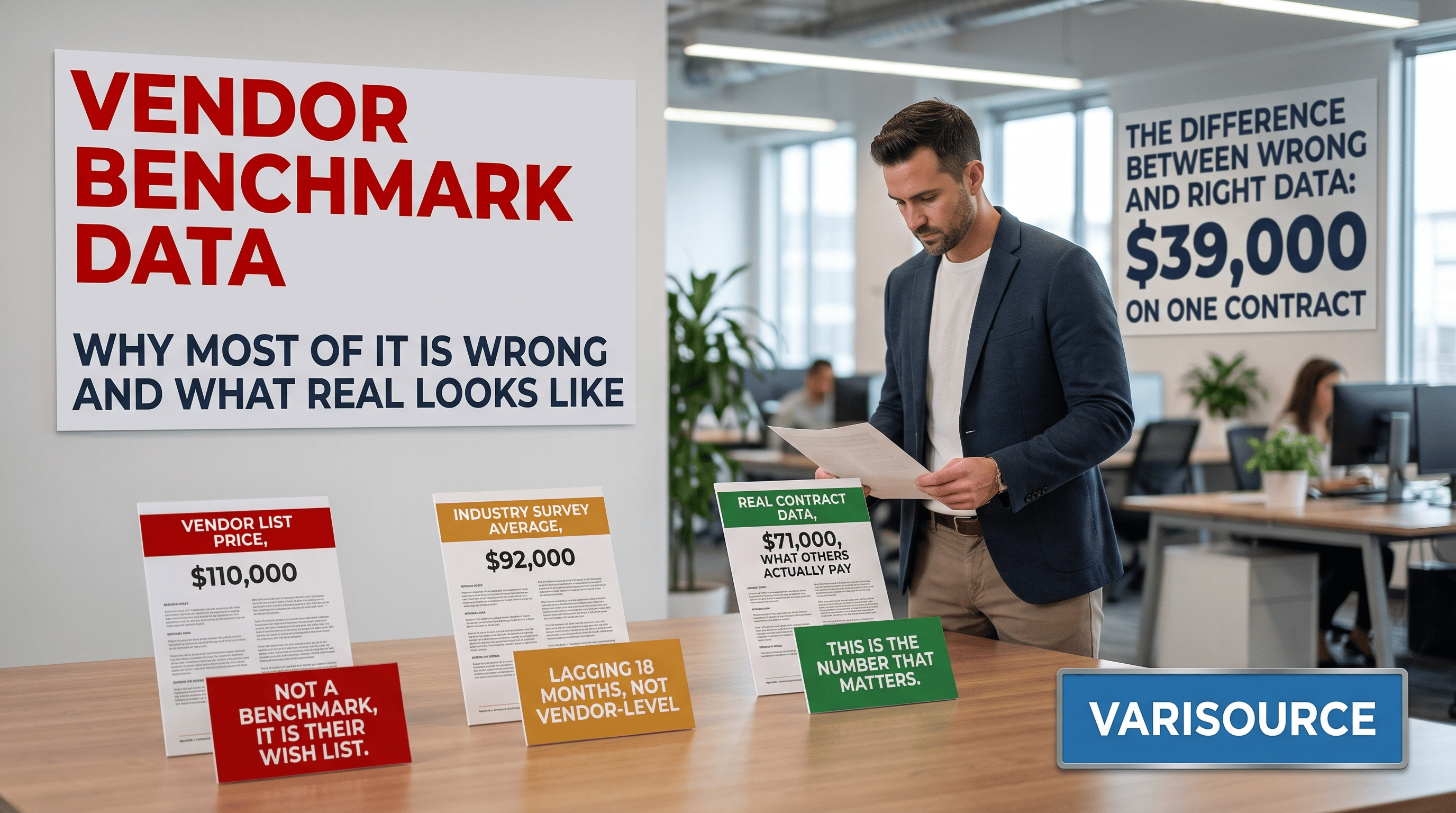
Most benchmark data used in vendor negotiations is not real benchmark data. Published rate cards are not benchmarks. Industry survey averages lag actual pricing by 12 to 18 months and are not specific to individual vendors. Vendor-supplied benchmarks are designed to support the vendor's pricing. Real benchmark data comes from actual contract transactions at the vendor level, and the difference between real data and estimated data changes negotiation outcomes significantly.
What Is the Problem With Most Vendor Benchmark Data?
The word benchmark has a precision problem in procurement. It is used to describe published rate cards, analyst survey averages, peer group comparisons, and actual contract data from real transactions. These are not the same thing, they do not produce the same negotiating outcomes, and conflating them is one of the most common reasons vendor negotiations underperform.
Understanding exactly what each type of data is, what it is useful for, and what it cannot tell you is the starting point for using benchmark data effectively rather than using a number that sounds credible but does not reflect market reality.
What Are the Most Common Types of Benchmark Data and Where Do They Fall Short?
Published rate cards and list prices. The most available and least useful benchmark. Rate cards represent where vendors want negotiations to start. Actual negotiated rates typically run 20 to 40 percent below list prices. Using a list price as a benchmark tells you the ceiling of what a vendor hopes to get. It tells you nothing about where deals actually close for companies of your size and usage profile. Walking into a renewal armed with list price data and asking for a 10 percent discount from there still leaves you 15 to 30 percent above market.
Industry survey averages from analyst firms. Better than list prices, but limited in two important ways. First, they are lagging indicators. Most procurement research cycles have 12 to 18 month publication lags from data collection to report release. In fast-moving categories like cloud infrastructure and SaaS, that lag means the benchmark reflects pricing from a different market environment. Second, they are reported at the category level, not the vendor level. Knowing that the average enterprise CRM costs $X per seat tells you something about the category. It tells you nothing specific about what companies your size pay Salesforce at your user tier, which is the number that changes a negotiation.
Vendor-supplied benchmarks. Some vendors proactively share benchmark comparisons as part of the renewal conversation. "Other companies your size pay similar amounts" is the most common framing. These are not neutral benchmarks. They are framed and selected by a party with a direct financial interest in the outcome. The companies being compared, the criteria for similarity, and the data points chosen are all controlled by the vendor. Vendor-supplied benchmarks should be treated as advocacy, not as intelligence.
Peer group comparisons from industry associations. Useful as directional context but suffer from the same lagging and aggregation problems as analyst surveys, often with smaller sample sizes. Self-reported data from peers also carries the risk of inaccuracy, either from memory errors or from reluctance to disclose actual contract terms.
What Does Real Benchmark Data Look Like?
Real benchmark data is actual contract transaction data collected from real purchases by real companies. It is not what companies say they pay in a survey. It is not what vendors say they charge on a rate card. It is the actual dollar amounts and terms from executed contracts between buyers and specific vendors.
The characteristics that make contract transaction data genuinely useful as a benchmark are specificity, recency, and comparability. Specificity means the data is at the vendor level, showing what companies pay a particular vendor for a particular product tier, not what they pay for a category in general. Recency means the data reflects current market pricing, not pricing from 18 months ago before multiple rounds of vendor price increases. Comparability means the companies in the dataset are similar to yours in size, industry, and usage profile, so the pricing reflects deals you could actually achieve rather than deals available to companies operating at a different scale.
Varisource's benchmark database contains 50M-plus real contract data points across 100K-plus vendors built from this type of transaction data. The practical result is a benchmark that can show what companies of your size and profile actually pay a specific vendor for a specific tier right now, which is the number that changes what you can credibly request in a negotiation.
How Does Data Quality Affect Negotiation Outcomes?
The financial difference between negotiating with real benchmark data versus estimated benchmark data is significant and measurable. Consider a company with a $500,000 annual Salesforce contract. If the only benchmark available is list price, a skilled negotiation might achieve 10 percent below list, landing the contract at $450,000. If the benchmark is real transaction data showing that comparable companies pay $360,000 for equivalent configurations, the negotiating target is specific, credible, and potentially worth $90,000 more in savings than the list-price negotiation produced.
Multiply that difference across 20 major vendor contracts in a portfolio and the aggregate impact of data quality on negotiation outcomes is in the hundreds of thousands to millions of dollars annually. The negotiating skill did not change. The data did.
The same principle applies to the dual benchmarking approach: vendor-level data showing what other customers of the same vendor pay, and market-level data showing what alternative vendors charge for equivalent capabilities. The second data point is what makes vendor consolidation decisions financially defensible rather than operationally speculative.
What Should Buyers Ask Spend Analysis Vendors About Data Quality?
Four questions expose the difference between real benchmark data and data that sounds authoritative but will not hold up in a negotiation. Where exactly does your benchmark data come from, and can you show me a sample of the underlying transaction records? How recent is the data, and how frequently is it updated? Is the data at the vendor level or aggregated to the category level? And, if a vendor disputes the benchmark you bring to a negotiation, what documentation can you provide to support the number?
Any vendor that cannot answer all four questions with specific, verifiable answers is selling a benchmark that is unlikely to perform when it matters most, in the negotiation itself.
Read more about how benchmark data works in vendor negotiations at Varisource.
Read more in the Spend Value Tips series at Varisource Blogs.
Frequently Asked Questions
How do you know if benchmark data is real or estimated?
Ask for the source. Real benchmark data comes from actual contract transactions and the provider should be able to describe the methodology for collecting and validating it. Survey-based or estimate-based data cannot be traced to individual transactions. If the provider cannot explain where each data point came from, it is not transaction data.
How much does data quality affect negotiation outcomes?
Significantly. The difference between a list-price benchmark and a real contract benchmark on a major vendor can be 20 to 40 percent in the final negotiated price. Over a portfolio of major contracts, the aggregate impact of data quality on savings achieved runs to hundreds of thousands of dollars annually for mid-market companies.
Can you use multiple types of benchmark data in one negotiation?
Yes, and doing so is good practice. Use real contract data as the primary benchmark and analyst survey data as corroborating context. The combination of specific transaction data and broader market trends gives you multiple credible reference points and makes the benchmark harder for the vendor to dismiss.
About the Author
.jpeg)
Victor Hou
Victor Hou is the founder of Varisource, the first ever Savings Automation Platform that automates Savings for Your Business. Victor helps companies access discounts, rebates, benchmark data, savings for renewals and new purchases across 100+ spend categories automatically to increase your company's margins and equity value by at least 15-20%. Victor is active and passionate about using AI + automation to help your business save time, money and run more efficiently.
%201.svg)

Varisource’s Savings Automation Platform guarantees savings and maximized leverage on every dollar spend across 100+ spend categories


