AI Cost Optimization Checklist: Reclaim 15% of Your IT Budget

There are savings with every vendor, no matter the category or the product, and 15% is a realistic target because of the way vendor overcharging compounds. On a first contract, vendors overcharge by 10 to 15% on average, sometimes more. Then the annual increases come, new services get added and multi-year terms get signed. At every step the vendor can upcharge, because the vendor knows you are stuck. The companies overspending in the 20 to 25% range are the ones that bought the first thing they saw or the name brand somebody recommended, and never had time to compare.
I approach spend in three steps. Visibility tells you that you spend $100,000 a year with a vendor and when that contract ends. Benchmarking tells you whether $100,000 is a competitive price, which takes different data and a different skill set. Execution gets you the better price, and that takes leverage. With AI, the first step can't wait. It's a usage product with very little monitoring around it, so any moment, any time, the cost can significantly go up without any notice.
Key Takeaways
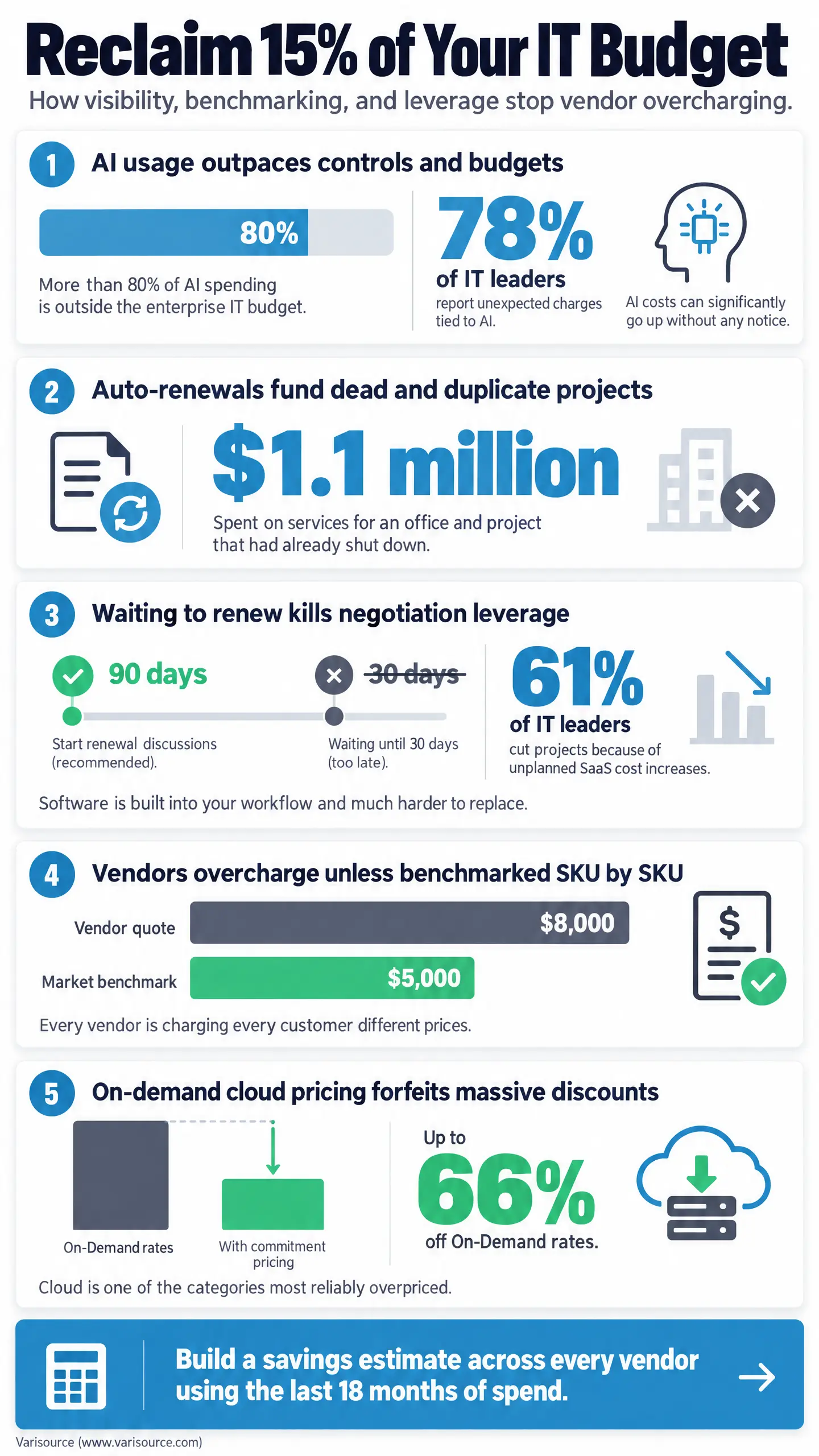
- According to BCG's 2026 research, more than 80% of corporate AI spending occurs outside the enterprise IT budget, requiring finance leaders to connect spend analytics directly to AI applications.
- The 2026 Zylo SaaS Management Index reveals that 78% of IT leaders experienced unexpected charges tied to AI features or consumption pricing over the previous year.
- Initiating software renewals 30 days before expiration destroys negotiation leverage, as demonstrated when a company accepted a 30% DocuSign discount instead of the 50% market benchmark due to time constraints.
- Vendor discounts often obscure underlying market rates, evidenced by a scenario where AT&T quoted $8,000 for a heavily discounted internet service that competitors priced at $5,000 for the exact same building.
- Introducing competitive bids into usage-based software negotiations forces price concessions, successfully increasing one Datadog contract discount from 5% to 20% without requiring the customer to reduce system monitoring.
- Companies frequently overpay for cloud flexibility, abandoning potential cost reductions like AWS's 66% Compute Savings Plan discounts to avoid restrictive one-year or three-year hourly commitments.
- Failing to centralize vendor contract dates and facility status results in massive unmonitored waste, including one organization spending $1.1 million on a closed project due to unchecked auto-renewals.
1. Put a Meter on AI Usage
Every prompt your team sends to ChatGPT, Claude or any other AI tool has a cost, and you don't really know what that one action or one question will cost you. With agents, the cost keeps going up as long as they keep running. Most companies don't have policies and controls on which model is used or how much budget is used. By the time people know or see it, it's too late, because the cost has already been charged. In Zylo's 2026 SaaS Management Index, 78% of IT leaders reported unexpected charges tied to AI features or consumption pricing over the prior year.
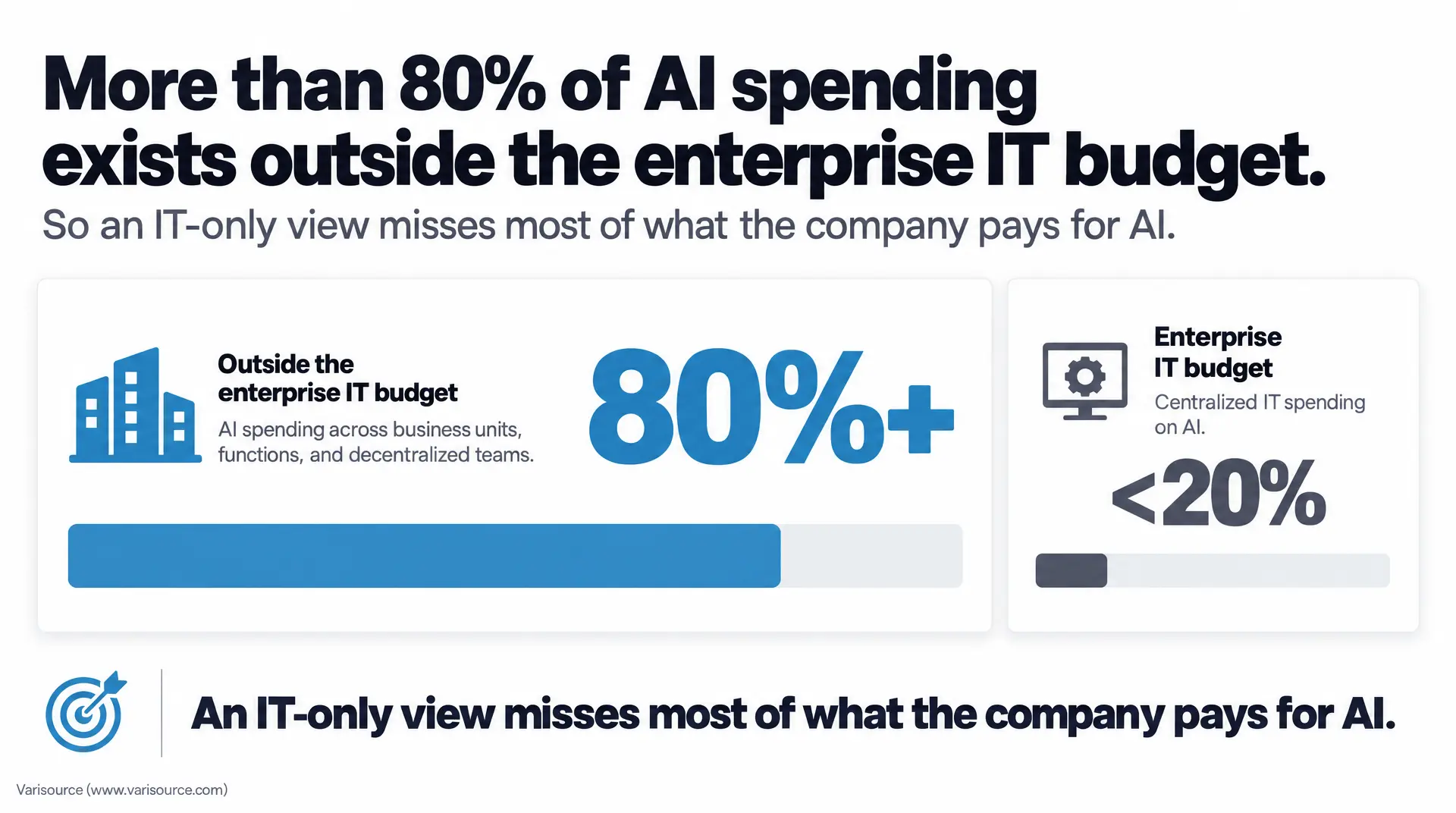
Those controls have to be in place before the invoice arrives, and the meter has to reach past your own budget. BCG's 2026 research puts more than 80% of AI spending outside the enterprise IT budget, so an IT-only view misses most of what the company pays for AI. I advise FP&A leaders to connect their spend analytics directly to their AI applications and their ERP, so usage shows up while there's still budget left.
I'd hold AI to the rule I'd have any CFO tape to the monitor: every spend dollar with a vendor has an ROI. Knowingly overpaying for AI can still be rational when you expect a much bigger return, but you can only make that call once you know what each tool costs.
2. Know What Canceling Costs
When a cost target lands on IT, canceling contracts looks like the fastest way to hit it. With a lot of technology, canceling can cost more than it saves, because telecom and software vendors will make you pay out the remaining term. One customer was closing an office and canceled the AT&T internet service there with a year left on the contract. AT&T charged them for the remaining year anyway, almost $60,000, because they didn't understand how the contract worked.
Surgical cutting needs a vendor database first. It should list every obligation down to the schedule level, with contract dates for every vendor. From there you go vendor by vendor. You look at license usage, how many people actually use each tool, when each contract expires, and whether the cancellation penalty is bigger than the savings. Tools that few people use probably have the least impact when they go. Categories like cell phones and cloud can be renegotiated immediately for significant savings without canceling anything.
3. Give Every Renewal 90 Days
I spent 15 years on the vendor side. In the 90 days before a big renewal, the sales team is always getting together, strategizing and putting a playbook in place. The goal is to give you enough comfort and confidence that you never go out to market. You hear that the service has been great, the team put in a lot of effort and your pricing is really, really good. You see the SLA uptime and the past discounts, while the support tickets you opened and the slow delivery times stay hidden. Customers usually start on that same renewal 30 days out, and that gap is why customers always overpay.
Time is one of the three parts of leverage, along with information and competition, and most of the negotiations we lose, we lose on time. We track contracts and renewals for customers months in advance for that reason. A 3,000-employee global company accepted a $125,000 DocuSign quote with a 30% discount because they only had 30 days to renew. The market benchmark supported a discount of more than 50%.
Software is built into your workflow and much harder to replace than office supplies. That's why SaaS vendors can push 8 to 20% increases every year, and that money comes straight out of your roadmap. In the same Zylo data, 61% of IT leaders cut projects because of unplanned SaaS cost increases. Tracking renewals early enough to build leverage is the one move that stops those increases.

4. Find Dead, Duplicate and List-Price Spend

On the vendor side, I saw a customer still paying $10,000 a month for a location that had closed. Finance never knew, and the invoices were never canceled. Seeing things like that was one of the main reasons we started Varisource, and we still find them. One customer was spending $1.1 million on services for an office and project that had already shut down, because the contract kept auto-renewing and no one noticed.
We've also found a company paying for four different CRMs that all did the same thing, inherited through acquisitions and never consolidated. Another had put close to a million dollars of Microsoft on a credit card, which means paying list price. Waste also hides inside contracts you actively use. On one Workato renewal, premium support was 15% of the total spend. The customer rarely used it and the vendor couldn't validate the usage, so we negotiated it out.
5. Benchmark Every SKU Against the Market
Every vendor is overcharging you and charging every customer different prices, because they can and because you would pay for it. All you see is a price and a discount. Just like buying a car or a house, you would never take the first price as the best price. Discounts are tricky because they come off a list price the vendor sets. AT&T quoted one customer $8,000 for 100 meg internet, presented as 20% off a $10,000 list price. Verizon and Vayo were quoting $5,000 for the exact same service in the exact same building.
Going SKU by SKU catches increases stacked on a bad baseline. It also catches hidden charges, like support components other customers get for free. A DocuSign renewal for 30,000 envelopes came with a 15% increase on a price that was already more than 40% above market. Once the finance team could see that, they pushed back successfully. Telecom is especially hard to read, because much of it is resold infrastructure with an underlying cost you never see. The invoices run 80 to hundreds of pages with hidden fees and taxes. The contracts usually run three years, and they never get re-priced while market pricing changes drastically.
Our benchmarks combine three things: anonymized spend data from thousands of customers, distributor and wholesale pricing that shows vendor costs and margins, and like-for-like quotes from alternative vendors. AI tools on their own come up short here. ChatGPT pulls its benchmarks from the internet, the same as Google. Most AI purchasing agents work from historical spend and don't have the real-time market pricing or the alternative vendors that create competition.
6. Answer "Use Less" with Competition
Ask a usage-based vendor for a better price and you'll usually hear that if you want to spend less, you should use less of the product, which defeats the purpose of having a good solution. In one Datadog renewal, the rep kept saying on the first call that it's a usage product and they'd already given their best discount. Over several calls we built leverage through competition and optimization options, and the discount went from 5% to 20%. In another case, Datadog told a customer there were no discounts and they should simply use less of the monitoring. The customer realized this wasn't a vendor that wanted to partner with them on unit economics. We helped them move to a cheaper, better, faster alternative that saved about 50%.
If you don't have leverage, a usage vendor isn't going to do anything. With AI vendors, leverage comes from understanding how the charges and components actually work, so you can put proper controls and monitoring in place. It also comes from knowing your options in the market. Routers can direct different queries to different AI tools. Aggregators offer multiple AI vendors at a wholesale rate, so you get the same engines underneath through a different channel.
We used the same lever on a $3 million Microsoft Enterprise Agreement. Benchmarks showed the reseller, CDW, was overcharging by 12%, and competing bids from other resellers let the customer switch and capture the savings. Options like these drive fear into the current vendor that you might leave. In our program, AI savings average 20 to 30%.
7. Stop Paying the Cloud Flexibility Premium
Cloud is one of the three categories I think are most reliably overpriced, along with software and telecom. Most customers don't buy three-year terms on AWS, Azure or GCP because they want flexibility. They run on-demand month-to-month or buy a one-year term instead. AWS advertises up to 66% off On-Demand rates on its most flexible Compute Savings Plans, but only with a one- or three-year hourly commitment. That's the kind of discount you give up every month you stay on-demand. Through our savings program, customers can get three-year term discounts on month-to-month flexibility, usually applied to EC2 and compute, savings plans and RIs. Our cloud savings average 25 to 35%.

8. Keep the Vendor, Change the Price
Most of our savings come from customers staying with the same vendor, so there's no migration for your engineers to run. On one NetSuite renewal, the scope stayed exactly the same and the customer still saved an additional 12 to 13%. They weren't using NetSuite support and hadn't heard from their sales rep until renewal time. Vendors pushed on price tend to suggest features will suffer. But software is built already and costs them about the same on the back end, so paying less meant less margin for the vendor and no downgrade for the customer.
When we call a vendor, we introduce ourselves as hired by the finance and procurement executives to re-evaluate budgets and renewals. Then we set out the benchmarks the vendor needs to meet to keep the business. The rep's answer is predictable: yes, we're not the cheapest, but we provide a lot of value, our support is great, and the customer has been with us for many years. When you show them the benchmarks in a professional way and still create a win-win, reps are usually very willing to help.
9. Don't Let Silence Renew the Contract

When we can't save a company money, a lot of times it comes down to the people and their agendas. We've seen stakeholders kill 20 to 30% telecom savings by going silent. Some didn't want to switch IP addresses or reinstall an internet service, and some were friends with the vendor. One customer asked us to track their contracts, and we reminded them several times about a renewal. By the time they responded, they had been auto-renewed for three years at significant cost. To the people making these decisions, it's the company's money. Often the company hasn't given them the vision, goals or incentives to want to help it save.
We found about 50% savings for one customer by moving off UKG, and they stayed because the system was too intertwined with their business. That decision can make sense when it's made knowingly, because switching a deeply integrated system can cost a company more than the premium.
Your 15%

Cloud, software, telecom and AI all run through technology leadership, which puts most of this money within your reach. Our customers save 15 to 20% on average. In a technology budget, that's roadmap money you can recover without a new budget request. A PE operating partner would ask a CFO for the ROI of every vendor and every spend: the who, what, when, why and how. A technology leader with benchmarks on every renewal can answer that question.
I'd be glad to look with you at whatever renewal is coming up in the next few months, whether it's a cloud commit, an observability contract or the ERP. An AP file with vendor names and the last 18 months of spend is enough for us to build a savings estimate across every vendor and category, without your team doing the work.
Frequently Asked Questions
How do we govern AI costs when the majority of adoption happens outside IT?
You must connect spend analytics directly to enterprise AI platforms and your ERP. BCG reports that over 80% of AI spend sits outside IT. Without centralized tracking and routing rules across departments, shadow AI consumption silently drains your innovation runway.
What financial risks do autonomous AI agents introduce compared to standard prompt models?
Agents run continuously, turning predictable prompt pricing into a runaway meter. While a BCG study notes 42% of companies will give agents decision authority, only 5% have proper controls. You must implement hard budget caps before deploying agentic workflows.
How do we negotiate AI vendor renewals when productivity gains are hard to quantify?
Demand unit-economic transparency and introduce competition. A Microsoft report notes 59% of leaders struggle to quantify AI ROI. If vendors defend high prices with vague productivity claims, threaten to use aggregators. Leverage comes from proving you can swap their underlying engine.
How does employee-led AI adoption impact our duplicate spend and enterprise leverage?
It destroys leverage and creates redundant spending. A 2024 survey found 78% of AI users bring their own tools to work. This drives maverick, list-price spending. You must audit your environment, consolidate duplicated AI wrappers, and negotiate enterprise agreements using pooled volume.
Should our cloud FinOps teams take ownership of AI-native SaaS application spend?
Yes, because AI consumption mimics cloud variable pricing. The FinOps Foundation reports 98% of practitioners now manage AI spend. With AI-native application costs exploding, applying FinOps rigor like unit-cost tracking and usage caps is mandatory to stop vendors from exploiting unmonitored API calls.
About the Author
.jpeg)
Victor Hou
Victor Hou is the founder of Varisource, the first ever Savings Automation Platform that automates Savings for Your Business. Victor helps companies access discounts, rebates, benchmark data, savings for renewals and new purchases across 100+ spend categories automatically to increase your company's margins and equity value by at least 15-20%. Victor is active and passionate about using AI + automation to help your business save time, money and run more efficiently.
%201.svg)

Varisource’s Savings Automation Platform guarantees savings and maximized leverage on every dollar spend across 100+ spend categories


