10 Best SaaS Spend Management Software in 2026: Pros & Cons

The average organization spends $55 million on SaaS annually and wastes about 36% of its licenses. The right spend management tool can cut that waste significantly, but the best choice depends on your team size, budget, and whether you need help with SaaS alone or your entire vendor spend. Varisource stands out for teams that want savings across all indirect spend categories with no upfront cost. Zylo is the enterprise gold standard for SaaS-only governance. SpendHound offers a solid free tier for smaller teams just getting started.
Why SaaS Spend Management Software Matters Right Now
The numbers tell a clear story. According to the Zylo 2026 SaaS Management Index, the average organization now spends $55 million annually on SaaS, up 8% year over year. That same report found that 36% of SaaS licenses go completely unused.
The problem is getting worse, not better. AI-native applications are the fastest-growing spend category, with costs up 393% year over year at companies with more than 10,000 employees. Vendors like Canva, Replit, and HubSpot are embedding AI features and raising prices accordingly. Meanwhile, 78% of IT leaders reported unexpected charges tied to consumption-based or AI pricing models, and 61% were forced to cut projects because of unplanned SaaS cost increases.
Business units now control 81% of SaaS spend while IT directly manages just 15%. The average organization runs 305 applications, yet the consolidation rate has dropped to just 5%. Companies waste an average of $500,000 a year.
This is the environment driving demand for SaaS spend management software. Most organizations report 20 to 30% spend reductions within 12 months of deploying a proper tool. With Gartner projecting global software spending to hit $1.43 trillion in 2026, even modest percentage savings translate to real money.
The question isn’t whether you need a tool. It’s which one fits your situation.
Get a free savings estimate from Varisource in about 48 hours, with no upfront commitment.
Quick Comparison Table
Tool
Best For
Starting Price
Benchmark Data
Coverage Beyond SaaS
Service Model
Varisource
Full indirect spend savings
No upfront cost (shared savings)
50M+ data points
Yes, 100+ categories
Done-for-you + AI
Zylo
Enterprise SaaS governance
~$30K/yr
40M licenses, $75B spend
No
Self-serve platform
Vendr
SaaS negotiation services
~$35K/yr
$15B+ pricing data
No
Managed negotiation
Tropic
Procurement workflows
~$3,167/mo
$18B+ spend data
No
Platform + expert buyers
CloudEagle
SaaS governance + identity
~$2K/mo
Included
No
Platform + negotiation
SpendHound
Budget-conscious teams
Free (under 1,000 employees)
250K+ vendors
No
Self-serve + benchmarks
Vertice
Outsourced negotiation
Custom pricing
16K+ vendors
Limited
Full managed services
Zluri
IT governance + identity
~$2.50/employee/mo
Limited
No
Self-serve platform
Torii
IT workflow automation
~$12K/yr
Limited
No
Self-serve platform
Productiv
Deep usage analytics
Quote-based
Feature-level usage
No
Self-serve platform
What to Look for in SaaS Spend Management Software
Before comparing individual tools, you need a framework for what actually matters. Too many buyers get distracted by feature lists and miss the factors that determine whether a platform delivers real savings.
Discovery and visibility. The tool should automatically find every SaaS application in your environment, including shadow IT that employees adopted without approval. If you’re still discovering tools manually, you’re missing 30% or more of your portfolio.
Benchmark pricing depth. Not all benchmark data is equal. Ask vendors how many actual transactions back their data for the specific software you use. Tools relying on list prices or small sample sizes produce misleading benchmarks. As Reddit’s own procurement leader Omar Ghani noted in a Vendr interview, “The biggest challenge is figuring out what the right benchmark even is.” A software pricing benchmark guide can help you evaluate what good data looks like.
Renewal automation timing. This is a detail most buyers overlook. Some tools only alert you 30 days before a renewal, which is far too late to negotiate meaningfully. You need 90 to 120 days of lead time to run competitive analysis, gather usage data, and approach vendors from a position of strength. Check out this SaaS renewal negotiation guide for a deeper walkthrough of timing strategy.
Negotiation support model. Self-serve platforms give you data and expect you to negotiate. Managed services handle negotiations for you. Done-for-you models like Varisource combine AI tools with human experts who execute the work. The right model depends on whether you have internal procurement staff.
Category coverage. This is the blind spot in most buyer evaluations. SaaS is typically just 30 to 40% of a company’s indirect vendor spend. If you’re also spending heavily on cloud infrastructure, telecom, hardware, or payments, a SaaS-only platform gives you a partial picture.
Speed to value. A platform that takes six months to deploy and requires a dedicated admin costs more than its sticker price in delayed savings and internal labor. Practitioners on Reddit consistently flag implementation burden as a dealbreaker, with several noting fatigue with tools that end up being “just another spreadsheet.”
Buyer Decision Tree
The 10 Best SaaS Spend Management Software Platforms
1. Varisource
Best for: Comprehensive indirect spend savings across SaaS and 100+ other categories
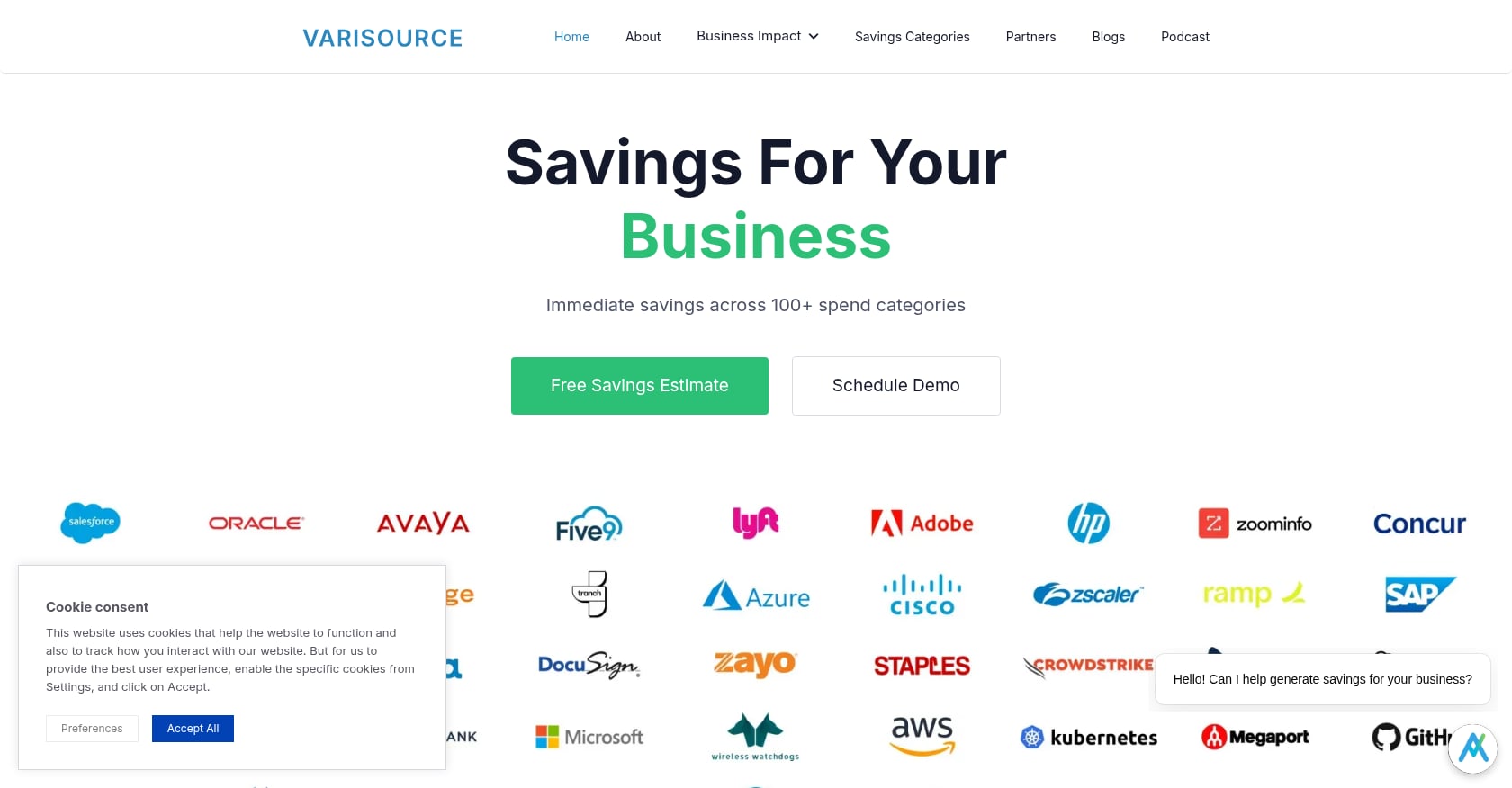
Most SaaS spend management tools stop at software. Varisource takes a fundamentally different approach by treating SaaS as one piece of a much larger indirect spend puzzle. It covers 300+ spend categories, including cloud, telecom, security, hardware, payments, travel, MRO, insurance, and professional services.
The model is built on shared savings, meaning there’s no upfront cost. You only pay when Varisource delivers actual savings. This removes the risk that plagues traditional procurement software purchases where you’re paying $30K or more annually before seeing a dollar of return.
Key Features:
Pricing: No upfront cost. Shared savings model where you pay only when savings are achieved.
Proof Points: 30x ROI, savings in under 30 days, 15% average margin lift, 50M+ data points.
Limitations:
Verdict: Varisource is the strongest choice for organizations that recognize SaaS is just one part of their vendor spend problem. The no-upfront-cost model and fast time-to-value (under 30 days) make it particularly appealing for mid-market companies without dedicated procurement teams. If your spend extends into cloud, telecom, or hardware, nothing else on this list covers that ground.
Request a free savings estimate to see what Varisource can save across your vendor portfolio.
2. Zylo
Best for: Enterprise SaaS portfolio visibility and governance
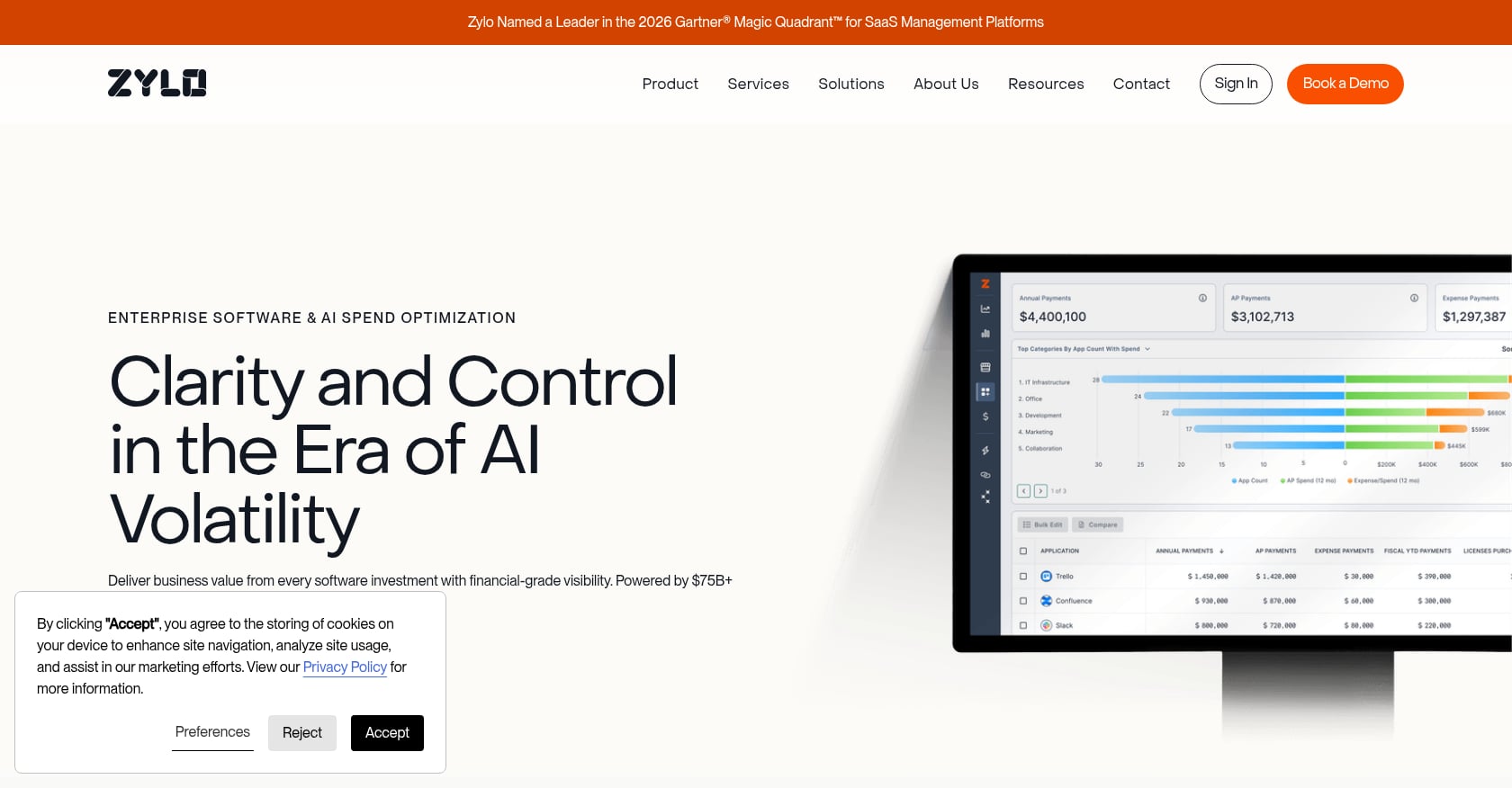
Zylo is the platform most often referenced when people talk about SaaS management at scale. It’s backed by one of the largest datasets in the category: more than 40 million SaaS licenses and $75 billion in managed spend. That data depth gives it genuine authority on what companies should be paying for specific tools.
The platform is built for IT, FinOps, and procurement teams that need a centralized system of record for their entire SaaS portfolio. Its financial discovery engine captures spend across accounts payable and expense data, surfacing applications and costs that would otherwise remain invisible.
Key Features:
Pricing: Quote-based, typically starting at $30,000 per year.
Limitations:
Real User Perspective: Zylo consistently earns strong satisfaction scores among enterprise users on G2 and Gartner Peer Insights, particularly for data depth and portfolio visibility. However, practitioners note that platforms like Zylo are “built for procurement teams and dedicated IT operations staff that most mid-market companies don’t have.”
Verdict: If you’re a large enterprise with a sprawling SaaS portfolio and dedicated procurement staff, Zylo is the gold standard for visibility and governance. But it’s overkill for most mid-market organizations, and it won’t help with your cloud or telecom spend.
3. Vendr
Best for: SaaS-focused negotiation and procurement services
Vendr takes a managed services approach to SaaS procurement. Alongside its software platform, it provides human negotiators who handle vendor conversations on your behalf. The company claims access to $15 billion or more in SaaS pricing data, which its team uses to benchmark deals and push for better terms.
This model works well for companies that lack internal procurement expertise but are spending enough on SaaS to justify the investment.
Key Features:
Pricing: Starts at $35,000 per year for Premium Intelligence and $38,000 per year for Premium Procurement (companies under 250 employees). Organizations managing $10 to $20 million in SaaS spend may pay between $130,500 and $250,500 annually.
Limitations:
Real User Perspective: Vendr gets positive marks for its negotiation support and access to benchmark data. The criticism centers on price and scope limitations.
Verdict: Vendr is a strong option if your spend problem is purely SaaS and you want someone else to handle the negotiations. But at $35K minimum, you need enough SaaS spend to justify the investment, and you won’t get help with anything else in your vendor portfolio.
4. Tropic

Best for: Procurement workflow automation with deep spend intelligence
Tropic differentiates through the depth of its spend data. The platform is built on more than $18 billion in processed spend, and in the first half of 2025 alone it negotiated $362 million in customer spend at an average savings rate of 15.5%.
Beyond negotiation, Tropic offers structured procurement workflows including intake forms, approval routing, and contract management. This makes it a good fit for teams that want both savings execution and process structure.
Key Features:
Pricing: Starts at approximately $3,167 per month. Historical data shows tiers from $10K per year (Supplier Intelligence) up to $22K or more annually (Intelligent Spend Management).
Limitations:
Real User Perspective: G2 reviewers consistently praise the user-friendly interface and responsive support team. The criticism tends to focus on integration limitations at lower price points and occasional gaps in savings delivery.
Verdict: Tropic is a solid choice for teams that want structured procurement workflows alongside negotiation support. The spend data depth is impressive. The main drawback is that it’s SaaS-only and the integrations you probably need may sit behind a paywall.
5. CloudEagle

Best for: AI-powered SaaS governance and identity management
CloudEagle combines SaaS spend management with identity governance, making it particularly appealing for security-conscious IT teams. With over 500 direct integrations, it provides broad visibility into applications, licenses, spend, and vendors. The platform claims to help enterprises reduce software costs by up to 30%.
A standout capability is shadow IT detection. CloudEagle identifies unapproved or unsanctioned SaaS tools in use across the organization, giving IT teams the visibility they need to enforce governance policies.
Key Features:
Pricing: Three editions ranging from $2,000 to $2,500 per month, scaling by employee count.
Limitations:
Real User Perspective: One G2 reviewer noted: “The renewal tracking feature has saved me from unexpected auto-renewals multiple times.” Users generally praise the breadth of integrations.
Verdict: CloudEagle is a strong pick for IT teams that need SaaS governance with identity management built in. The integration depth is genuinely impressive. But if your primary goal is savings (rather than governance), other tools on this list deliver more focused negotiation support.
6. SpendHound

Best for: Budget-conscious teams that need a free starting point
SpendHound’s pricing model makes it unique on this list: it’s free for companies under 1,000 employees. The catch is that your spend data gets de-identified and aggregated to power SpendHound’s benchmarking database. For many small and mid-market companies, that’s a reasonable trade.
The platform combines visibility, pricing benchmarks, vendor intelligence, renewal tracking, and negotiation support in a single system. It’s not the deepest tool on any single dimension, but the breadth at zero cost makes it a compelling starting point.
Key Features:
Pricing: Free for companies under 1,000 employees. $10,000 per year for larger organizations.
Limitations:
Verdict: If you’re a smaller company just getting started with SaaS spend optimization, SpendHound removes the budget barrier entirely. It won’t replace a dedicated procurement tool at scale, but it’s a solid foundation for understanding what you’re spending and where the waste is.
7. Vertice
Best for: Organizations that want to fully outsource vendor negotiations
Vertice takes the managed services model further than most competitors. Rather than just providing data and tools, Vertice’s team participates directly in vendor negotiations, securing savings and managing vendor relationships on your behalf.
The company maintains a database of 16,000+ vendor pricing benchmarks and employs dedicated procurement specialists who handle the negotiation work.
Key Features:
Pricing: Custom, not publicly disclosed. Based on guaranteed annual cost savings with a flat pricing structure.
Limitations:
Verdict: Vertice works well for procurement-led organizations that want to hand off vendor negotiations entirely. The savings guarantee model reduces risk. The downside is that you’re dependent on their team rather than building internal capability, and you won’t get the same visibility into the benchmark data as you would with a self-serve platform.
8. Zluri

Best for: IT-led SaaS governance and identity administration
Zluri positions itself at the intersection of SaaS management and identity governance. It uses nine different discovery methods to find SaaS applications across your organization, making it one of the more thorough options for uncovering shadow IT.
The platform helps IT teams eliminate waste by removing duplicate apps, identifying unused applications, consolidating overlapping tools, and providing insights for license renewals based on actual usage data.
Key Features:
Pricing: From $2.50 per employee per month for the Basic tier (discovery, visibility, renewal tracking). Professional and Enterprise pricing is undisclosed, typically $30K to $80K or more per year at mid-market scale.
Limitations:
Verdict: Zluri is a good fit for IT and security teams at mid-market companies that need visibility plus identity governance. The per-employee pricing makes it accessible at smaller scales. But if your primary goal is saving money through negotiations, you’ll need to pair Zluri with another service or do the work internally.
9. Torii

Best for: Automated SaaS discovery and workflow automation
Torii’s strength is automation. It connects to over 200 integration sources and offers no-code automation for onboarding and offboarding workflows, license reclamation triggers, and spend alerts. For IT teams drowning in manual SaaS management tasks, Torii can eliminate significant operational overhead.
The platform offers a free tier for basic benchmarking, making it accessible for teams that want to test the waters before committing.
Key Features:
Pricing: Free tier available. Paid plans start at approximately $12,000 per year (Platform tier) and scale up to $120,000 or more for full managed services.
Limitations:
Verdict: Torii is the strongest choice for IT teams that want to automate SaaS lifecycle management without complex configuration. The free tier is a nice on-ramp. But the tight renewal windows and limited negotiation support mean you’ll likely need another tool or service to actually save money on your renewals.
10. Productiv
Best for: Deep application usage analytics at the feature level
Productiv’s differentiation is specific and meaningful. While most SaaS management tools tell you whether an employee logged in, Productiv tracks actual feature usage, distinguishing between someone who opened a tool and someone who actively used it. For companies making decisions about expensive enterprise software like Salesforce, Workday, or ServiceNow, this granularity can justify or prevent six-figure purchasing decisions.
Key Features:
Pricing: Quote-based. Enterprise focused with no published pricing.
Limitations:
Verdict: Productiv is worth considering if you’re spending millions on a few large enterprise platforms and need to understand actual adoption before making renewal or expansion decisions. It’s not a spend management tool in the traditional sense. Think of it as the scalpel you use alongside a broader platform.
How These Categories Actually Differ
Not all SaaS spend management tools solve the same problem. Understanding the category distinctions helps you avoid buying the wrong solution.
SaaS management platforms (Zylo, Zluri) focus on discovery, visibility, and governance. They tell you what you have, who’s using it, and whether licenses are being wasted. They’re built for IT teams managing large portfolios.
SaaS procurement and negotiation services (Vendr, Tropic, Vertice) go beyond visibility to actually execute purchases and renewals on your behalf. They employ negotiators and maintain pricing databases. They’re built for companies that want savings without adding headcount.
Spend visibility tools (SpendHound, Torii) emphasize discovery and tracking. They give you data and dashboards but leave the action to you. They’re the most affordable starting point.
Full indirect spend savings programs (Varisource) treat SaaS as one category among many. This distinction matters because indirect spend on cloud infrastructure, telecom, hardware, and payments often exceeds SaaS spend. No other tool on this list covers that ground.
The practical implication: if your company’s spend challenges extend beyond software, a SaaS-only tool gives you a partial solution. Practitioners on Reddit’s r/ITManagers thread (which Google ranks on the first page for this query) consistently emphasize that the critical factor is whether a tool “actually saves money” versus just providing visibility. Several users express fatigue with tools that turn out to be “just another spreadsheet.”
Many organizations find the most practical approach is pairing a visibility tool with a savings execution service, or choosing a platform like Varisource that combines both across a wider set of vendor categories.
Frequently Asked Questions
What is SaaS spend management software?
SaaS spend management software helps organizations discover, track, optimize, and reduce spending on cloud-based software subscriptions. Most platforms provide some combination of application discovery, license utilization analysis, renewal tracking, pricing benchmarks, and negotiation support. The category ranges from free visibility tools to full-service procurement platforms.
How much does SaaS spend management software cost?
Pricing varies dramatically. SpendHound is free for companies under 1,000 employees. Zluri starts at $2.50 per employee per month. Mid-range platforms like Torii and CloudEagle run $12,000 to $30,000 per year. Enterprise tools like Zylo and Vendr typically start at $30,000 to $35,000 annually and scale up from there. Varisource uses a shared savings model with no upfront cost, meaning you only pay when savings are delivered.
When should I start preparing for a SaaS renewal?
At minimum, 90 days before the renewal date. Ideally 120 days. This gives you time to gather usage data, benchmark pricing, evaluate alternatives, and approach the vendor from a position of informed negotiation. Tools with 30-day alert windows (like Torii’s default) don’t provide enough lead time for meaningful renegotiation. A proper SaaS management strategy should build renewal preparation into your quarterly planning cadence.
Can SaaS spend management tools help with non-software vendors?
Most cannot. The majority of tools on this list focus exclusively on SaaS. Varisource is the notable exception, covering 100+ indirect spend categories including cloud infrastructure, telecom, hardware, payments, insurance, and professional services. If your vendor spend extends beyond software, explore broader cost reduction strategies or choose a platform designed for full indirect spend.
How do I evaluate the quality of a tool’s benchmark data?
Ask three questions: How many actual transactions back the benchmarks for your specific vendors? How recent is the data? Does it cover your company’s size tier and industry? Tools that rely on list prices or small sample sizes produce misleading benchmarks. Platforms like Zylo (40M licenses, $75B spend), Varisource (50M+ data points), and Tropic ($18B+ processed spend) have the most credible data sets in the market.
Do I need a dedicated team to manage these tools?
It depends on the model. Self-serve platforms like Zylo, Zluri, and Torii require internal staff to interpret data and take action. Managed services like Vendr and Vertice handle negotiations but typically assume you have someone internally to manage the relationship, which practitioners estimate costs $15,000 to $30,000 per year in dedicated time. Done-for-you models like Varisource minimize the internal resource requirement by combining AI-powered tools with human execution.
What’s the typical ROI timeline for SaaS spend management software?
Most organizations report measurable savings within 3 to 12 months, depending on the tool and their existing spend profile. Platforms with faster implementation (Varisource claims under 30 days to savings) deliver ROI sooner. Enterprise platforms like Zylo may take longer to deploy but can uncover significant waste in large portfolios. The typical range is a 20 to 30% reduction in SaaS spend within the first year.
See what Varisource can save for your team, with no upfront cost and savings typically delivered in under 30 days.
About the Author
.jpeg)
Victor Hou
Victor Hou is the founder of Varisource, the first ever Savings Automation Platform that automates Savings for Your Business. Victor helps companies access discounts, rebates, benchmark data, savings for renewals and new purchases across 100+ spend categories automatically to increase your company's margins and equity value by at least 15-20%. Victor is active and passionate about using AI + automation to help your business save time, money and run more efficiently.
%201.svg)

Varisource’s Savings Automation Platform guarantees savings and maximized leverage on every dollar spend across 100+ spend categories


