How to Reduce Vendor Costs Without Cutting a Single Service
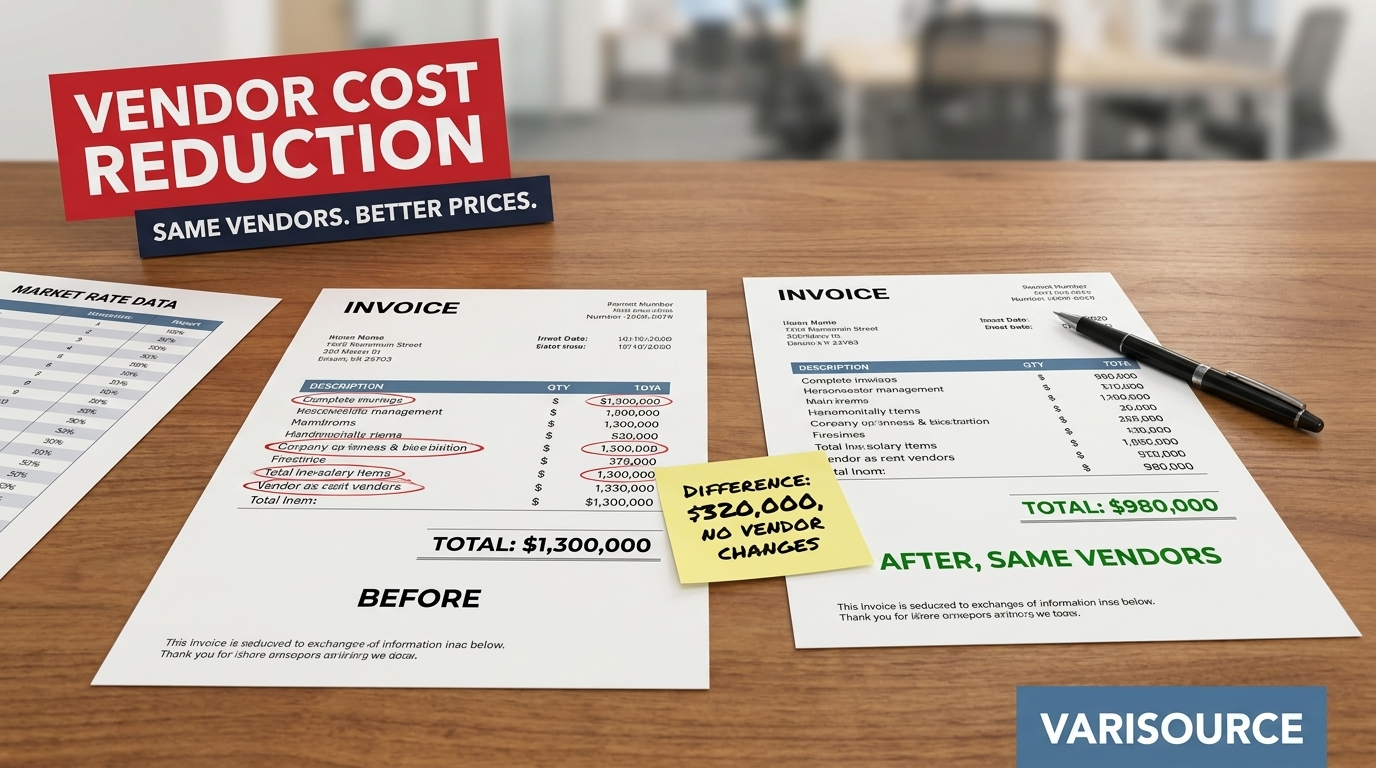
Most vendor cost reduction does not require cutting services or switching providers. It requires better timing, real pricing data, and a system that runs continuously rather than reactively. The six approaches here consistently produce 8 to 15 percent savings on managed vendor spend in year one. None require adding headcount or changing how the business operates.
Why Are Companies Overpaying Their Vendors Right Now?
Vertice's 2025 research found that 9 in 10 companies overpay their vendors by an average of 26 percent. Not from a single bad decision. From a pattern: contracts signed years ago at rates that made sense then, auto-renewing every year with built-in price increases, benchmarked against nothing except what the vendor asks for.
The vendor side of the equation does not work this way. Your software vendor knows exactly what every other company pays for the same service. Their sales team has that data. Their renewal team uses it. The information asymmetry, the fact that vendors have complete market pricing data and most buyers have only last year's invoice, is the entire reason the 26 percent gap exists. It is not dishonesty. It is a structural advantage that compounds quietly until someone decides to look at the numbers.
Here is how to look at the numbers, and what to do about what you find.
How Do You Actually Reduce Vendor Costs? Six Approaches That Work
1. Get real benchmark data before any renewal conversation. The most useful thing you can have in a vendor negotiation is a specific number: what comparable companies actually pay that vendor for the same service, right now. Not the vendor's published rate card, which typically runs 20 to 40 percent above what buyers negotiate. Not a survey estimate from 18 months ago. Real contract data at the vendor level. When you can say "our research shows companies our size pay $X for this service and we'd like to get our contract to that level," you have converted a subjective pricing complaint into a fact-based negotiating position. Vendors respond to those very differently.
2. Start every renewal 90 days early, not 30. The window in most software contracts is 30 to 90 days before expiration. Miss it and the contract auto-renews. Wait until 30 days and there is no time to get alternatives, run benchmarks, or credibly threaten to switch. At 90 days, you have all three. Proactive renewal processes reduce contract costs by 5 to 15 percent annually compared to reactive approaches, per multiple 2024 to 2025 procurement studies. This single timing change, applied consistently, is worth hundreds of thousands of dollars per year on a $5 million spend base.
3. Audit license utilization before you talk price. Zylo's 2026 SaaS Management Index puts average software license utilization at 54 percent. Nearly half of purchased licenses in the average company are unused or underused. Before any renewal conversation, find out what you are actually using: active users, features accessed, login frequency in the last 90 days. That data gives you the right-sizing case before the price case. You are not asking for charity. You are asking to pay for what you use.
4. Consolidate where you are fragmented. The average organization runs 305 SaaS applications across dozens of overlapping categories. Video conferencing, project management, CRM tools, security platforms, all with multiple products doing the same job in different departments. Each vendor sees a small account and prices accordingly. Consolidating similar categories into fewer vendors creates volume. Volume creates leverage. Research consistently shows 10 to 15 percent savings in consolidated categories, plus the secondary benefit of fewer contracts to manage.
5. Collect the rebates you are already owed. Most companies leave a significant amount of rebate money uncollected every year because nobody has a system to track it. Enable.com found that 4 percent of all eligible rebate money goes unclaimed annually. On a $5 million spend base that is $200,000 per year. Rebates are available across software, cloud, telecom, Microsoft licensing, managed services, internet, and HR platforms, the same categories you are already paying for every month. They do not require negotiating anything new. They require a tracking system and a submission process.
6. Use group buying power to access pricing you cannot reach alone. Most mid-market companies cannot individually reach the pricing tiers that large enterprises unlock. Group purchasing programs pool spend across many companies so every member accesses pricing built on collective volume, regardless of their own size. The Hackett Group's 2024 research found that 56 percent of companies now use group purchasing tools. For a company spending $2 million annually on software, a 15 percent group discount is $300,000 back to the business on purchases it was already going to make.
What Is the Fastest Way to Start Reducing Vendor Costs?
The fastest path is an AP spend file analysis against real market benchmark data. Share your vendor spend file, and within 48 hours you have a category-by-category view of where your pricing is above market, where rebates are available, and where renewals are approaching the leverage window. That analysis tells you exactly where to start and how much is available.
The Varisource Savings Program delivers this analysis for free, covers 300-plus spend categories with vendor-level benchmark data from 50M-plus real contract data points, and operates on a shared-savings model with no upfront cost.
See the procurement metrics and benchmarks that matter most.
Read more in the Spend Value Tips series at Varisource Blogs.
Frequently Asked Questions
How much can a company realistically reduce vendor costs?
Companies implementing structured vendor cost reduction programs for the first time typically see 8 to 12 percent savings on managed spend in year one, per Hackett Group and Ardent Partners research. The range depends on how long the portfolio has been unreviewed and how far above market current pricing sits. Portfolios that have never been benchmarked often find larger gaps.
Does reducing vendor costs require switching vendors?
No. The majority of savings come from improving pricing, right-sizing utilization, and capturing rebates with existing vendors. Switching is occasionally the right outcome, but it is not required for most vendor cost reduction. The goal is fair pricing, not disruption.
What is the single most impactful change a company can make to reduce vendor costs?
Getting real vendor-level benchmark data before any renewal conversation. Once you know what comparable companies pay the same vendor for the same service, every subsequent step, right-sizing the ask, setting the opening position, evaluating the vendor's counter, gets dramatically easier and more effective.
About the Author
.jpeg)
Victor Hou
Victor Hou is the founder of Varisource, the first ever Savings Automation Platform that automates Savings for Your Business. Victor helps companies access discounts, rebates, benchmark data, savings for renewals and new purchases across 100+ spend categories automatically to increase your company's margins and equity value by at least 15-20%. Victor is active and passionate about using AI + automation to help your business save time, money and run more efficiently.
%201.svg)

Varisource’s Savings Automation Platform guarantees savings and maximized leverage on every dollar spend across 100+ spend categories


