Procurement Spend Analysis: 2026 Guide + 6 Key Steps

Procurement spend analysis is the process of collecting, cleansing, classifying, and analyzing purchasing data to understand where an organization’s money goes, who it goes to, and what to do about it. Done well, it typically reveals 5 to 15% in savings opportunities and brings visibility to the roughly 29% of enterprise spend that procurement teams still don’t manage. It is now the number one use case for generative AI in procurement, with over 53% of CPOs prioritizing it for AI investment.
Key Takeaway: What is Procurement Spend Analysis? Procurement spend analysis is the systematic process of identifying, gathering, cleansing, grouping, and analyzing an organization's expenditure data. Its primary goal is to reduce procurement costs, improve efficiency, and ensure contract compliance. By answering the "who, what, where, when, and why" of corporate spending, organizations typically uncover 5% to 15% in bottom-line savings.
What Is Procurement Spend Analysis?
Procurement spend analysis is not a software feature, and it is not a one-time audit. It is an ongoing discipline: the systematic process of collecting, cleansing, classifying, and analyzing organizational purchasing data to answer a handful of deceptively simple questions.
What are we buying? How much did we pay? How much did we buy? Who are we buying from? Who is buying? On what terms?
Those six questions sound basic. In practice, answering them accurately across a mid-size or large organization is remarkably difficult. Data lives in multiple ERPs, accounts payable systems, corporate cards, expense reports, and spreadsheets that nobody maintains. Suppliers show up under different names in different systems. Categories overlap or don’t exist at all.
The goal of spend analysis is to cut through that mess and give procurement, finance, and operations leaders a clear picture of spending patterns so they can make better decisions, whether that means consolidating suppliers, enforcing contract compliance, or simply stopping the bleeding on categories nobody was watching.
Procurement Spend Analysis vs. Related Terms
One of the biggest sources of confusion is the cluster of similar-sounding terms that orbit this topic. Here is how they actually differ.
Term
What It Means
Key Difference
Spend analysis
Collecting, cleansing, categorizing, and evaluating spend data to uncover insights
The analytical foundation
Spend management
The broader strategy and practices for controlling organizational spending
Uses spend analysis as an input; covers policy, process, and execution
Spend analytics
Applying AI, machine learning, and statistical models to spend data for prediction and automation
Adds forecasting and prescriptive recommendations on top of analysis
Spend reporting
Generating backward-looking summaries of what was spent
Descriptive only (“here’s what happened”), no interpretation
Cost analysis
Evaluating the expenses of a specific product, service, or decision
Narrow focus; spend analysis examines company-wide purchasing patterns
The practical implication: organizations that confuse spend reporting with spend analysis often think they have visibility when they actually just have dashboards nobody acts on. Reporting tells you what happened. Analysis tells you what it means. Analytics tells you what to do next. If you want to understand how spend management drives business growth, the distinction matters more than it seems.
Why Procurement Spend Analysis Matters

The business case for procurement spend analysis is not theoretical. The numbers are large and well documented.
It Reveals Real Savings
Spend analysis typically uncovers 5 to 15% in savings opportunities through supplier consolidation, contract compliance enforcement, demand management, and rate benchmarking. For an organization with $100 million in annual spend, the low end of that range is $5 million.
Top-performing companies with spend analysis capabilities see a 24.4% increase in spend management visibility, which translates directly into better negotiation leverage and reduced waste.
The Visibility Gap Is Enormous
On average, procurement teams now manage about 71% of total enterprise spend, the highest figure in two decades of Ardent Partners research. That sounds good until you consider the other side: 29% of spend remains unmanaged. Every additional dollar brought under procurement management yields 6 to 12% in savings during the initial contract period.
Best-in-class teams achieve 91.7% spend under management versus 61.1% for all others. That gap represents millions of dollars in unrealized savings for most companies.
Off-Contract Spending Is Rampant
Research consistently shows that 20 to 40% of enterprise spend occurs off-contract. Employees buying outside approved channels, auto-renewals that skip procurement review, departments going directly to vendors without checking existing agreements. Without spend analysis, you cannot even see this happening, let alone fix it.
Indirect Spend Is the Hidden Majority
Indirect expenses (everything not tied directly to production, including SaaS, IT, telecom, facilities, travel, and professional services) typically account for 40 to 60% of total organizational spend. Yet these categories are rarely monitored with the same discipline as direct materials. This is where the biggest untapped savings tend to live. For a deeper look at this category, see our indirect spend analysis guide.
For organizations struggling with indirect spend visibility, exploring how Varisource supports procurement teams can show what a service-based approach looks like in practice, covering 100+ indirect spend categories with benchmark data and negotiation support.
Types of Procurement Spend Analysis
Not all spend analysis is the same. The type you run depends on the questions you need answered and the maturity of your data and tools.
Descriptive Analysis
What happened? This is the most common starting point. Historical dashboards showing spend by category, supplier, business unit, or region. Most organizations live here.
Diagnostic Analysis
Why did it happen? Root-cause investigation into anomalies, such as why a particular category spiked 30% quarter over quarter, or why one business unit pays significantly more than another for the same service.
Predictive Analysis
What is likely to happen? Machine learning models that forecast demand patterns, price trends, supplier risk, and budget overruns before they materialize.
Prescriptive Analysis
What should we do about it? AI-driven recommendations to consolidate suppliers, renegotiate specific contracts, switch vendors, or adjust purchasing timing. This is where AI procurement tools add the most value.
Comparative/Benchmark Analysis
How do we stack up? Comparing your pricing, terms, and supplier mix against peers and market rates. Without external benchmarks, you can only measure against yourself, which limits the insights you can generate.
Most teams operate at the descriptive and diagnostic levels. The shift toward predictive and prescriptive analysis is where AI is making the biggest impact, and where the gap between leaders and laggards is widening fastest.
The Procurement Spend Analysis Process, Step by Step
The textbook version of spend analysis follows a clean, linear process. Reality is messier, but the framework holds.
Step 1: Define Scope and Objectives
Start with specifics. What time period are you analyzing? Which business units? Which categories? What questions need answers? “Analyze all our spend” is not a useful objective. “Identify the top 10 categories where we’re paying above market rate” is.
Step 2: Collect and Consolidate Data
Pull data from every relevant source: ERP systems, accounts payable, corporate cards, expense management tools, and yes, spreadsheets. The goal is a single, unified dataset sometimes called a “spend cube” that captures supplier, category, amount, date, business unit, and contract information. For guidance on building this foundation, our spend data management overview covers the key principles.
Dimension
Data Point Examples
Strategic Value
Who (Suppliers)
Parent companies, subsidiaries, diversity status
Identify supplier consolidation opportunities.
What (Categories)
IT, Professional Services, MRO, SaaS
Track category-specific inflation and price variances.
Where (Units)
Business units, departments, regions
Eliminate "Maverick Spend" and internal price silos.
Step 3: Cleanse and Normalize
This is where projects stall. “IBM Corp,” “I.B.M.,” “International Business Machines,” and “IBM” are all the same supplier, but your systems don’t know that. Parent-child relationships need resolution. Formats need standardization. Duplicates need elimination.
Sievo, a firm with two decades of procurement data experience, warns that “master data is a mess, and vendor registries are out of control” at most organizations. Analysts commonly spend 80% of their time on data preparation rather than actual analysis. This is not an exaggeration; it is the norm.
Step 4: Classify and Categorize
Map every transaction to a taxonomy, whether UNSPSC (the most common standard), a custom framework, or something industry-specific. Classification should be multi-level: Category, then Subcategory, then item or SKU. Without consistent classification, you cannot compare spend across business units or time periods.
Step 5: Analyze and Segment
Now you can actually analyze. Slice spending by supplier, category, geography, business unit, cost center, or contract status. Look for concentration risks, pricing outliers, redundant suppliers, and compliance gaps. This is where the six core questions from the definition section get answered.
Step 6: Report, Act, and Repeat
Analysis without action is expensive trivia. Build dashboards, generate recommendations, assign owners, and set timelines. Then do it again next quarter. Procurement spend analysis is a cycle, not a project.
Key KPIs to Track
The metrics that matter most in spend analysis fall into a few categories.
Spend under management (SUM): The percentage of total spend actively managed through procurement processes, contracts, and approved suppliers. A higher ratio indicates better control and alignment with financial planning. The current average is 71%; best-in-class organizations hit 91.7%.
Cost savings vs. cost avoidance: Hard savings reduce actual outlays. Cost avoidance prevents future spending increases. Both matter, but they are tracked differently and reported to different stakeholders. Our breakdown of cost savings vs. cost avoidance explains the distinction in detail.
Contract compliance rate: What percentage of spend flows through pre-approved suppliers and contracts? Low compliance means you are leaking value even when good contracts exist.
Maverick spend rate: The inverse of compliance. Spending that happens outside approved channels, often driven by employees going directly to vendors or using personal accounts for business purchases.
Purchase price variance (PPV): The difference between what you actually paid and what your contract or benchmark says you should have paid. A reliable indicator of negotiation effectiveness and contract enforcement.
Supplier concentration: How dependent are you on your top vendors? The Pareto principle applies here: 80% of spend typically flows through 20% of suppliers. That concentration creates risk.
Savings as a percentage of spend: The simplest measure of procurement effectiveness. Top performers achieve 8.1% or higher on addressable spend.
Common Challenges (and How to Overcome Them)
Every guide lists the process steps. Fewer are honest about why most organizations still struggle to execute them.
Dirty, Fragmented Data
This is the number one barrier, and it is not close. Data scattered across ERPs, AP systems, corporate cards, and spreadsheets creates a puzzle that takes months to assemble manually. BT Group, for example, manages 10,000+ suppliers across 35 to 40 ERP systems. Most mid-market companies face a scaled-down version of the same problem.
The fix: Don’t wait for perfect data. Start with accounts payable data (it is the most complete source) and iterate. Perfect is the enemy of useful.
Lack of Standardized Taxonomy
Without consistent classification, you cannot compare spending across business units, time periods, or geographies. Two divisions might both buy “consulting services” but classify them differently, making consolidation invisible.
The fix: Pick a taxonomy (UNSPSC is the default) and commit to it. Even a rough first pass beats none.
Stakeholder Resistance
Departments resist central visibility into “their” spend. This is political, not technical, and it kills more spend analysis initiatives than bad data does.
The fix: Lead with what is in it for them. Show business unit leaders how spend analysis helps them get better pricing and faster approvals, not just how it lets procurement police their purchases.
One-and-Done Mentality
Treating procurement spend analysis as a project rather than an ongoing capability guarantees that insights go stale and savings evaporate.
The fix: Build spend analysis into quarterly business reviews and tie it to KPIs that someone owns.
Tool Overload Without Action
Having dashboards does not mean savings happen. While 85% of procurement leaders express optimism about AI’s potential efficiency gains, 61% of procurement teams have yet to implement AI into their workflows. The gap between buying tools and using them effectively is where billions of dollars in potential savings disappear.
How to Implement AI in Spend Analysis (2026 Strategy)
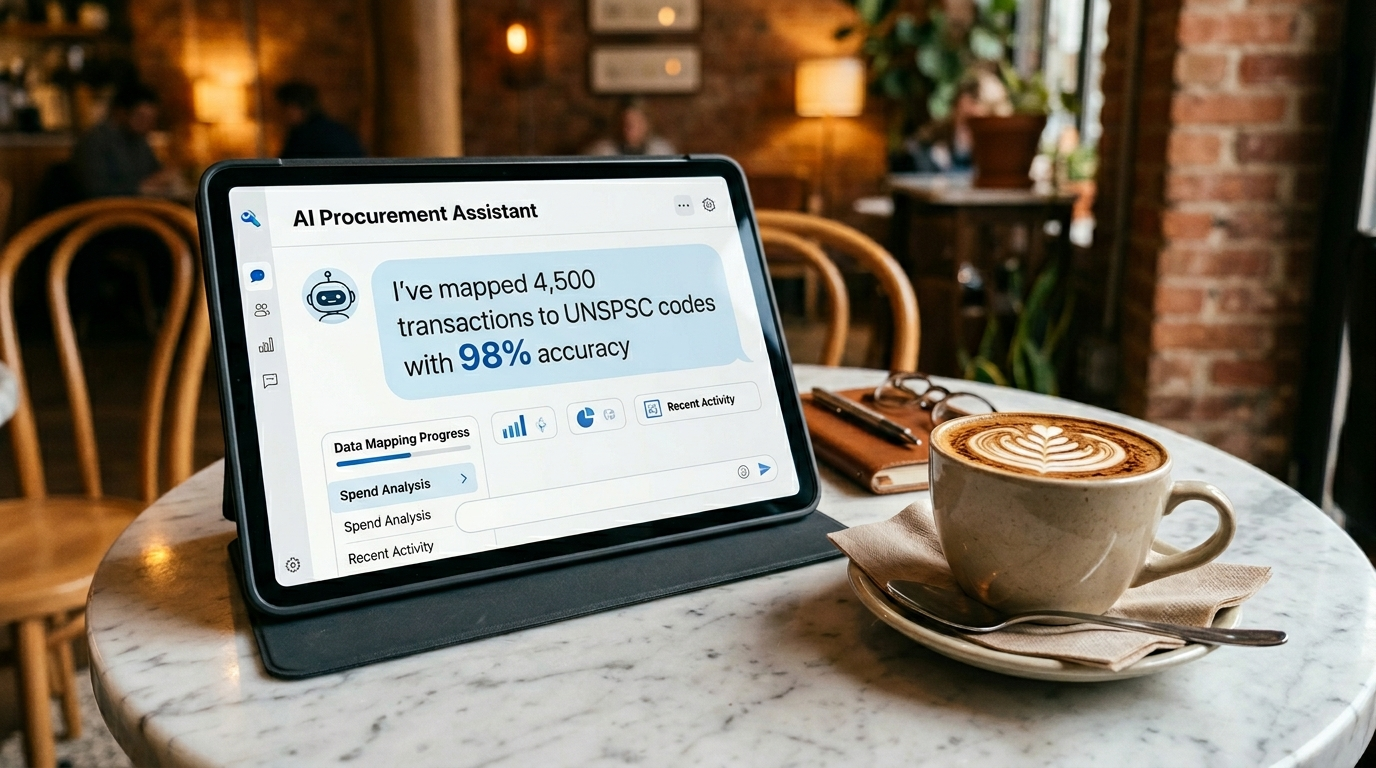
To move from descriptive reporting to prescriptive AI analytics, follow this three-tier maturity model:
- Automated Classification: Use LLMs to map messy line-item descriptions to UNSPSC codes with >95% accuracy.
- Predictive Risk Guardrails: Deploy agentic AI to monitor global supply chain news against your supplier list to predict price volatility.
- Autonomous Sourcing: Link spend analysis insights to automated RFPs for low-complexity categories (the "tail spend").
The Role of AI in Procurement Spend Analysis
Spend analysis is, according to the Deloitte 2025 Global CPO Survey, the number one use case for generative AI in procurement, cited by 53.44% of CPOs. That is ahead of RFP/RFQ generation (42.33%) and contract summarization (41.27%).
The reasons are practical. AI accelerates the parts of spend analysis that are most painful and time-consuming:
- Data cleansing and normalization: Automatically resolving duplicate suppliers, standardizing formats, and building parent-child hierarchies
- Auto-classification: Mapping transactions to taxonomy categories without manual review
- Anomaly detection: Flagging unusual spending patterns, price spikes, or compliance violations in real time
- Benchmark comparisons: Matching internal pricing against market data at the SKU level
- Prescriptive recommendations: Suggesting specific actions (consolidate, renegotiate, switch) based on pattern analysis
Organizations that implement intelligent spend analysis report up to 90% reduction in time spent on manual data preparation. McKinsey estimates 25 to 40% efficiency improvement potential from agentic AI in procurement more broadly.
Yet adoption lags behind enthusiasm. The EY 2025 Global CPO Survey found that 80% of CPOs plan to deploy generative AI over the next three years, but only 36% currently have meaningful implementations. The window for early-mover advantage is still open.
Expert Tip: The 80/20 Rule in Spend Analysis Most organizations find that 80% of their savings come from just 20% of their categories. When starting, ignore the "Tail Spend" (the thousands of small transactions) and focus on your top 5 indirect categories: SaaS, Telecom, Travel, Professional Services, and Utilities.
Direct vs. Indirect Spend Analysis
Direct spend covers raw materials, components, and anything tied directly to producing what a company sells. These categories are usually well-managed because they are visible, high-volume, and directly connected to cost of goods sold.
Indirect spend covers everything else: SaaS subscriptions, cloud infrastructure, telecom, office supplies, professional services, insurance, travel, MRO, and hundreds of other categories. According to Zycus, indirect spend represents roughly 45% of total organizational spending, and top-performing teams can expect cost savings between 20% and 40% in these categories.
The challenge is that indirect spend is fragmented across more vendors, more stakeholders, and more systems than direct spend. A manufacturing company might have 50 direct material suppliers and 2,000 indirect vendors. Nobody owns the full picture.
This fragmentation is exactly why indirect categories represent the biggest opportunity. When practitioners on forums and procurement communities discuss where they find “easy wins,” indirect spend categories like software renewals, telecom contracts, and payment processing fees come up repeatedly. The savings are there; the problem is that nobody was looking.
For organizations looking to gain visibility into indirect spend across 100+ categories, a benchmark-driven approach that compares pricing against market data can surface savings in weeks rather than months.
How to Get Started
Procurement spend analysis does not require a six-figure software implementation to begin. Here is a practical path.
Start with AP data. Your accounts payable file is the fastest, most complete data source available. It captures most organizational spending by default. Pull 12 months of AP data and you have a working foundation.
Focus on your top 20 suppliers first. The Pareto principle holds: 80% of spend typically flows through 20% of vendors. Analyzing your top 20 suppliers will cover the majority of your spending and produce the fastest insights.
Don’t wait for perfect data. Start with “good enough” and iterate. Every round of analysis improves data quality for the next round. Organizations that insist on perfect data before beginning never begin.
Set a specific goal. “Do spend analysis” is not a goal. “Identify $500K in addressable savings within 90 days” is. Specificity creates accountability and makes the business case tangible.
Consider a service-based approach. Not every organization needs to build a full spend analysis capability in-house. For faster results (particularly on indirect spend), working with a partner that provides benchmarks, negotiation support, and proven cost reduction strategies can deliver savings in under 30 days without the overhead of deploying and maintaining procurement software.
Practitioners surveyed by Procurato and SpendQube, including procurement directors at FTSE 100 and Fortune 500 firms, emphasize developing comprehensive categorization, consolidating and cleansing data, evaluating contract compliance, and monitoring market benchmarks as the highest-impact practices. Start there.
If you want a concrete starting point, Varisource’s free Savings Estimate Report turns an AP file into actionable benchmarks and savings opportunities, typically delivered within 48 hours.
Frequently Asked Questions
What is procurement spend analysis?
Procurement spend analysis is the process of collecting, cleansing, classifying, and analyzing organizational purchasing data to understand where money goes, who it goes to, and what to do about it. It answers questions about what is being bought, how much is paid, who the suppliers are, and whether purchases align with contracts and policies.
What is the difference between spend analysis and spend management?
Spend analysis is the analytical process of examining purchasing data to uncover patterns and savings opportunities. Spend management is the broader strategy for controlling organizational spending, including policies, approvals, supplier management, and contract enforcement. Spend management depends on the insights that spend analysis generates.
How much can procurement spend analysis save?
Spend analysis typically reveals 5 to 15% in savings opportunities on analyzed spend. Additionally, every dollar of previously unmanaged spend brought under procurement control yields 6 to 12% in savings during the initial contract period. For most organizations, this translates to millions of dollars annually.
What is a spend cube?
A spend cube is a unified dataset that consolidates purchasing data from multiple sources (ERP, AP, corporate cards, expense systems) into a single, analyzable structure. It typically organizes data across three dimensions: supplier, category, and business unit or cost center.
What is maverick spend?
Maverick spend is purchasing that occurs outside approved channels, contracts, or suppliers. It bypasses procurement policies and typically results in higher prices, compliance risks, and lost volume discounts. Research shows 20 to 40% of enterprise spend occurs off-contract.
How does AI help with spend analysis?
AI automates the most time-consuming parts of spend analysis: data cleansing, supplier deduplication, transaction classification, anomaly detection, and benchmark comparison. Organizations using AI-powered spend analysis report up to 90% reduction in manual data preparation time. Spend analytics is the top generative AI use case in procurement, cited by over 53% of CPOs.
What is spend under management?
Spend under management (SUM) is the percentage of total organizational spend that is actively managed through procurement processes, contracts, and approved suppliers. The current industry average is 71%, while best-in-class organizations achieve 91.7%.
Why does spend analysis fail?
The most common reasons are poor data quality, lack of standardized classification, stakeholder resistance to transparency, and treating analysis as a one-time project rather than an ongoing process. Analysts often spend 80% of their time preparing data, leaving little capacity for the analysis that actually produces insights and savings.
{
"@context": "https://schema.org",
"@type": "FAQPage",
"@id": "#faq",
"mainEntity": [
{
"@type": "Question",
"@id": "#faq-question-1",
"name": "What is procurement spend analysis?",
"acceptedAnswer": {
"@type": "Answer",
"text": "Procurement spend analysis is the process of collecting, cleansing, classifying, and analyzing organizational purchasing data to understand where money goes, who it goes to, and what to do about it. It answers questions about what is being bought, how much is paid, who the suppliers are, and whether purchases align with contracts and policies."
}
},
{
"@type": "Question",
"@id": "#faq-question-2",
"name": "What is the difference between spend analysis and spend management?",
"acceptedAnswer": {
"@type": "Answer",
"text": "Spend analysis is the analytical process of examining purchasing data to uncover patterns and savings opportunities. Spend management is the broader strategy for controlling organizational spending, including policies, approvals, supplier management, and contract enforcement. Spend management depends on the insights that spend analysis generates."
}
},
{
"@type": "Question",
"@id": "#faq-question-3",
"name": "How much can procurement spend analysis save?",
"acceptedAnswer": {
"@type": "Answer",
"text": "Spend analysis typically reveals 5 to 15% in savings opportunities on analyzed spend. Additionally, every dollar of previously unmanaged spend brought under procurement control yields 6 to 12% in savings during the initial contract period. For most organizations, this translates to millions of dollars annually."
}
},
{
"@type": "Question",
"@id": "#faq-question-4",
"name": "What is a spend cube?",
"acceptedAnswer": {
"@type": "Answer",
"text": "A spend cube is a unified dataset that consolidates purchasing data from multiple sources (ERP, AP, corporate cards, expense systems) into a single, analyzable structure. It typically organizes data across three dimensions: supplier, category, and business unit or cost center."
}
},
{
"@type": "Question",
"@id": "#faq-question-5",
"name": "What is maverick spend?",
"acceptedAnswer": {
"@type": "Answer",
"text": "Maverick spend is purchasing that occurs outside approved channels, contracts, or suppliers. It bypasses procurement policies and typically results in higher prices, compliance risks, and lost volume discounts. Research shows 20 to 40% of enterprise spend occurs off-contract."
}
},
{
"@type": "Question",
"@id": "#faq-question-6",
"name": "How does AI help with spend analysis?",
"acceptedAnswer": {
"@type": "Answer",
"text": "AI automates the most time-consuming parts of spend analysis: data cleansing, supplier deduplication, transaction classification, anomaly detection, and benchmark comparison. Organizations using AI-powered spend analysis report up to 90% reduction in manual data preparation time. Spend analytics is the top generative AI use case in procurement, cited by over 53% of CPOs."
}
},
{
"@type": "Question",
"@id": "#faq-question-7",
"name": "What is spend under management?",
"acceptedAnswer": {
"@type": "Answer",
"text": "Spend under management (SUM) is the percentage of total organizational spend that is actively managed through procurement processes, contracts, and approved suppliers. The current industry average is 71%, while best-in-class organizations achieve 91.7%."
}
},
{
"@type": "Question",
"@id": "#faq-question-8",
"name": "Why does spend analysis fail?",
"acceptedAnswer": {
"@type": "Answer",
"text": "The most common reasons are poor data quality, lack of standardized classification, stakeholder resistance to transparency, and treating analysis as a one-time project rather than an ongoing process. Analysts often spend 80% of their time preparing data, leaving little capacity for the analysis that actually produces insights and savings."
}
}
]
}
About the Author
.jpeg)
Victor Hou
Victor Hou is the founder of Varisource, the first ever Savings Automation Platform that automates Savings for Your Business. Victor helps companies access discounts, rebates, benchmark data, savings for renewals and new purchases across 100+ spend categories automatically to increase your company's margins and equity value by at least 15-20%. Victor is active and passionate about using AI + automation to help your business save time, money and run more efficiently.
%201.svg)

Varisource’s Savings Automation Platform guarantees savings and maximized leverage on every dollar spend across 100+ spend categories


