Indirect Spend Analysis: 2026 Guide to Hidden Savings

In the world of procurement, it’s easy to focus on the big ticket items, the direct costs that go into creating your product. But what about the thousands of other purchases that keep your business running? We’re talking about everything from software subscriptions and office supplies to marketing services and utility bills. This is your indirect spend. Indirect spend analysis is the process of systematically gathering, cleansing, and categorizing this data to find hidden savings, improve efficiency, and reduce risk. For many companies, it’s a goldmine waiting to be discovered.
This comprehensive guide will walk you through every critical concept you need to know. We’ll break down the entire lifecycle, from gathering messy data to generating real time insights that boost your bottom line. Let’s dive in and explore how a thorough indirect spend analysis can transform your operational costs from a necessary evil into a strategic advantage.
is designed to be the "Direct Answer" that Google scrapes for the top of the search results.
Quick Takeaway: What is Indirect Spend Analysis?
Indirect spend analysis is the systematic process of collecting, categorizing, and auditing expenses on non-production goods and services (e.g., IT, marketing, utilities). In 2026, organizations using AI-driven analysis typically achieve:
Initial Cost Reduction: 15% – 25% within the first 12 months.
Maverick Spend Reduction: Up to 30% through improved visibility.
Process Efficiency: 80% reduction in data cleansing time via automation. The Goal: To transform fragmented "shadow spending" into a consolidated, strategic advantage.
What is Indirect Spend?
Indirect spend includes all the goods and services a company buys that are not directly part of its final product. Think of it as the operational spending required to keep the lights on and the business functioning. This includes categories like IT hardware and software, marketing agencies, professional services, travel, and facilities maintenance. For a broader view, explore our savings categories.
While direct spend (like raw materials for a manufacturer) gets a lot of attention, indirect spend is a huge piece of the puzzle, often making up 20% to 30% of a company’s total costs. Historically, it has been managed less rigorously, which means it’s frequently an area filled with waste and missed opportunities for savings.
Direct Spend vs. Indirect Spend: At a Glance
Feature
Direct Spend
Indirect Spend
Definition
Raw materials & goods for production.
Goods/services for daily operations.
Examples
Steel, components, specialized labor.
SaaS, office supplies, travel, utilities.
Management
Centralized, highly optimized.
Often fragmented across departments.
Visibility
High (linked to COGS).
Low (often "shadow" or "maverick" spend).
Savings Potential
Incremental (margins are tight).
High (15%+ via consolidation).
The Business Case for Indirect Spend Analysis
So, why dedicate time and resources to an indirect spend analysis? The business case is built on a powerful return on investment. It’s about showing that the effort of analyzing your spending will pay for itself many times over through cost savings, improved efficiency, and reduced risk.
At its core, indirect spend analysis is one of the most effective ways to reduce costs. By digging into procurement data, companies consistently find opportunities to negotiate better deals and eliminate wasteful spending. Research shows that a first round of analysis can yield an initial cost reduction of about 15 percent. Some companies have even managed to cut indirect costs by an incredible 15% to 30% by consolidating their spending data and optimizing their supplier list. For a company with $50 million in indirect spend, a 10% saving translates to an extra $5 million in profit.
Beyond the hard numbers, a strong business case also highlights efficiency gains. Fragmented spending across different departments often leads to paying different prices for the same product or service. An analysis uncovers these inconsistencies, allowing you to streamline purchasing and consolidate vendors. According to a Deloitte survey, 65% of CPOs believe analytics will have the most impact on procurement over the next two years, showing a wide consensus that visibility is key to smarter decision making.
What is Spend Visibility?
Spend visibility is simply having a clear, complete, and accurate picture of where your company’s money is going. It’s the ability to answer critical questions quickly, such as “How much did we spend on cloud services last quarter?” or “Who are our top 15 suppliers by volume?”.
For many organizations, achieving this is a major challenge. Spend data is often scattered across different systems like ERPs, accounting software, and credit card statements, making it tough to get a single, unified view. This lack of visibility means you can’t manage what you can’t see, leading to missed savings and hidden risks. It’s no wonder that in one survey, 38% of respondents identified enhancing data analytics and spend visibility tools as a top technology priority for their procurement function over the next 12 months. Full visibility is the foundation of effective spend management, empowering procurement teams to make data driven decisions.
Identifying Your Spend Data Sources
The very first step in any indirect spend analysis project is figuring out where all the relevant data lives. This process, known as spend data source identification, involves mapping out every system and location that contains purchasing information.
This data is typically fragmented. You might need to pull information from:
- Accounts Payable (AP) systems
- Enterprise Resource Planning (ERP) software
- Corporate credit card (P card) statements
- Travel and expense management platforms
- eProcurement tools
- Spreadsheets managed by individual departments
The key is to cast a wide net and collaborate with Finance, IT, and department heads to uncover any hidden spending channels. Getting this step right is essential, because you can’t analyze the data you haven’t collected.
Data Collection and Consolidation
Once you’ve identified your data sources, the next phase is data collection and consolidation. For step‑by‑step best practices, see our guide to spend data management. This is the process of extracting the data from all those disparate systems and merging it into a single, unified dataset. This consolidated repository, sometimes called a spend cube, turns fragmented records into a powerful tool for holistic analysis.
This can be a significant undertaking, but it’s where the magic begins to happen. Once data is consolidated, you can spot patterns that were previously invisible. For example, you might discover that three different departments are buying the same software from the same vendor but at three different prices. This insight alone creates an immediate opportunity to negotiate a better enterprise level deal. In fact, experts often cite data consolidation as a fundamental driver of cost savings, with an initial cost reduction of about 15%, with most gains captured within 12 to 18 months.
Data Cleansing and Standardization
Raw data pulled from multiple sources is almost always messy. You’ll find different spellings for the same supplier (“IBM Corp” vs. “I.B.M.”), duplicate entries, inconsistent formats, and missing information. Data cleansing and standardization is the critical process of cleaning up this mess.
Cleansing involves correcting errors and removing duplicates, while standardization means applying a consistent format and structure to the data. This step is non negotiable because poor data quality leads to flawed conclusions. Analysts have been known to spend up to 80% of their time just preparing and cleaning data before they can even begin to analyze it. Investing in this stage ensures that your analysis is built on a foundation of accurate and trustworthy information, making it easier to generate reliable insights and make intelligence based decisions.
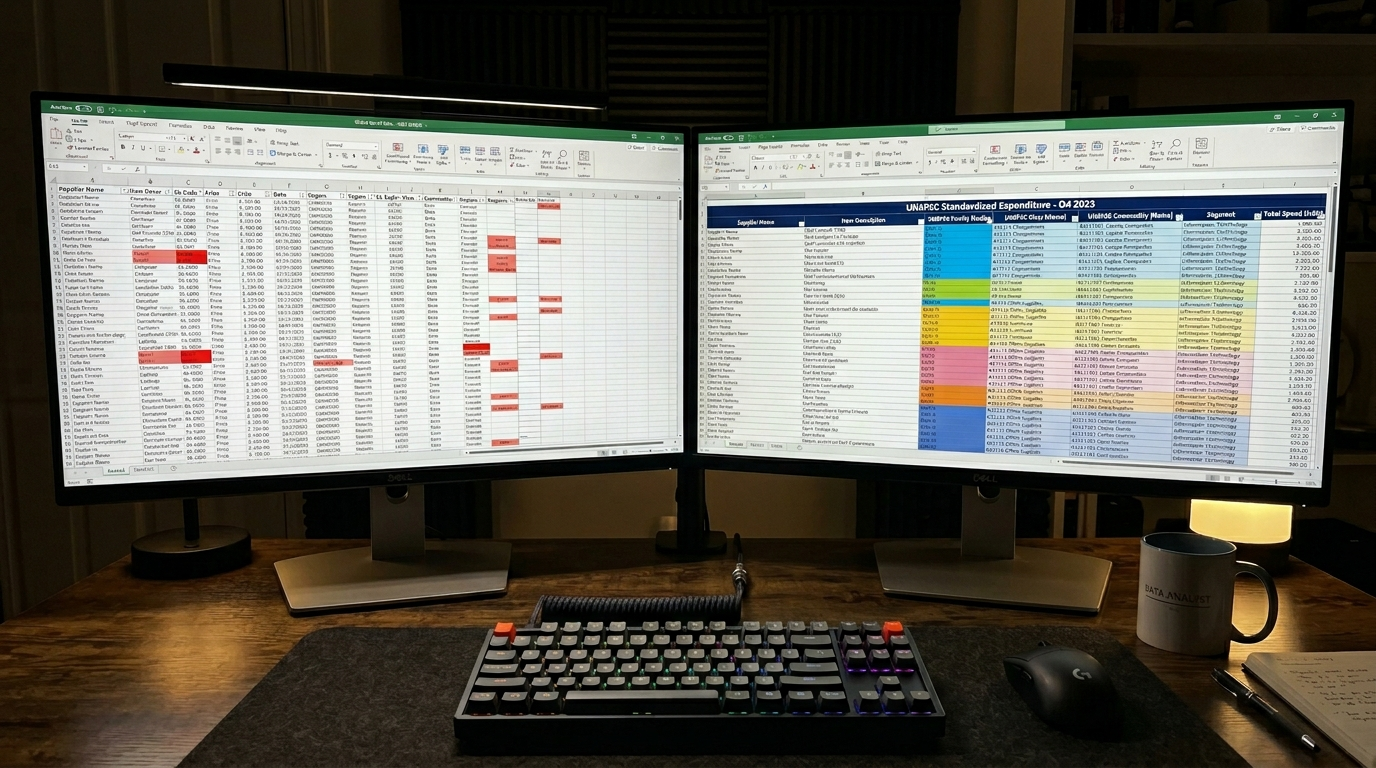
Understanding Spend Classification Taxonomy (UNSPSC)
A spend classification taxonomy is a structured system for categorizing everything your company buys. It acts as a universal language for labeling purchases, allowing you to group similar items together for analysis.
One of the most widely used standards is the United Nations Standard Products and Services Code (UNSPSC). It’s an open, global system that provides a hierarchical set of codes to classify goods and services with incredible detail. For example, a purchase could be coded down to a specific commodity like a “Tower model PC.” Using a standard like UNSPSC ensures consistency across the entire organization, enabling precise spend analysis at any level. This structure is what allows you to confidently answer questions like, “What was our total spend on temporary labor services last year?”.
Supplier Segmentation
Not all suppliers are created equal. Supplier segmentation is the practice of grouping your suppliers into categories based on factors like their strategic importance, spend volume, and risk profile. This allows you to manage your relationships more effectively, focusing your energy where it matters most.
A common insight from this process is the Pareto principle, or the 80/20 rule. It’s not unusual to find that roughly 80% of your total spend is concentrated with just 20% of your suppliers. These top tier suppliers are your strategic partners and warrant close management and collaboration. The remaining 80% of suppliers make up the “long tail” of your spend. Segmentation helps you apply the right level of attention to each group, preventing you from wasting hours on a low value vendor while neglecting a critical partner.
Cost Driver Identification
Once you know what you’re spending and with whom, the next step is to understand why the costs are what they are. Cost driver identification is the process of figuring out the underlying factors that cause costs to change.
For corporate travel, a cost driver might be how far in advance a flight is booked. For software licenses, it might be the number of users. By identifying these drivers, you can find levers to control costs. For instance, if you realize last minute travel bookings are a major cost driver, you can implement a policy to encourage advance planning. This analysis moves procurement from a reactive function to a proactive one, focused on managing the root causes of spending.
Benchmarking and Supplier Rationalization
Benchmarking is the practice of comparing your purchasing prices and performance against an external standard, such as market averages or best in class peers. It helps you answer a simple but crucial question: Are we paying a fair price? If you discover you’re paying 20% more for a service than the market average, you have a clear, data backed opportunity to renegotiate.
Supplier rationalization is the strategic process of reducing the number of suppliers you work with. If an analysis reveals you’re buying office supplies from 15 different vendors, you could rationalize that down to two or three. This consolidation drives savings through volume discounts, reduces administrative overhead (fewer invoices and contracts to manage), and builds stronger relationships with your key suppliers. These two strategies often go hand in hand; benchmarking identifies overpriced categories, and supplier rationalization is a powerful way to fix them.
For companies looking to accelerate this process, expert partners can provide immense value. For example, Varisource leverages a massive database with 50+ million market data points to benchmark client spending at a granular level, instantly flagging overpayment and guiding rationalization efforts.
Continuous Monitoring and Governance
Spend management isn’t a one time project; it’s an ongoing discipline. Continuous monitoring and governance involves the constant oversight of spending, supplier performance, and compliance in real time.
Instead of relying on quarterly reports or annual audits, which often identify problems long after the damage is done, continuous monitoring uses systems to act as “guardrails.” The moment a purchase drifts out of bounds, like exceeding a budget or using an unapproved vendor, an alert is triggered. This proactive approach ensures that policies are followed consistently, risks are caught early, and the savings you’ve negotiated are actually realized.
Policy Control
Procurement policies are the rules of the road for company spending. They might include things like requiring three quotes for purchases over $5,000 or mandating the use of specific suppliers for certain categories. Policy control is the enforcement of these rules.
Without effective control, you get “maverick spend,” where employees bypass established procedures, often resulting in higher costs. Off contract purchases can cost 10% to 20% more than those made through negotiated agreements. Modern procurement systems embed policy controls directly into purchasing workflows, making it easy for employees to do the right thing and difficult to do the wrong thing.
Compliance and Audit Readiness
In spend management, compliance means adhering to both internal policies and external regulations, like anti corruption laws or financial controls. Audit readiness is the ability to prove that you are compliant at any given moment.
This requires maintaining organized records, clear approval trails, and transparent processes. Strong compliance prevents regulatory fines and reputational damage. It also drives savings, as compliant spending typically means using preferred suppliers with negotiated discounts. A centralized spend analysis system is a huge asset here, as it provides a single source of truth that makes demonstrating compliance and navigating audits much simpler.
Cross Functional Collaboration
Indirect spend touches nearly every part of the business, so managing it effectively requires teamwork. Cross functional collaboration is the close partnership between procurement and other departments like Finance, IT, and Marketing.
Procurement can’t operate in a silo. When sourcing a new marketing technology, for example, the procurement team needs to work with Marketing to understand their needs and with IT to ensure technical compatibility. This collaborative approach breaks down barriers, ensures buy in from stakeholders, and leads to better outcomes that balance cost, quality, and functionality. It shifts procurement from being seen as a gatekeeper to a strategic business partner.
Maverick Spend Management
Maverick spend, also called rogue spend, refers to any purchase made outside of established procurement channels or contracts. It happens when employees bypass the rules, often for convenience, leading to lost savings and increased risk. In some organizations, maverick buys can account for a staggering 20% to 30% of indirect purchases.
Managing maverick spend involves a combination of clear policies, user friendly technology (making the right way the easy way), and continuous monitoring to catch off contract purchases. A detailed indirect spend analysis is often the first step to uncovering how much maverick spend is happening and where, providing a clear roadmap for bringing it under control.
Controlling Shadow Spending
Shadow spending is similar to maverick spend but is often harder to detect. It refers to expenses incurred by departments that are technically within their budget but happen outside the visibility of central procurement or finance.
A classic example is “shadow IT,” where a business unit subscribes to a SaaS tool without involving the IT department. Analysts estimate that 38% of technology spending occurs outside the consolidated IT budget. This leads to duplicate services, missed volume discounts, and security risks. Controlling shadow spend requires improving visibility through data analysis, fostering collaboration with department heads, and providing easy to use channels for approved purchasing.
Tail Spend Analysis
Tail spend refers to the high volume of low value purchases that make up the “long tail” of company spending. This is often defined by the 80/20 rule: tail spend is the 20% of expenditure that comes from 80% of your suppliers.
Because each transaction is small, this area is notoriously undermanaged. However, in aggregate, the tail can represent millions of dollars in spending and is often filled with inefficiencies. A tail spend analysis uncovers opportunities to consolidate suppliers, automate small purchases, and enforce policies on low value buys. Managing the tail effectively can unlock quick savings and significantly reduce administrative complexity.
Category Analysis
Category analysis is a deep dive into a specific group of similar products or services, like IT software or professional services. The goal is to understand everything about that category: how much you spend, who the suppliers are, what the market dynamics look like, and where the savings opportunities lie.
This holistic approach allows procurement to develop a tailored strategy for each category. For example, an analysis of the travel category might reveal that enforcing an advance booking policy could save 15% on airfare. This targeted, strategic approach, known as category management, is a hallmark of mature procurement organizations and can yield savings of 10% or more in previously unmanaged categories.
Item Analysis
If category analysis is the big picture view, item analysis is the granular, line item deep dive. This involves examining purchases at the individual SKU (Stock Keeping Unit) level to find micro inefficiencies.
An item analysis might reveal that the company is buying 20 different types of pens when one or two standard options would suffice, allowing for better bulk pricing. In IT, it could uncover that you have licenses for five different project management tools with overlapping functionality. This granular approach is powerful for identifying opportunities for standardization and ensuring you aren’t overpaying for any specific item. This is where modern AI solutions shine, automatically comparing your SKU level pricing against a vast market database to pinpoint exact savings opportunities.
If this level of detail sounds like the key to unlocking hidden value in your organization, you might benefit from an expert assessment. Consider getting a free Savings Estimate from Varisource to see how item level benchmarking could impact your bottom line.
Supplier Analysis
Supplier analysis involves taking a deep, data driven look at each of your suppliers. This goes beyond just how much you spend with them and includes their performance on metrics like on time delivery and quality, their financial stability, and the overall risk they represent to your business.
This analysis helps you understand spend concentration (are you too dependent on one supplier?) and performance issues. For example, if it takes 500 different suppliers to account for 80% of your spend, your supplier base is likely fragmented and could be consolidated. A thorough supplier analysis provides the insights needed to optimize your supplier relationships, drive better performance, and mitigate supply chain risks.
Contract Analysis
A contract is more than just a piece of paper; it’s a rulebook for your relationship with a supplier. Contract analysis is the process of reviewing your agreements to ensure you’re getting the promised terms, taking advantage of all discounts, and avoiding costly pitfalls like auto renewal traps. If you’re evaluating tooling, see our guide to contract lifecycle management (CLM).
Poor contract management can lead to significant value leakage, with some estimates suggesting companies can lose up to 9% of their annual revenue through missed discounts or unfavorable terms. A proactive analysis of your contracts, especially leading up to renewal dates, arms you with the data needed to renegotiate from a position of strength.
Payment Term Analysis
Payment term analysis focuses on when you pay your suppliers and the financial impact of those terms. This includes analyzing terms like “Net 30” or “Net 60” and evaluating early payment discounts.
Did you know that taking a “2% 10, Net 30” discount (a 2% discount for paying in 10 days instead of 30) is equivalent to a roughly 36% annualized return on your cash? An analysis can reveal if you’re leaving these lucrative discounts on the table. It can also identify opportunities to extend payment terms with some suppliers, which improves your company’s working capital by holding onto cash longer.
Spend Cube Analysis
Spend cube analysis is a way of looking at your spending data from multiple dimensions at once, often visualized as a three dimensional cube. The typical dimensions are:
- What was purchased (spend category).
- Who it was purchased from (supplier).
- Who in the business made the purchase (department or business unit).
By slicing and dicing this cube, you can uncover deep insights. For example, you might see that two different departments are buying the same services from the same supplier but at different rates. This multi dimensional view is essential for spotting consolidation opportunities and compliance issues that a simple, flat report would miss.
KPI and Savings Tracking
You can’t improve what you don’t measure. In procurement, KPI and savings tracking is the discipline of defining Key Performance Indicators (KPIs) and systematically measuring them over time.
Common KPIs include cost savings, spend under management (the percentage of spend that follows procurement processes), and contract compliance rates. Rigorous tracking is especially important for savings to ensure that the savings negotiated in a contract are actually realized in the company’s financial statements. Dashboards with clear KPIs transform procurement into a data driven function that can clearly demonstrate its value to the business.
Predictive Analytics and Forecasting
While most analysis looks at past spending, predictive analytics uses data and AI to forecast what is likely to happen in the future. This represents a shift from reactive to proactive procurement.
Predictive models can forecast future demand for a product, predict price fluctuations for key commodities, or even identify suppliers who are at risk of financial failure. This foresight allows procurement to make strategic moves now to prepare for the future, such as locking in prices before an expected increase or diversifying suppliers to mitigate risk. As one SAP report notes, analysis of the past provides a basis to make strategic predictions for future planning.
Expert Tip: "The biggest mistake companies make is ignoring the 'Tail Spend.' While individual transactions are small, the administrative cost of managing thousands of tiny vendors often outweighs the cost of the products themselves." — Varisource Procurement Lab
The Modern Indirect Spend Tech Stack

To achieve the savings mentioned in this guide, procurement teams are moving away from manual spreadsheets. The 2026 standard includes:
- AI Data Classifiers: Automated engines that map messy line items to UNSPSC codes instantly.
- Autonomous Sourcing: AI agents that negotiate low-value tail spend without human intervention.
- Real-Time API Integration: Connecting ERP, HRIS, and Credit Card feeds for a "Live Spend" view.
Real Time Dashboard and Reporting
A real time dashboard is a live, interactive portal that displays your most important spend metrics as they happen. Unlike a static monthly report, a dashboard gives you an up to the minute view of your spending, savings, and other KPIs.
This immediacy allows you to spot anomalies or budget overruns within hours or days, not weeks or months later. With the ability to drill down into data with a few clicks, stakeholders across the business can get the answers they need on demand. This makes spend management a dynamic, everyday activity and empowers your team to make faster, more informed decisions.
A powerful indirect spend analysis program can give you this kind of on demand visibility. If you’re ready to see your savings in real time, explore how an AI powered savings program works.
Frequently Asked Questions about Indirect Spend Analysis
What is the main goal of an indirect spend analysis?
The primary goal is to gain visibility and control over all non core operational spending to identify opportunities for cost reduction, improve efficiency, increase compliance, and mitigate supplier risk. Ultimately, it turns an often overlooked area of spending into a source of strategic value and bottom line savings.
How do you start an indirect spend analysis project?
The first step is always data. You begin by identifying all the sources where spend data is located (like AP systems, expense platforms, and P card statements). The next step is to collect, consolidate, and cleanse this data to create a single, reliable dataset that can be accurately categorized and analyzed.
What are the biggest challenges in indirect spend analysis?
The most common challenges are poor data quality and data that is fragmented across multiple, disconnected systems. It can be time consuming to collect, clean, and standardize this data. Another challenge is getting buy in from different departments to change their purchasing behaviors based on the analysis findings.
How can AI help with indirect spend analysis?
AI can dramatically accelerate and improve the process. For examples and tooling, check out our overview of AI procurement cost‑savings tools. AI agents can automate the tedious work of extracting and cleansing data from various sources. They can also classify transactions into categories with high accuracy and analyze millions of data points to benchmark your pricing at the SKU level, instantly identifying savings opportunities that a human analyst might miss.
What’s the difference between maverick spend and tail spend?
Maverick spend refers to any purchase that violates procurement policy, regardless of size (e.g., using an unapproved supplier). Tail spend refers specifically to the large number of low value purchases from many different suppliers. While there can be overlap (a lot of maverick spend happens in the tail), they are different concepts. You can have a policy compliant purchase that is still part of your tail spend. Still have questions? Contact us for tailored advice.
About the Author
.jpeg)
Victor Hou
Victor Hou is the founder of Varisource, the first ever Savings Automation Platform that automates Savings for Your Business. Victor helps companies access discounts, rebates, benchmark data, savings for renewals and new purchases across 100+ spend categories automatically to increase your company's margins and equity value by at least 15-20%. Victor is active and passionate about using AI + automation to help your business save time, money and run more efficiently.
%201.svg)

Varisource’s Savings Automation Platform guarantees savings and maximized leverage on every dollar spend across 100+ spend categories


