Software Industry Procurement Strategy - How to Stop Overpaying for Technology in 2026?
Technology procurement has a fundamental problem that most other procurement categories do not share: the vendors know more about pricing than the buyers do, and they have structured the entire buying experience to keep it that way.
Software vendors do not publish their actual pricing. They publish rate cards that almost nobody pays. They bury price escalation clauses in multi-year contracts. They bundle AI features into existing tiers to justify price increases that would otherwise be difficult to defend. And they have complete data on what every one of their customers pays — knowledge that buyers, negotiating in isolation, almost never have.
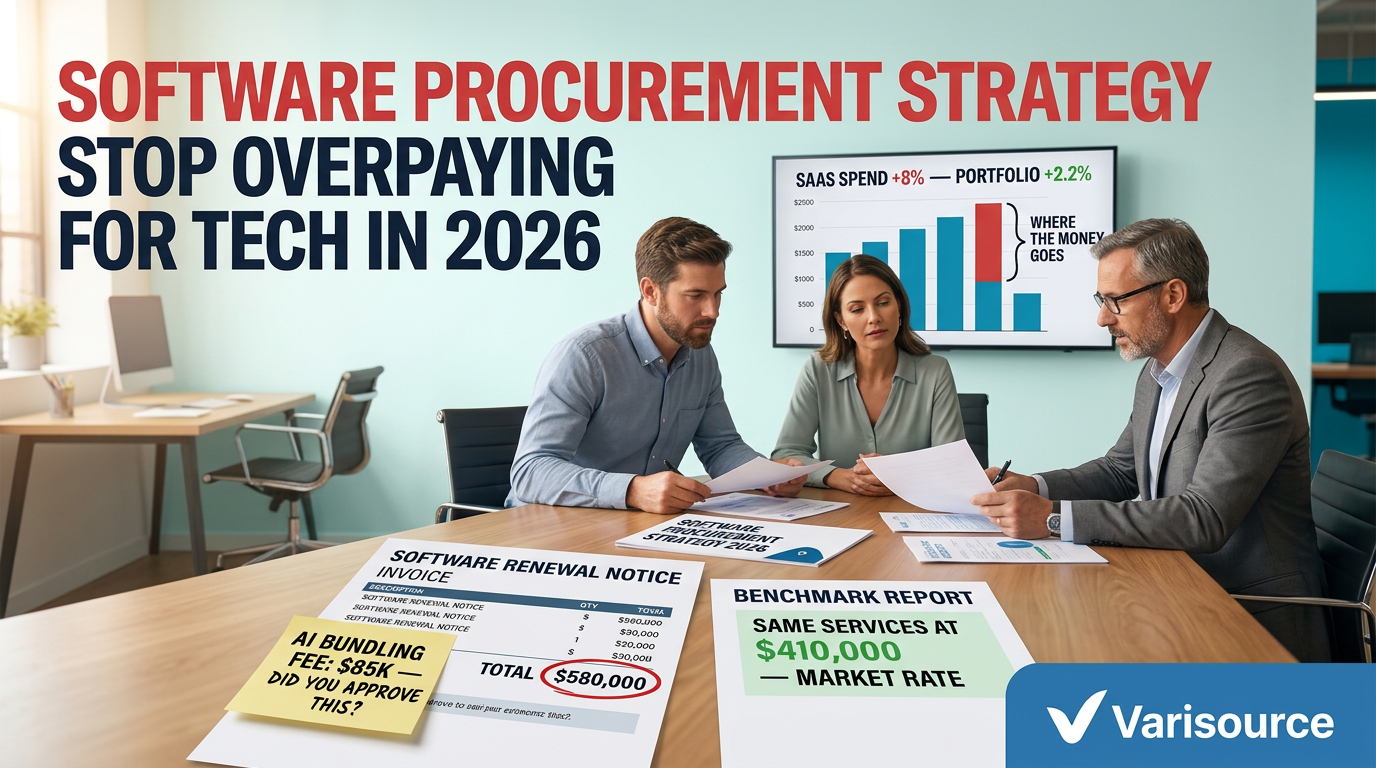
Zylo's 2026 SaaS Management Index captures the result: average software spend rose nearly 8% in a single year while the average number of applications stayed flat at 305. The bill is growing faster than the portfolio. That gap is not accidental. It is the output of a procurement environment where vendors have structural pricing advantages that most buyers have not yet organized to counter.
Why Does Software Procurement Require a Different Strategy Than Other Spend Categories?
Three characteristics of the software market make standard procurement approaches insufficient.
Pricing opacity is deliberate. Unlike physical goods where market pricing is relatively transparent, software vendors systematically obscure their real pricing — through non-disclosure terms in contracts, rate cards that bear no relationship to negotiated prices, and pricing pages designed to make cost estimation difficult. Vertice research found that 60% of SaaS vendors deliberately mask their price increases, making it difficult for procurement teams to accurately assess whether they are paying market rates. The implication: you cannot benchmark software pricing from public information alone. You need real contract data.
The cost model is changing mid-contract. Traditional procurement strategies assume a stable pricing model within a contract period. Software vendors are systematically moving away from that. Per-seat subscriptions are being layered with consumption-based fees for AI features. Tiers are being restructured so features in your current plan migrate to a higher tier at renewal. This is not a price increase — it is a structural change that produces the same financial outcome without announcing itself as one. A procurement strategy that does not monitor these mid-contract changes will consistently discover price increases it did not anticipate.
Purchase decisions happen outside procurement. In most organizations, a significant portion of software spend is initiated by departments rather than procurement teams — on credit cards, through direct vendor relationships, without contract review or pricing benchmarks. BetterCloud found that SaaS buying is distributed across IT, finance, operations, and procurement in 63% of companies. A technology procurement strategy that only manages purchases that come through formal channels is missing a substantial portion of the spend it is supposed to manage.
What Does an Effective Software Procurement Strategy Include?
A technology vendor inventory that stays current. Every application, every vendor, every cost, every renewal date — in a single system that updates as the portfolio changes. This is the foundation. Nothing else in a software procurement strategy works without it. Organizations that maintain this inventory consistently outperform those that do not on every cost metric.
Benchmark pricing as a standard process step. Before any software renewal or new purchase, procurement should have vendor-level benchmark data — what comparable organizations pay for the same product at the same tier and scale. Published rate cards are not benchmarks. Actual negotiated rates across the software market run 20 to 40% below published prices. The Varisource benchmark database contains 50M+ real contract data points across 100K+ vendors specifically because vendor-level pricing data is what changes negotiation outcomes.
Early renewal management, systematically enforced. Zylo's 2026 Index found the average organization manages 211 SaaS renewals annually. Most start renewal conversations too late to negotiate meaningfully. A software procurement strategy sets 90-day and 180-day automated alerts for every contract, triggers a standard review process at the 90-day mark, and ensures every significant renewal gets a utilization audit and benchmark comparison before the vendor conversation begins.
Governance that reaches shadow IT. A technology procurement strategy that only manages what procurement already knows about is incomplete. Effective governance creates a pathway for department-initiated software purchases that runs quickly enough to be used rather than bypassed — fast approval, vendor vetting, and pricing review that takes days, not months. When procurement is too slow, departments go around it. When it is fast and adds visible value, they come through it.
Group purchasing access for volume-dependent pricing. The software market has meaningful pricing tiers, and mid-market companies rarely reach the volume levels that unlock the best ones independently. Group purchasing programs that pool technology spend across many organizations give their members access to pricing that individual volume cannot reach. The Hackett Group's 2024 research found that 56% of companies now use these tools — a rapid adoption rate driven by measurable results.
What Separates World-Class Technology Procurement From Average?
The Hackett Group's 2025 research provides the clearest answer: Digital World Class procurement teams deliver 2.6 times greater return on investment than average teams while operating with 31% fewer staff. The gap is not headcount or effort. It is process maturity, data quality, and timing discipline.
World-class technology procurement teams benchmark every renewal before negotiating, start every renewal 90 days early, capture rebates systematically, and have real-time visibility into their full software portfolio. Average teams do some of these things, some of the time, when they get to it.
The Varisource Savings Program provides the infrastructure that makes world-class software procurement accessible to any organization regardless of internal procurement maturity — benchmark data, group discounts, rebate tracking, renewal management, and execution support across 300+ spend categories, with a free savings estimate delivered within 48 hours.
See Varisource's benchmarking resources and formulas.
Read more in the Spend Value Tips series at Varisource Blogs.
About the Author

Victor Hou
Victor Hou is the founder of Varisource, the first ever Savings Automation Platform that automates Savings for Your Business. Victor helps companies access discounts, rebates, benchmark data, savings for renewals and new purchases across 100+ spend categories automatically to increase your company's margins and equity value by at least 15-20%. Victor is active and passionate about using AI + automation to help your business save time, money and run more efficiently.
%201.svg)

Varisource’s Savings Automation Platform guarantees savings and maximized leverage on every dollar spend across 100+ spend categories


