Expert Tactics to Negotiate Business Contracts for Cloud & SaaS [2026]

The standard advice for a software renewal is to ask for a discount and threaten to leave. For cloud and SaaS, I think that advice is wrong. Cloud is infrastructure, so it connects to everything in the business. Software comes with integrations, setup, years of historic effort and a lot of your data inside it, and the vendor knows that makes it very, very difficult for you to simply switch. We once found a customer about 50% savings with another vendor. They stayed on UKG anyway because it was so intertwined with their business, which I think can sometimes make sense.
Asking for a better price on its own doesn't work either, because if you don't have leverage, the vendor isn't going to do anything. In these categories, leverage comes from information, competition and the time to put both to work. With a small procurement team and hundreds of vendors, time is the piece you have least of, and the other two depend on it.
Key Takeaways
- SaaS vendors typically overcharge by 10 to 15% on initial contracts, creating an inflated pricing baseline that compounds across subsequent renewals and multi-year terms.
- Cloud vendors obscure price increases by activating unrequested modules and double-counting usage, a tactic that generated a 35% overcharge on one analyzed Datadog account.
- Benchmarking a $3 million Microsoft Enterprise Agreement for E5 licenses against wholesale distributor pricing revealed that the reseller CDW was overcharging the customer by 12%.
- Presenting alternative competitive quotes from Adobe Sign, HelloSign, and Dropbox Sign forced DocuSign to lower a customer's renewal pricing by 18% without requiring an actual software switch.
- Consolidating eligible software purchases through the AWS Marketplace increases committed cloud spend, providing procurement teams with leverage to negotiate compute cost reductions exceeding 30%.
- Unused premium support fees quietly inflate SaaS invoices, as evidenced by a Workato renewal where unvalidated support charges accounted for 15% of the customer's total spend.
What Tactics Do Cloud and SaaS Vendors Use in 90-Day Renewal Playbooks?
I spent 15 years selling for vendors. In the 90 days before a big renewal, the sales team gets together and builds a plan and a playbook. If you push back on price, the playbook has three parts. There's an ROI case that's very difficult to argue with, a reminder of how hard similar service is to find, and a comparison showing other vendors can't deliver as well. The line is always some version of "the service has been great, the team put in a lot of effort, and the pricing you have is really, really good." All of it is meant to give you enough comfort and confidence that you never go out to market.
Vendors pick their numbers, too. You'll hear about SLA uptime and past discounts. You won't hear how many support tickets you opened or how slow delivery was. Meanwhile, the customer usually deals with that same renewal 30 days in advance, and that gap is why customers always overpay.

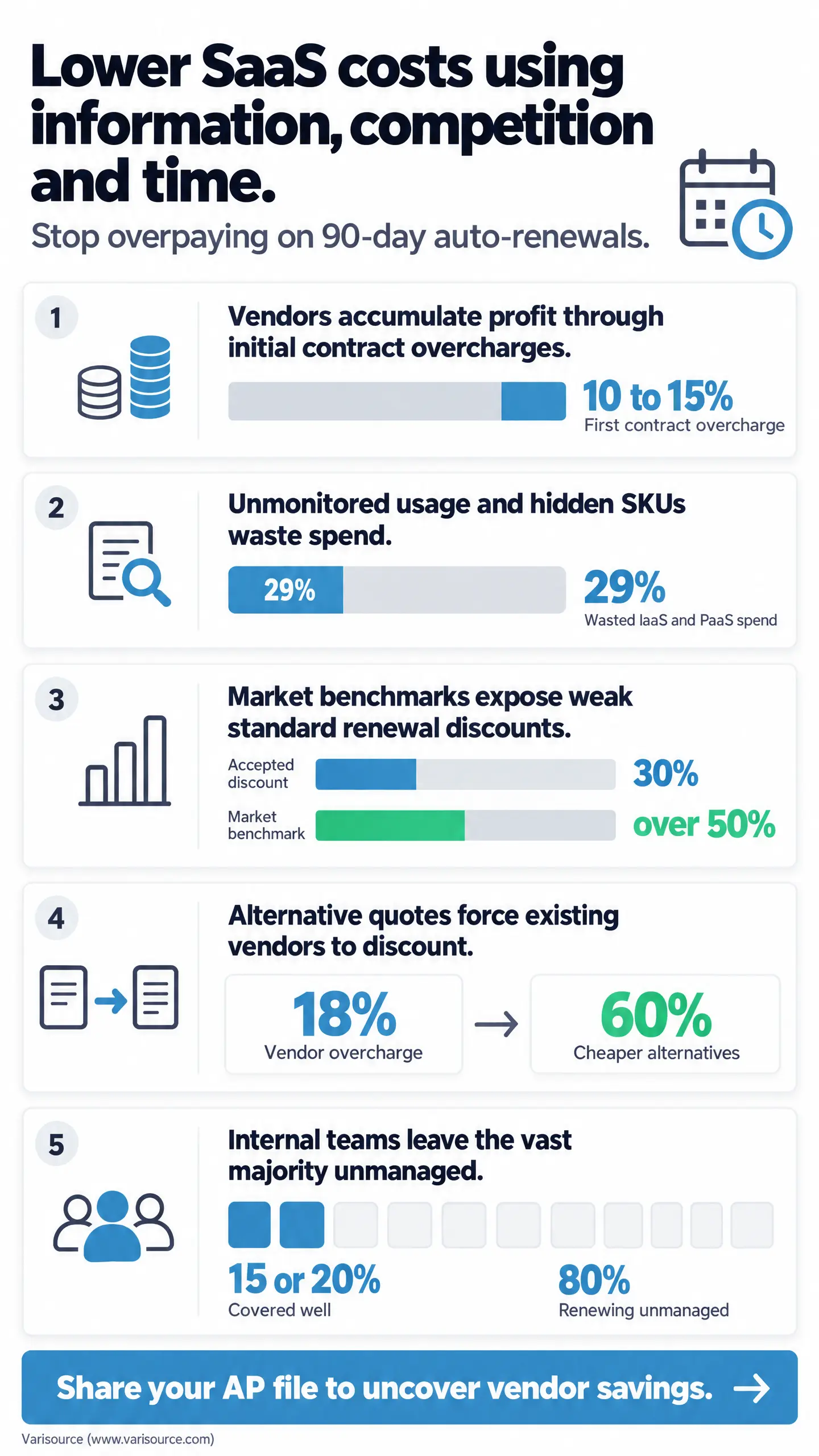
The vendor also knows you're stuck. From what we see across our customers, vendors overcharge by 10 to 15% on a first contract on average. That keeps accumulating with every renewal, add-on and multi-year term, because the vendor knows you won't switch.
How Does a Proactive Renewal Schedule Improve SaaS Contract Negotiations?
Most of the negotiations we lose come down to time. We've had customers come to us two weeks before renewal on a deeply integrated vendor, and the vendor knew they weren't going to switch in two weeks. Another customer asked us to track their contracts, and we reminded them several times about a renewal. By the time they responded, they'd been auto-renewed for three years at a significant cost.
Day one for us at Varisource is an AP analysis to see every vendor in the business. We gather the existing contracts and put a contract date next to each vendor in the AP file. With that renewal schedule, you can separate what's due in the next 30 to 50 days from the vendors you need to get ahead of. Proactive monitoring then tells you when each contract needs your time. That gives you visibility, which is the first step toward optimization. It still doesn't tell you whether you're paying a fair price on any of those contracts.
How Does SKU-Level Analysis Reveal Hidden Costs in Cloud and SaaS Contracts?
Before anyone calls the vendor, we compare last year's invoice and contract with this year's to see what increased and what changed. We also ask the people using the tool what needs to be added, moved or changed. Then we go through the quote SKU by SKU.
Cloud vendors raise costs quietly. They change the pricing model so the calculation changes, add modules you didn't ask for and hold back the right SKU-level discounts as usage grows. On one Datadog account, the customer was overcharged by about 35%. The causes were unrequested modules, price increases blamed on inflation and R&D, and usage that was being double-counted.

Developers also spin up modules and forget to turn them off. The vendor won't flag it, because they expect the technical stakeholders to watch usage while finance pays the bill. Respondents to Flexera's 2026 cloud survey estimated that 29% of IaaS and PaaS spend was wasted, so it's worth finding your share before the vendor call.
We look hard at support too, because we've caught quotes charging for support components that other customers get for free. On a Workato renewal, premium support was 15% of the customer's total spend. They rarely used it and the vendor couldn't validate the usage, so we negotiated the fee out.
What Data Sources Provide Accurate Market Pricing Benchmarks for SaaS Contracts?
Every vendor is overcharging you and charging every customer different prices because they can, and because you would pay for it. Business buyers don't have a Zillow or an Expedia to see what other companies pay. All you see is a price and a discount off a list price the vendor chose. A 3,000-employee global company accepted a 30% discount on a $125,000 DocuSign quote because they only had 30 days to renew. The market benchmark supported a discount of over 50%.
An increase can also hide a bigger problem. On a DocuSign renewal for 30,000 envelopes, the vendor proposed an automatic 15% increase on a price that was already more than 40% above market. Showing that baseline gave the finance team the evidence to push back on the increase.
Our benchmarks come from three sources. We use anonymized spend data across thousands of customers, distributor and wholesale pricing that shows the vendor's costs and margins, and like-for-like quotes from alternative vendors. When we benchmarked a customer's $3 million Microsoft Enterprise Agreement for E5 licenses, it showed their reseller, CDW, was overcharging them by 12%. We got competing bids from other resellers, and the customer switched and captured the savings.
How Do Quick RFPs Generate Competitive Leverage for SaaS Contract Renewals?

On the first call, we tell the vendor there's a new procurement process that puts due diligence on every renewal and purchase. We tell them we're not just going to renew automatically with no due diligence and insight. We also tell them budgets are being cut, and there are benchmarks they'll need to get to in order to continue the business.
Some reps hear that as a bluff, and so we back it up right away. We tell them we'll be coming back with market benchmarks and going out for a quick RFP, whether they like it or not. The most successful procurement processes are ones you can back up with a strategy, a plan and execution, versus just random messages. Run 90 to 120 days out, a quick RFP gives other companies the opportunity to bid for your business, and it drives fear into the current vendor. Whether you switch or not, you can decide, but at least you put the vendor in a competitive situation.
On one renewal, we told the vendor we were putting them on alert and weren't going to auto-renew. We said we'd let the market tell us whether their solution and features were up to par. They had been planning that renewal for months, but I think the approach surprised them, and taking it to market built the leverage. A lot of procurement leaders are surprised by how the tone changes once they have the leverage and the time.
How Do Alternative Vendor Quotes Lower SaaS Costs Without Software Switching?

I think most AI purchasing agents will struggle to lower renewal prices. They work from historical spend data and don't bring the real-time market pricing or alternative vendors that create competition. On one DocuSign renewal, the customer was overcharged by 18%. We brought in like-for-like quotes from Adobe Sign, HelloSign and Dropbox Sign that were at least 60% cheaper. DocuSign reduced its pricing without the customer's CFO having to do any of the work.
Most of our savings come from customers staying with their existing vendor. Sometimes switching is unrealistic, like with a deeply integrated ERP. Even then, we still build a market benchmark next to the vendor benchmark, so the current vendor knows what the market offers before the customer has to walk away.
Staying also protects the deal from your own stakeholders. We've seen telecom savings of 20 to 30% die because stakeholders didn't want to switch IP addresses or reinstall internet service. Some of them were friends with the vendor, and in the end they simply stopped responding. It's not their money, and so the extra work never feels worth it to them. A same-vendor, same-service saving asks them for none of it.
When the benchmarks land, the rep's defense is predictable: "Yes, we are not the cheapest, but we provide a lot of value, our support is great, and the customer has been with us for many years." Show them what the market has to offer, stay professional and keep it win-win, and they're usually very willing to help.
How Does Competitive Leverage Overcome Initial Vendor Discounts in SaaS Negotiations?
On the first call, Datadog told one of our customers that it's a usage product and they'd already given the best discount they could. Over several calls, we built leverage through competition, optimization options and working it through with the customer. The discount went from 5% to 20%.
In another Datadog case, the vendor refused any discount and told the customer to use less. That kind of defeats the purpose of having a good solution, and so we helped them move to a faster alternative and save about 50%.
Some software vendors suggest that a lower price means fewer features. I don't think it holds up, because software is built already and usually costs the same on the back end. Paying less means less margin for the vendor, with no downgrade for the customer. On a NetSuite renewal, the customer wasn't using NetSuite support and hadn't heard from their sales rep until renewal time. Showing that next to the benchmark helped the finance leader secure an additional 12 to 13% for the exact same scope.
How Can Procurement Optimize AWS Cloud Commitments and Usage-Based AI Costs?
Cloud savings in our program average 25 to 35%. Most customers buy on-demand or one-year terms because they want flexibility. AWS's own Savings Plans advertise discounts of up to 66% on compute, but they require a one- or three-year commitment you can't cancel during the term. Through our program, we can get customers three-year term discounts on month-to-month flexibility. That's usually on EC2 and compute, savings plans and reserved instances.
The other lever is understanding what the cloud salesperson is looking for. For one customer, we moved a large portion of their software purchases into the AWS marketplace. That raised their AWS spend and gave us the leverage to cut their compute costs by over 30%, while AWS got the revenue it wanted. AWS only counts Marketplace purchases toward committed spend when the individual product is eligible, so it's worth checking each product before you move anything.

AI tools are usage-based too. Without policies on which models get used, individual prompts and AI agents quietly rack up charges before management notices. By the time people see it, the cost has already been charged. Zylo's 2026 SaaS Management Index reports that 78% of IT leaders ran into unexpected charges tied to AI features or consumption-based pricing. So I'd have your FP&A team connect spend analytics directly to the AI applications and the ERP before the budget runs out. From there, usage policies and AI routers that send queries to different tools help you control the spend. AI aggregators with wholesale rates on the underlying engines also give you an alternative to negotiate with.
How Can Procurement Teams Optimize Renewals for Unmanaged SaaS and Cloud Vendors?

All of this takes time and different expertise in every category. Somebody who knows AWS isn't automatically an expert in DocuSign or Salesforce. I think expecting procurement people to be experts in every category, vendor and savings mechanism is unfair. It's like expecting a VP of Sales to be an expert in marketing, finance and IT. Most companies have hundreds of vendors, if not thousands, and only a few procurement people. Even a team that covers the top 15 or 20% well leaves the other 80% renewing without anyone looking closely.
We built the Varisource savings program to cover that 80%. Your time goes to the big renewals and the stakeholder relationships, and we handle the analysis, benchmarks and negotiation. The decisions stay with you. Every saving is measured against a baseline we agree on up front, usually the previous quote or previous spend, and validated with you before it counts.
One procurement leader told us that if we really did what we said, his boss would question what they needed him for. He gave us a chance and found that we complement him and make him look good, and he's still a customer.
Your vendors will keep planning their big renewals 90 days out, whether or not your team has time to plan with them. If you have a big cloud or SaaS renewal coming up with a few hundred vendors behind it, I'd be glad to look at it with you. The vendor names and spend from your AP file are enough for us to show you where the savings are.
Frequently Asked Questions
How do you negotiate business contracts when the renewal date is under 30 days away?
Time is your biggest leverage point, so you have to manufacture it. Inside 30 days, ask for a short-term extension at the current rate. Vendors resist, but pushing back signals you're evaluating alternatives. It buys you the window to run a quick RFP and gather the market benchmarks needed to negotiate properly.
Should you negotiate business contracts based on purchased license counts or actual usage?
Always negotiate based on audited usage. The gap between purchased and used licenses is where vendors pad margins. For example, a NASA audit found the agency spent $15 million on unused Oracle licenses. Before engaging the vendor, verify exactly what your team actually deployed.
Are group purchasing discounts an effective way to negotiate business contracts for SaaS?
Group purchasing works for commodities, but rarely maximizes savings for proprietary tech. Microsoft doesn't need pooled leverage. To negotiate business contracts effectively, you need custom benchmarks based on your specific SKU mix and competitive quotes, rather than generic tiered discounts that leave money behind.
How should a small procurement team track their ROI when they negotiate business contracts?
Always establish a baseline before negotiating - usually the last quote or previous spend. When you negotiate business contracts, log the final verified outcome against that baseline. Documenting this delta ensures the CFO attributes hard-dollar savings directly to procurement, proving your ROI instead of letting finance absorb the credit.
How do you negotiate business contracts when internal stakeholders are loyal to the incumbent vendor?
Neutralize resistance by focusing strictly on same-vendor savings. Tool owners often sabotage deals because they fear the work of switching. If you negotiate business contracts using competitive benchmarks, you can force the incumbent to drop prices without changing software. The stakeholder keeps their tool, and you get the win.
About the Author

Victor Hou
Victor Hou is the founder of Varisource, the first ever Savings Automation Platform that automates Savings for Your Business. Victor helps companies access discounts, rebates, benchmark data, savings for renewals and new purchases across 100+ spend categories automatically to increase your company's margins and equity value by at least 15-20%. Victor is active and passionate about using AI + automation to help your business save time, money and run more efficiently.


Varisource’s Savings Automation Platform guarantees savings and maximized leverage on every dollar spend across 100+ spend categories


