How to Reduce Indirect Spend: 2026 Strategies That Work

The most effective way to reduce indirect spend is by following a three-part strategy: gaining total visibility into purchasing, building a strategic framework for control, and executing targeted savings initiatives. Indirect spend, the money spent on goods and services not directly part of your final product, represents a huge chunk of money for many companies, and can represent 10% to 18% of revenue in some industries.
The problem? This spending is frequently uncontrolled and lacks visibility. A recent survey found that only 19 percent of CFOs and CPOs have a full view of their indirect spending. This guide provides a comprehensive roadmap to help you see, control, and ultimately reduce indirect spend, turning a major cost center into a source of significant savings.
Quick Summary: How to Reduce Indirect Spend in 3 Steps
To reduce indirect spend effectively in 2026, organizations must follow a See-Control-Optimize framework:
1. Visibility: Consolidate fragmented data into a single source of truth to identify "maverick spend."
2. Governance: Implement category management and automated approval workflows to enforce compliance.
3. Strategic Sourcing: Leverage supplier consolidation and AI-driven benchmarking to negotiate 15%–20% savings on initial contracts. The Bottom
Line: Shifting from tactical purchasing to a centralized strategic framework can reclaim 10% to 18% of lost revenue.
The Foundation: Gaining Visibility Into Your Spending
You can’t control what you can’t see. The first step to reduce indirect spend is to get a crystal clear picture of where your money is actually going.
Get Total Indirect Spend Visibility
Indirect spend visibility is simply the ability to see and analyze all your company’s non product related purchases. It means knowing who is buying what, from which suppliers, how often, and for how much. Without this, you’re flying blind. Given that 82 percent of procurement leaders feel their indirect spend is not well managed, achieving visibility is the critical starting point.
Consolidate Your Spend Data
In most companies, spend data is scattered everywhere: ERP systems, accounting software, credit card statements, and various spreadsheets. Data consolidation is the process of pulling all this fragmented information into one single, unified view. This creates a single source of truth for all purchasing activity, eliminating the guesswork and internal debates caused by conflicting data sources. Platforms from providers like Varisource specialize in this, automatically consolidating spend data into one clear dashboard. See this guide to spend data management for what to include and why it matters.
Align Your Category Taxonomy
A category taxonomy is your company’s dictionary for purchases; review common savings categories most teams standardize on to keep terminology consistent. It’s a structured, hierarchical system for grouping similar goods and services (for example, IT > Software > CRM). Taxonomy alignment means getting everyone in the organization to use the same dictionary. Without it, one department might call something “Consulting” while another calls it “Professional Services,” making it impossible to see your total spend in that area.
Classify Spend Consistently
Once you have a taxonomy, you need to apply it. Consistent spend classification is the practice of accurately tagging every single purchase to the correct category. Misclassifying even a small percentage of spend can hide enormous savings opportunities.
Use Spend Analytics to Find Opportunities
With clean, consolidated, and classified data, you can finally perform spend analytics. Here’s how to boost your bottom line with spend analysis. This is the process of analyzing your expenditure data to uncover actionable insights. Analytics answers key questions like:
- Are we buying the same product from five different suppliers at five different prices?
- Where is our spending growing the fastest?
- Which suppliers make up 80 percent of our costs?
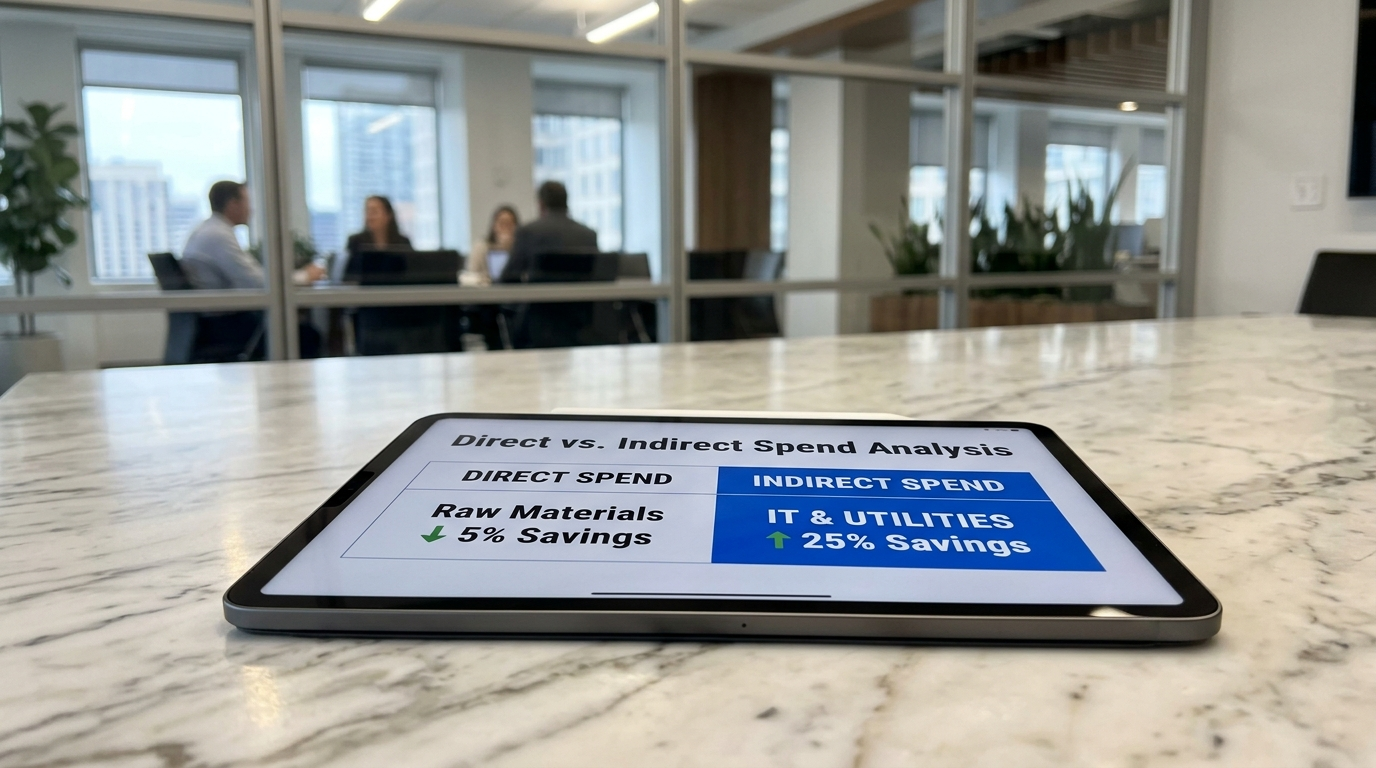
Spend analytics turns raw data into a treasure map, pointing directly to the areas where you can reduce indirect spend most effectively.Indirect vs. Direct Spend: Key Differences & Savings Potential
Feature
Direct Spend
Indirect Spend
Definition
Goods/Services for final product (Raw materials)
Goods/Services for operations (IT, Travel, Utilities)
Visibility
High (Managed in BOM)
Low (Fragmented across departments)
Typical Savings
2% – 5% (Mature categories)
10% – 25% (Unmanaged categories)
Primary Driver
Production Volume
Operational Policy & Demand
Building a Strategic Framework for Control
Visibility is the starting point, but a strategic framework is what allows you to act on what you see and create lasting change.
Embrace Category Management
Category management is a strategic approach where you group related purchases (like all marketing spend or all IT hardware) and manage each group as its own mini business unit. Instead of buying things one by one, you develop a holistic strategy for the entire category. This allows you to leverage your total volume, reduce the number of suppliers, and align purchasing with your company’s goals.
Assign Clear Category Ownership
To make category management work, you need category ownership. This means assigning a specific person or team (a Category Manager) to be fully responsible for a spend category. That owner becomes the expert, monitoring market trends, managing supplier performance, and driving savings initiatives for their area. This closes gaps in accountability and ensures no significant area of spend falls through the cracks.
Establish Procurement Governance and Policy
Procurement governance is the set of rules, policies, and approval workflows that ensure everyone buys things in a controlled, compliant way; see how mature teams structure procurement governance and policy. It’s the framework that prevents “maverick spend” (employees buying from unapproved vendors or outside of negotiated contracts). With 93 percent of executives citing maverick spend as a major source of cost leakage, strong governance is non negotiable if you want to reduce indirect spend.
Engage and Align with Stakeholders
Procurement can’t succeed in a silo. Stakeholder engagement and alignment means actively collaborating with the internal departments who use the goods and services. When procurement and business units like IT, Marketing, and Finance work together, the results are powerful. Here’s a practical guide to collaborating with stakeholders. High performing teams that engage in cross functional collaboration see 28 percent higher savings.
Track Key Performance Indicators (KPIs)
What gets measured gets managed. Key Performance Indicators (KPIs) are the metrics you use to track the success of your efforts to reduce indirect spend. Important KPIs include:
- Cost Savings: Savings targets are tracked as a KPI by 52% of CPOs.
- Spend Under Management: The percentage of total spend that procurement actively influences.
- Compliance Rate: The portion of spending that follows company policy.
- Supplier Performance: Metrics like on time delivery and quality.
- Procurement ROI: The value procurement delivers compared to its cost.
Actionable Strategies to Reduce Indirect Spend
With a solid foundation and framework, you can now deploy specific strategies to capture savings.
Develop a Sourcing Plan
A sourcing plan is your strategic roadmap. It outlines which spend categories you will tackle, in what order, and with what strategy. The plan should be based on your spend analysis, prioritizing the areas with the biggest savings potential and considering factors like contract renewal dates. A structured plan ensures your team’s limited resources are focused on the highest impact projects.
Implement Strategic Sourcing
Strategic sourcing goes beyond just getting three quotes. It’s a systematic process of analyzing your needs, understanding the supplier market, negotiating for total value (not just price), and managing the supplier relationship long term. Applying strategic sourcing to previously unmanaged indirect categories can yield impressive results, with companies often achieving 15 to 20 percent savings on initial projects.
Consolidate Your Suppliers
Supplier consolidation is the process of reducing the number of vendors you work with to concentrate your spending with a smaller group of preferred partners. This allows you to leverage your increased volume for better pricing, often leading to cost savings of 5 to 15 percent. It also dramatically reduces administrative complexity, since you have fewer contracts, invoices, and relationships to manage.
Analyze Total Cost of Ownership (TCO)
The cheapest option isn’t always the least expensive. Total Cost of Ownership (TCO) analysis is a method for evaluating the full lifecycle cost of a purchase. This includes the upfront price plus all other costs like energy consumption, maintenance, and disposal. For example, an energy efficient server might cost more initially but save thousands in electricity bills over its life, making it the better choice.
Focus on Demand Management
One of the most powerful ways to reduce indirect spend is to simply buy less. Demand management and consumption reduction focus on controlling whether a product or service is needed in the first place. This involves challenging assumptions and changing user behavior, for example, by standardizing on less expensive equipment or implementing policies to reduce non essential travel.
Consider Energy Efficiency
A key part of TCO and demand management is energy efficiency. Choosing products that consume less energy, from laptops to data centers, directly reduces utility bills and supports sustainability goals; explore practical ways to save technology costs without sacrificing performance. Energy efficiency has become a core factor in modern procurement.
Forecast Future Spend
Spend forecasting involves using historical data and business plans to predict future expenditures. An accurate forecast helps with budgeting and allows procurement to be proactive. If you know a dozen software contracts are up for renewal in the third quarter, you can start preparing your negotiation strategy now instead of scrambling at the last minute.
Leveraging AI for Autonomous Indirect Spend Management
In 2026, manual spend analysis is being replaced by Autonomous Procurement. To stay competitive, include these elements in your strategy:

- AI-Powered Benchmarking: Use real-time market engines to compare your contract rates against global averages instantly.
- Predictive Anomaly Detection: Implement AI agents that flag "maverick spend" or duplicate invoices before payment is processed.
- Automated RFPs: Use Generative AI to draft Request for Proposals (RFPs) and evaluate supplier responses based on TCO (Total Cost of Ownership) rather than just price.
Conclusion
Mastering the techniques to reduce indirect spend is a journey, but it’s one with a clear and substantial reward. It begins with achieving full visibility through data consolidation and analytics. From there, you build a strategic framework with category management, clear governance, and stakeholder alignment. Finally, you execute with powerful tactics like strategic sourcing, supplier consolidation, and a focus on total cost.
This process transforms procurement from a tactical function into a strategic driver of profitability. The savings are real and can be significant. If you’re unsure where to begin, getting an expert analysis can be a great first step. Services like Varisource Inc. can provide a data driven roadmap for savings. You can even get a free Savings Estimate Report to see your potential opportunities without any upfront cost. By taking a structured approach, you can successfully reduce indirect spend and unlock capital to reinvest in growth.
Frequently Asked Questions
1. What is the fastest way to reduce indirect spend?
The fastest way often involves targeting “low hanging fruit” identified through a spend analysis. This could be consolidating suppliers in a fragmented category like office supplies or renegotiating an upcoming contract renewal where you have market data showing you’re overpaying. Using a service that provides immediate access to group buying discounts can also deliver very quick savings.
2. What are some common examples of indirect spend?
Common categories include Information Technology (software, hardware, cloud services), Marketing (agencies, advertising, events), Professional Services (consulting, legal, accounting), Facilities (rent, utilities, maintenance), and Corporate Travel (flights, hotels, rental cars).
3. How can technology and AI help reduce indirect spend?
Technology is a massive enabler. Spend analytics platforms automate the process of consolidating and classifying data to find savings opportunities. AI agents can benchmark your pricing against market data in real time, automatically flag risky contract clauses, and even support negotiations. See how AI procurement cost-savings tools make this possible. This allows teams to analyze more spend and capture more savings with less manual effort.
4. Why is it so difficult to control indirect spend?
It’s difficult because it’s often highly fragmented, with thousands of suppliers and purchases made by many different people across the organization. This decentralization, combined with a lack of visibility and weak governance, makes it easy for costs to spiral out of control.
5. What is a realistic savings target to reduce indirect spend?
While it varies by category and a company’s maturity, it’s realistic to target savings of 10 to 20 percent in many indirect spend categories when they are strategically sourced for the first time. The average ongoing procurement savings across all spend is often cited as about 7.6% of annual spend (Hackett Group’s 2014 benchmark shows 7.56%–7.68% in total spend cost savings as a percent of annual spend).
6. How can I get started if I have no visibility into my spend?
The first step is data consolidation. Start by gathering your accounts payable data for the last 12 months. This vendor spend file is the foundation for an initial analysis. Engaging a third party expert to analyze this file for you can be a quick and effective way to get an initial roadmap for savings.
{
"@context": "https://schema.org",
"@type": "FAQPage",
"@id": "#faq",
"mainEntity": [
{
"@type": "Question",
"@id": "#faq-question-1",
"name": "1. What is the fastest way to reduce indirect spend?",
"acceptedAnswer": {
"@type": "Answer",
"text": "The fastest way often involves targeting \"low hanging fruit\" identified through a spend analysis. This could be consolidating suppliers in a fragmented category like office supplies or renegotiating an upcoming contract renewal where you have market data showing you're overpaying. Using a service that provides immediate access to group buying discounts can also deliver very quick savings."
}
},
{
"@type": "Question",
"@id": "#faq-question-2",
"name": "2. What are some common examples of indirect spend?",
"acceptedAnswer": {
"@type": "Answer",
"text": "Common categories include Information Technology (software, hardware, cloud services), Marketing (agencies, advertising, events), Professional Services (consulting, legal, accounting), Facilities (rent, utilities, maintenance), and Corporate Travel (flights, hotels, rental cars)."
}
},
{
"@type": "Question",
"@id": "#faq-question-3",
"name": "3. How can technology and AI help reduce indirect spend?",
"acceptedAnswer": {
"@type": "Answer",
"text": "Technology is a massive enabler. Spend analytics platforms automate the process of consolidating and classifying data to find savings opportunities. AI agents can benchmark your pricing against market data in real time, automatically flag risky contract clauses, and even support negotiations. See how [AI procurement cost-savings tools](https://www.varisource.com/blog/ai-procurement-cost-savings-tools) make this possible. This allows teams to analyze more spend and capture more savings with less manual effort."
}
},
{
"@type": "Question",
"@id": "#faq-question-4",
"name": "4. Why is it so difficult to control indirect spend?",
"acceptedAnswer": {
"@type": "Answer",
"text": "It's difficult because it's often highly fragmented, with thousands of suppliers and purchases made by many different people across the organization. This decentralization, combined with a lack of visibility and weak governance, makes it easy for costs to spiral out of control."
}
},
{
"@type": "Question",
"@id": "#faq-question-5",
"name": "5. What is a realistic savings target to reduce indirect spend?",
"acceptedAnswer": {
"@type": "Answer",
"text": "While it varies by category and a company's maturity, it's realistic to [target savings of 10 to 20 percent in many indirect spend categories](https://dair.nps.edu/bitstream/123456789/1066/1/SYM-AM-13-047.pdf) when they are strategically sourced for the first time. The average ongoing procurement savings across all spend is often cited as [about 7.6% of annual spend (Hackett Group’s 2014 benchmark shows 7.56%–7.68% in total spend cost savings as a percent of annual spend)](https://www.scribd.com/document/485497704/WS08-Analyze-This-Procurement-Metrics-That-Matter-The-Hackett-Group-Zycus-2014-10-09)."
}
},
{
"@type": "Question",
"@id": "#faq-question-6",
"name": "6. How can I get started if I have no visibility into my spend?",
"acceptedAnswer": {
"@type": "Answer",
"text": "The first step is data consolidation. Start by gathering your accounts payable data for the last 12 months. This vendor spend file is the foundation for an initial analysis. Engaging a third party expert to analyze this file for you can be a quick and effective way to get an initial roadmap for savings."
}
}
]
}
About the Author
.jpeg)
Victor Hou
Victor Hou is the founder of Varisource, the first ever Savings Automation Platform that automates Savings for Your Business. Victor helps companies access discounts, rebates, benchmark data, savings for renewals and new purchases across 100+ spend categories automatically to increase your company's margins and equity value by at least 15-20%. Victor is active and passionate about using AI + automation to help your business save time, money and run more efficiently.
%201.svg)

Varisource’s Savings Automation Platform guarantees savings and maximized leverage on every dollar spend across 100+ spend categories


