7 Best SaaS Spend Management Tools in 2026 (With Pricing)

TL;DR
Organizations spend an average of $55.7 million on SaaS annually, with 36% of licenses going unused. The SaaS spend management market has split into three distinct models: discovery platforms for IT teams, procurement and negotiation services for finance teams, and broad indirect spend programs that cover SaaS alongside hundreds of other categories. This guide compares seven leading tools with real pricing, honest trade-offs, and user feedback to help you pick the right fit.
Why SaaS Spend Management Matters in 2026
The numbers are hard to ignore. According to the Zylo 2026 SaaS Management Index, organizations now spend an average of $55.7 million on SaaS annually, an 8% increase year over year. That growth isn’t coming from tool sprawl. Application portfolios are holding steady at roughly 305 apps. The cost increases are driven by pricing model changes, particularly the shift toward consumption-based and AI-driven pricing.
AI-native applications represent the fastest-growing spend category, with costs up 108% year over year across the board and a staggering 393% in organizations with more than 10,000 employees. Meanwhile, 78% of IT leaders reported unexpected charges tied to these new pricing models in the past 12 months, and 61% were forced to cut projects because of unplanned SaaS cost increases.
The governance gap compounds the problem. Business units now control 81% of SaaS spend, while IT directly manages just 15%. Only 14% of organizations have managed or optimized SaaS governance programs. The result: Gartner estimates that 25% of every SaaS dollar is wasted, translating to roughly $45 billion in global waste annually.
Proper license optimization can recover 23 to 30% of SaaS spending. But choosing the right tool depends on understanding three distinct categories that have emerged in this market. For a deeper look at SaaS spend management strategies, it helps to first understand which model fits your organization.
The three models:
- SaaS Management Platforms (Zylo, Torii, Productiv) focus on discovery, usage analytics, and governance. They’re typically IT-led.
- SaaS Procurement and Negotiation Platforms (Vendr, Tropic, Vertice) focus on getting better prices through benchmarks and negotiation services. They’re typically finance or procurement-led.
- Broad Indirect Spend Savings Programs (Varisource) cover SaaS alongside cloud, telecom, hardware, payments, and hundreds of other categories. They work cross-functionally.
Most comparison articles lump all these tools together as if they’re interchangeable. They aren’t. A discovery platform and a negotiation service solve fundamentally different problems.
Get a free savings estimate to see how much your organization could recover across all indirect spend categories, not just SaaS.
At-a-Glance Comparison Table
| Tool | Starting Price | Category Coverage | Key Differentiator | Best For | Model | G2 Rating |
|---|---|---|---|---|---|---|
| Varisource | No upfront cost (shared savings) | 300+ categories (SaaS, cloud, telecom, hardware, payments, more) | Group buying power ($80B+) with AI agents and done-for-you service | Broad indirect spend savings beyond SaaS | Managed service + AI | N/A |
| Zylo | ~$50,000+/year | SaaS only | Largest SaaS dataset (40M+ licenses, $75B spend); Gartner MQ Leader | Enterprise SaaS discovery and governance | Self-serve platform | 4.8/5 (51 reviews) |
| Vertice | $30,000/year (for $250K-$1M spend) | SaaS and cloud | Guaranteed savings model with 16,000+ vendor benchmarks | Mid-market managed SaaS negotiation | Managed service + software | 4.6/5 (255 reviews) |
| Tropic | ~$14,500/year | SaaS only | $18B+ spend intelligence with intake-to-procure workflows | Data-driven SaaS procurement for tech companies | Hybrid (software + negotiation) | 4.5/5 (134 reviews) |
| Vendr | $36,000/year (free tier for benchmarks) | SaaS only | 130,000+ enterprise deal benchmarks; AI negotiator “Ruth” | Outsourced SaaS negotiation | Managed service | 4.6/5 (111 reviews) |
| Torii | ~$2.50/employee/month | SaaS only | Proactive shadow IT scanning with 200+ native integrations | IT-led shadow IT discovery and lifecycle management | Self-serve platform | 4.5/5 (302 reviews) |
| Productiv | Custom (enterprise) | SaaS only | Feature-level usage analytics, not just login tracking | Deep SaaS usage analytics and AI governance | Self-serve platform | 4.6/5 (75 reviews) |
1. Varisource
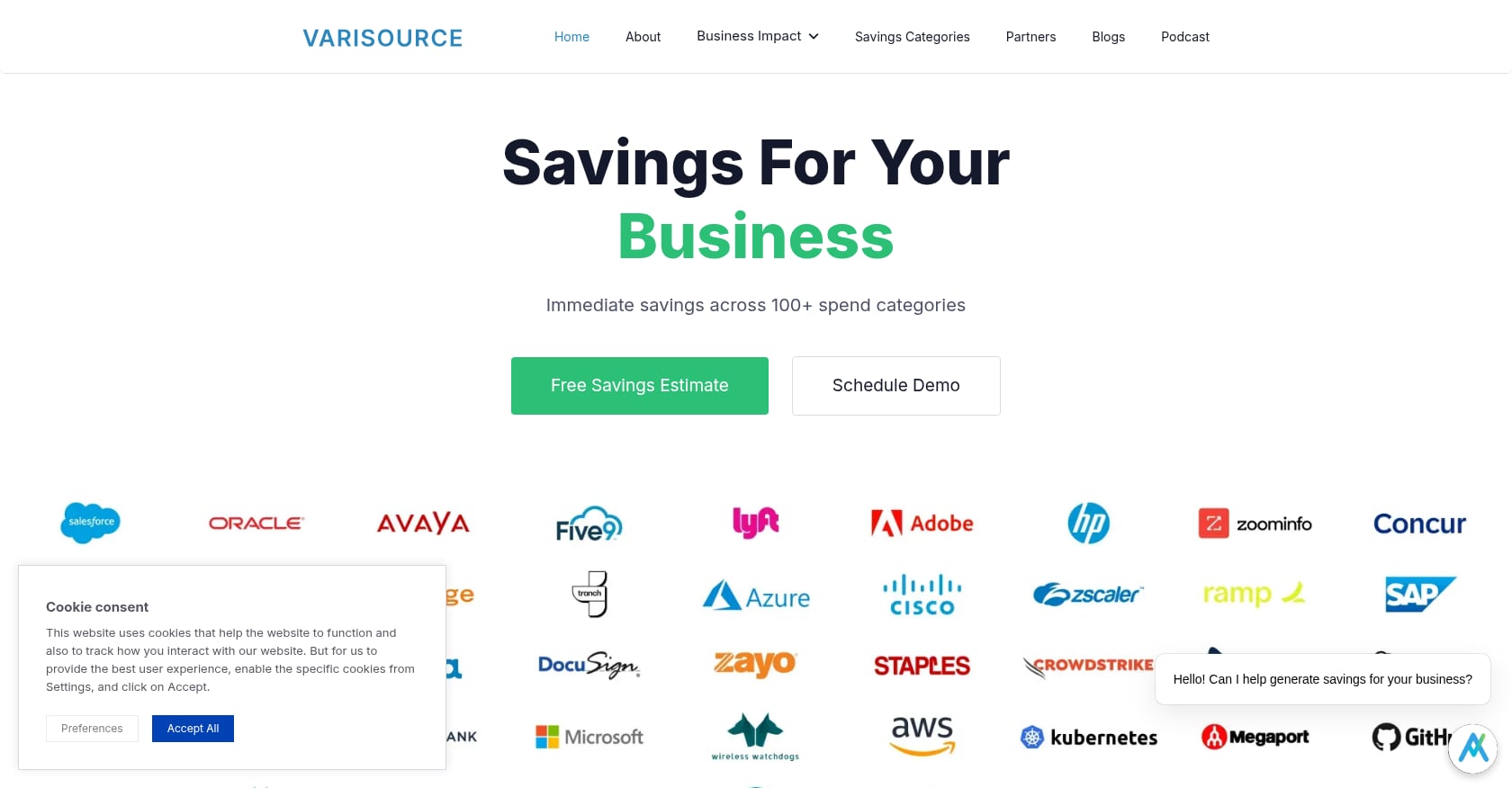
Best for: Mid-market and enterprise organizations that want savings across all indirect spend, not just SaaS, without deploying another enterprise software platform.
Pricing: No upfront cost. Varisource operates on a shared-savings model, meaning you pay only when savings are realized. A free Savings Estimate Report is typically delivered within 48 hours.
Key features:
- Covers 300+ spend categories including SaaS, cloud, security, telecom, hardware, payments, travel, MRO, insurance, consulting, and professional services
- 50 million+ benchmark data points at the SKU and quote level
- Seven purpose-built AI agents: Savings AI, Benchmark AI, Sourcing AI, Extraction AI, Request AI, Negotiation AI, and Contract Reminder AI
- Group buying power backed by $80B+ in purchasing volume, plus rebates on renewals and new purchases
- Done-for-you and done-with-you service model that complements existing procurement, IT, and finance teams
- Savings typically realized in under 30 days with 20 to 30%+ average savings
Why it stands out in SaaS spend management: Every other tool on this list focuses exclusively (or primarily) on SaaS. Varisource is the only option that treats SaaS as one category among many. For organizations that also overpay on cloud infrastructure, telecom, hardware, and dozens of other indirect categories, a SaaS-only tool leaves most of the savings on the table.
The service model is the other major differentiator. Most tools are self-serve software that requires internal expertise and months of implementation. Varisource combines AI agents with hands-on execution, which means your team doesn’t need to become experts in vendor negotiation across every category.
Trade-offs to consider:
- Not a full procure-to-pay suite, so it won’t replace your ERP or P2P system
- Requires sharing AP spend and vendor data to generate savings estimates
- Pricing is not publicly listed beyond the shared-savings structure
Who should look elsewhere: If you specifically need deep SaaS usage analytics at the feature level (who’s using which Salesforce dashboards, for example), a dedicated SaaS management platform like Productiv or Zylo will go deeper on that specific capability.
Explore all 300+ savings categories to see the full scope of indirect spend Varisource covers.
2. Zylo
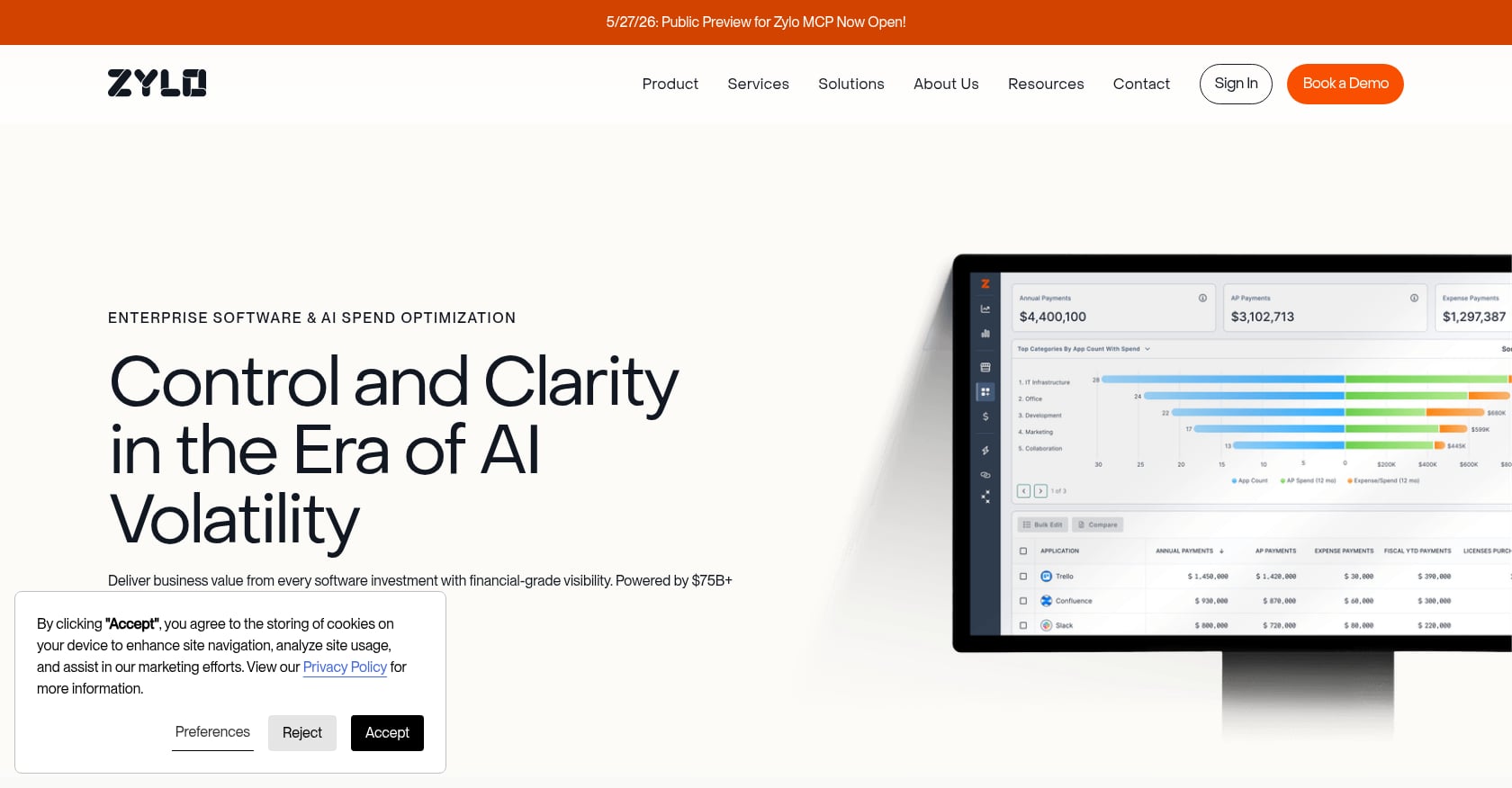
Best for: Large enterprises needing deep SaaS discovery, license optimization, and governance at scale.
Pricing: Custom enterprise pricing, typically starting at $50,000+ annually based on SaaS spend under management. Per-employee estimates range from $12 to $20 per month depending on features and scale.
Key features:
- Powered by the industry’s largest SaaS dataset: 40 million licenses and over $75 billion in spend
- Named a two-time Leader in the 2025 Gartner Magic Quadrant for SaaS Management Platforms
- Only vendor named a Customers’ Choice in the 2025 Gartner Peer Insights Voice of the Customer report
- Publishes the annual SaaS Management Index, which has become the default industry benchmark
- Deep discovery capabilities for finding shadow IT and unmanaged subscriptions
- License optimization recommendations based on actual usage data
Trade-offs to consider:
- Enterprise focus means a larger investment and longer implementation compared to lighter-weight platforms
- SaaS-only coverage with no visibility into cloud infrastructure, telecom, hardware, or other indirect spend
- No free tier or quick-start option
- Data accuracy concerns flagged by some users
What users say: A Gartner Peer Insights reviewer noted that Zylo is useful for monitoring renewal contracts and starting negotiations earlier. However, users on Gartner also flagged that “sometimes the data can be inaccurate and some integrations have trouble.” The G2 rating of 4.8 out of 5 (though based on only 51 reviews) reflects generally strong satisfaction among enterprise buyers.
For organizations focused specifically on enterprise SaaS efficiency, Zylo provides the deepest visibility into application portfolios, but that depth comes at a premium price and a narrow scope.
3. Vertice
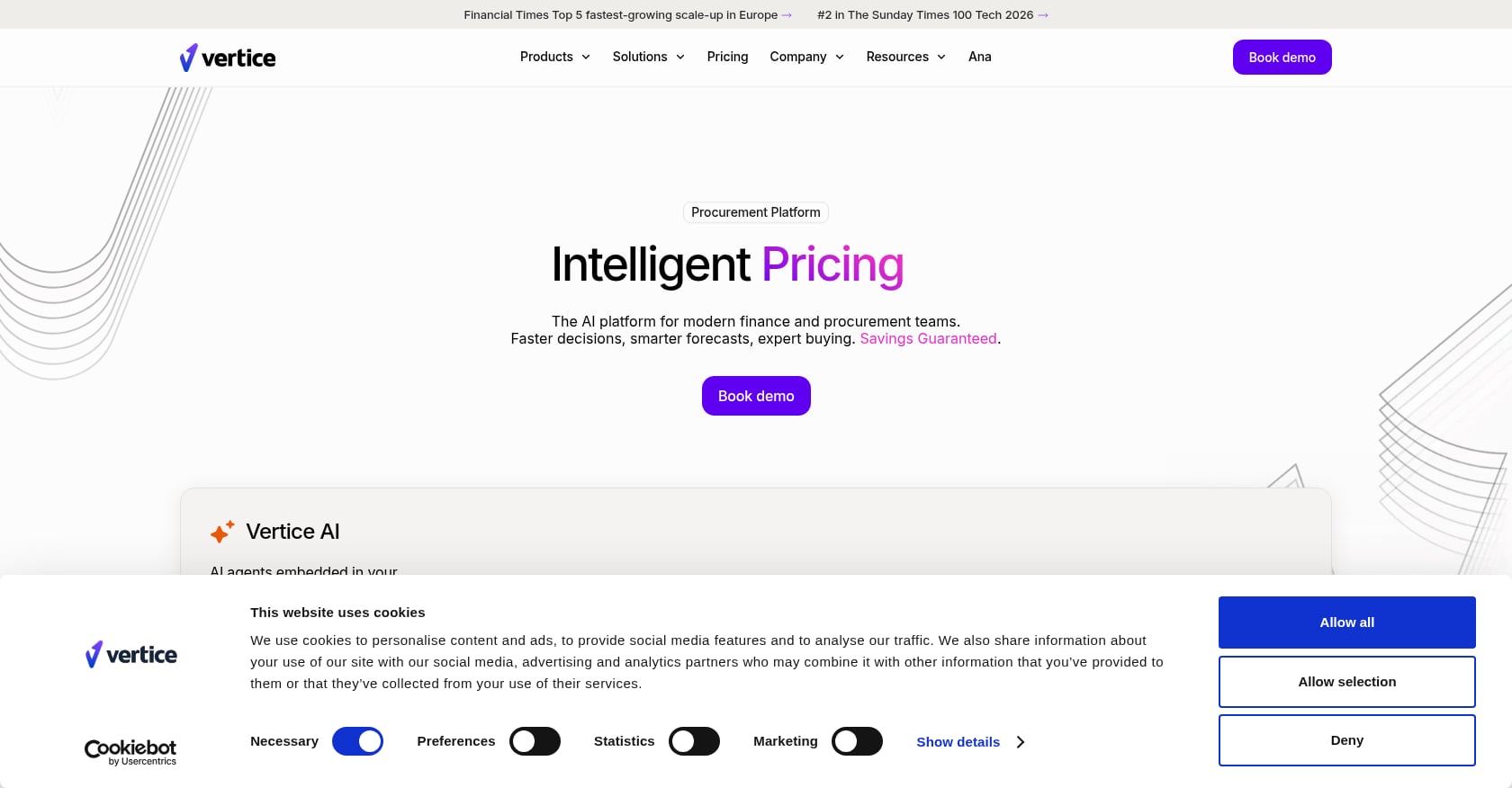
Best for: Mid-market organizations wanting managed negotiation services with guaranteed savings on SaaS contracts.
Pricing: Transparent, tiered pricing based on SaaS spend under management. The Standard plan starts at $30,000 for $250K to $1M in spend (with guaranteed savings of $60,000+). Professional starts at $50,000 for $1M to $2.5M in spend ($150,000+ guaranteed). Premium starts at $80,000 for $2.5M to $5M in spend ($320,000+ guaranteed).
Key features:
- Processes over $30 billion in spend data with a track record of delivering 20%+ savings
- Pricing intelligence from a database of more than 16,000 software providers
- Flat pricing with guaranteed savings, reducing buyer risk
- Strong central contract visibility and renewal management
- Expanding into cloud cost optimization alongside SaaS
Trade-offs to consider:
- Focused on SaaS and cloud, with limited coverage of non-software categories
- No free plan available
- Less depth in SaaS discovery and shadow IT detection compared to Zylo or Torii
- Some manual dependencies in workflows that users note could be improved
What users say: G2 reviewers (4.6/5, 255 reviews) praise the negotiation support and central contract visibility. One reviewer described Vertice as “a true extension of our team.” The guaranteed savings model is a significant draw for organizations wary of paying for a tool that might not deliver ROI.
Understanding the difference between cost savings vs. cost avoidance matters here: Vertice’s guarantees typically refer to hard-dollar savings on renewals, not the softer cost avoidance metrics some platforms use.
4. Tropic
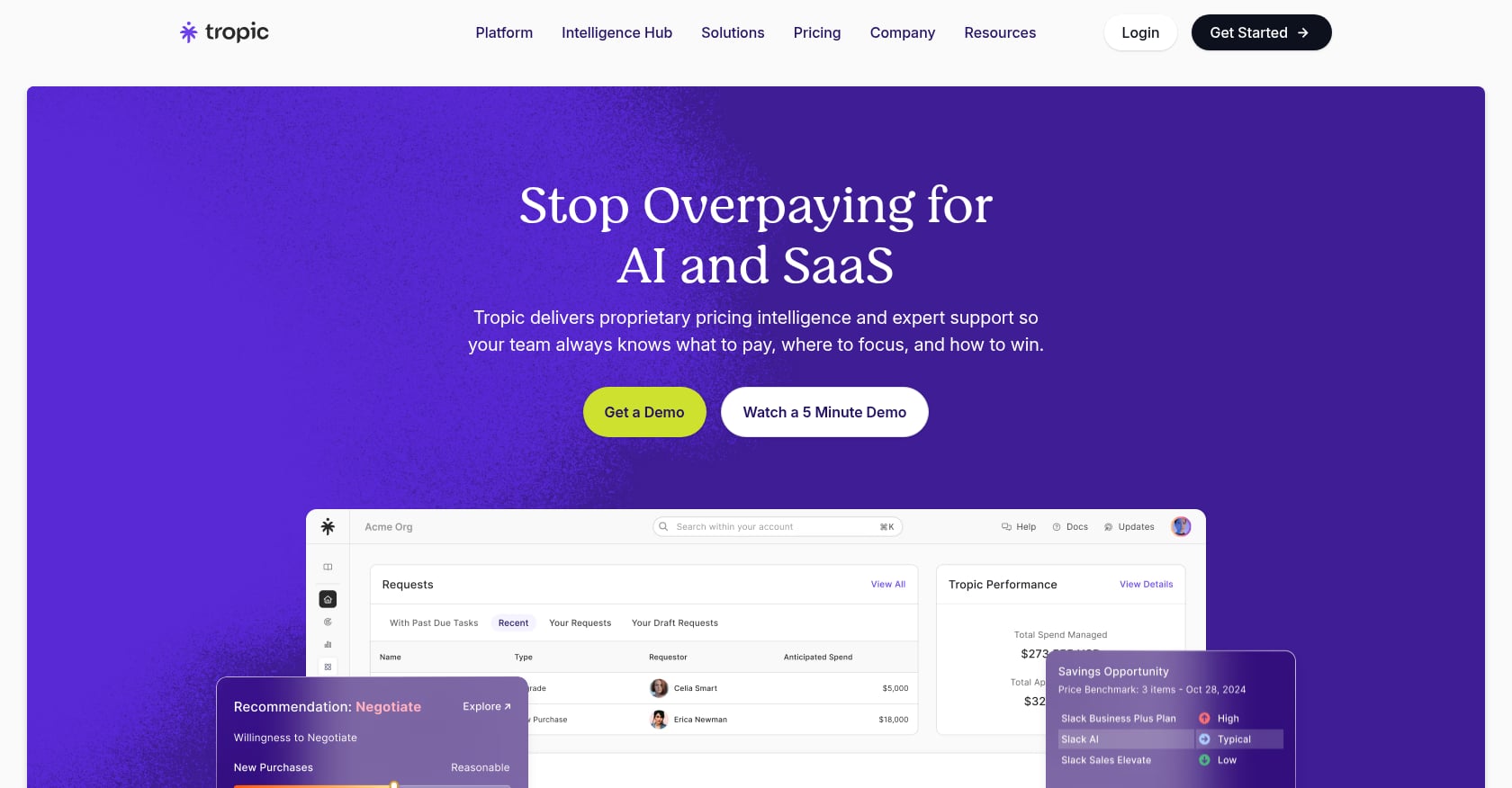
Best for: Tech companies with $1M+ SaaS spend seeking intelligence-driven procurement with intake-to-procure workflow automation.
Pricing: Intake to Procure at $14,500 per year. Intelligent Spend Management at $22,000 per year. Some sources suggest starting around $3,167 per month for certain configurations.
Key features:
- AI agents built on $18B+ in spend insights
- In H1 2025, Tropic negotiated $362 million in customer spend and delivered $56 million in verified savings, a 15.5% average savings rate
- Strong intake-to-procure workflow that automates the entire software buying process
- Rapid benchmarking and vendor comparison capabilities
Trade-offs to consider:
- SaaS-only focus, not a general procurement platform
- Niche vendors and smaller suppliers are not always represented in the benchmark database
- No free tier
- Onboarding can initially feel overwhelming according to multiple users
What users say: G2 reviewers (4.5/5, 134 reviews) highlight Tropic’s benchmarking speed and Microsoft licensing negotiation support as standouts. However, practitioners on G2 note that “some smaller or niche suppliers are not yet represented in Tropic’s database,” which limits utility for organizations with specialized vendor portfolios.
The lower starting price ($14,500/year) makes Tropic more accessible than Zylo or Vendr, though the SaaS-only scope means it can’t address the broader indirect spend optimization challenge.
5. Vendr
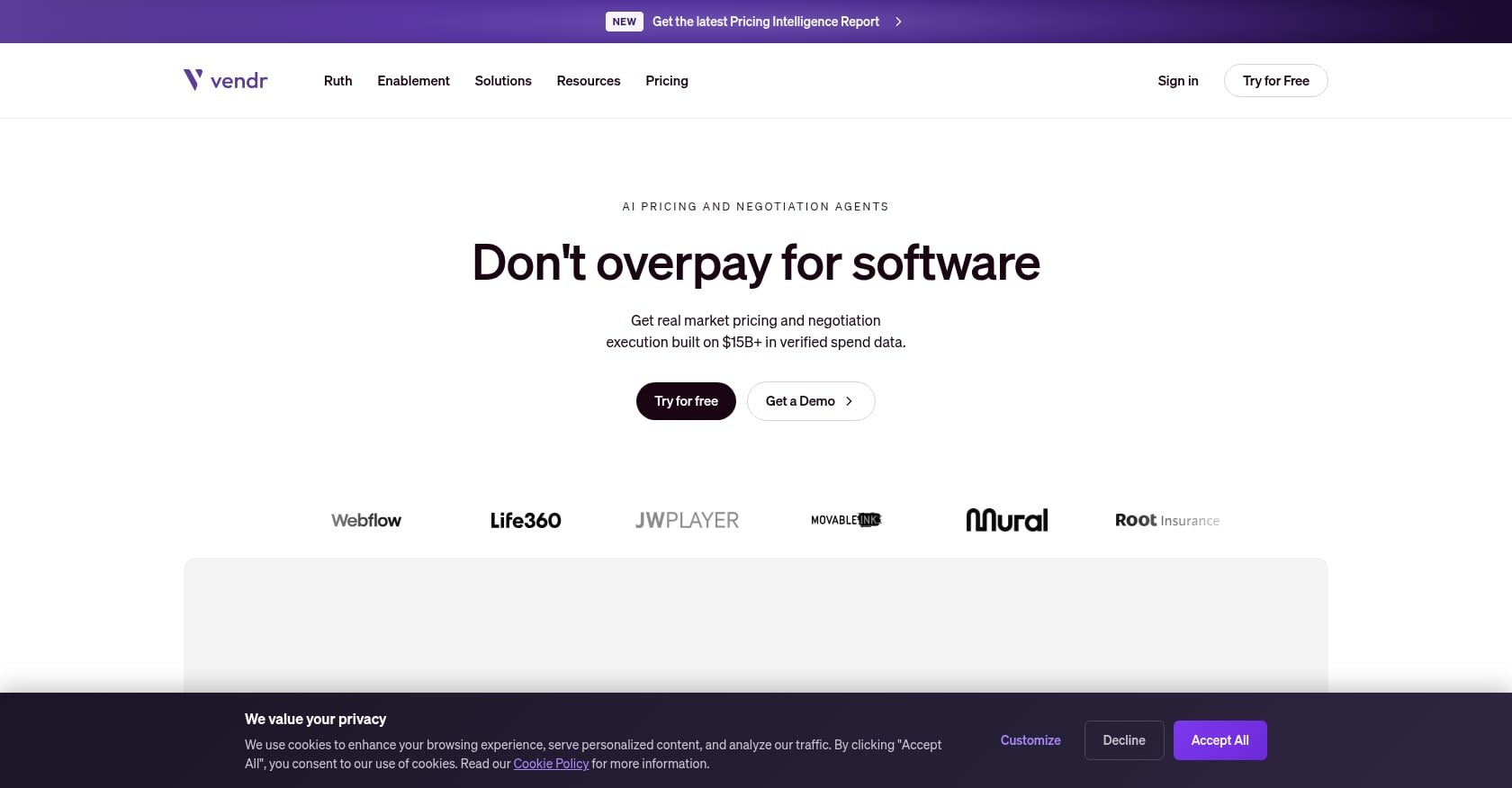
Best for: Teams wanting outsourced SaaS negotiation services backed by the largest deal benchmark dataset in the category.
Pricing: Three tiers ranging from $36,000 to $120,000 per year. Buyers pay a median of $36K annually. A free tier exists but is limited to pricing benchmarks only.
Key features:
- Pricing benchmarks and negotiation playbooks drawn from 130,000+ enterprise deals
- AI-powered negotiator called “Ruth” built on $3B+ in transaction data
- Money-back savings guarantee
- Hands-off model where Vendr handles the negotiation process on your behalf
Trade-offs to consider:
- Lacks true SaaS management features like user provisioning and detailed license tracking
- Key capabilities require expensive add-ons costing thousands extra per month
- High minimum spend threshold (roughly $400K+ in SaaS spend for meaningful ROI)
- SaaS-only coverage
- Negotiation service quality varies depending on which account manager is assigned
What users say: G2 reviewers (4.6/5, 111 reviews) appreciate the convenience of outsourced negotiation. But the variability in account manager quality is a recurring theme. Users note that the experience can be excellent with one representative and mediocre with another. The free tier is useful for benchmarking but won’t deliver actual savings without upgrading.
6. Torii
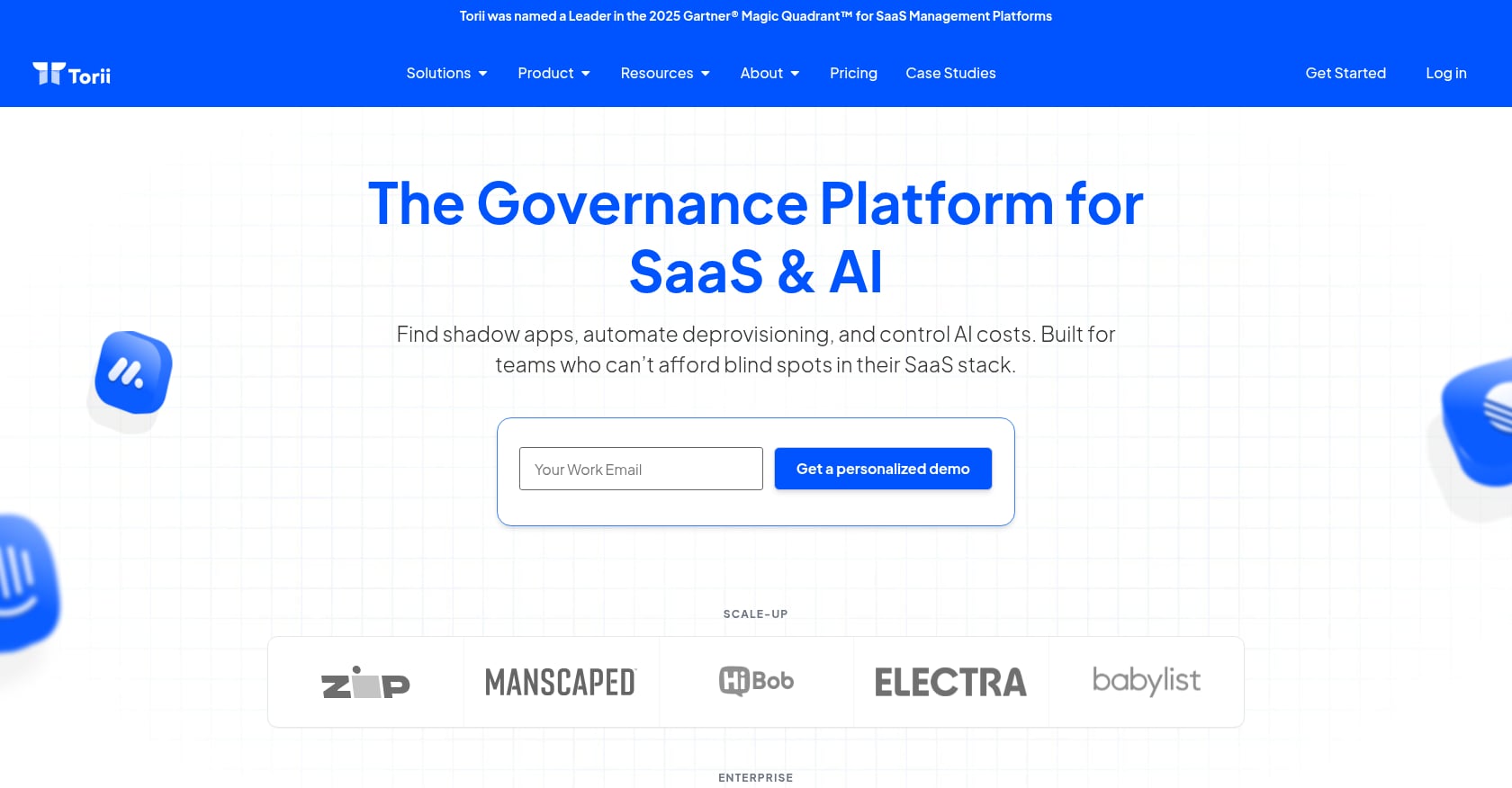
Best for: IT teams focused on shadow IT discovery, SaaS governance, and automated lifecycle management.
Pricing: The most accessible entry point in this category. The Basic plan costs $2.75 per employee per month (monthly billing) or $2.50 per employee per month (annual billing). Enterprise pricing is custom.
Key features:
- Proactive environment scanning that finds hidden systems before a credit card charge surfaces
- 200+ native integrations
- No-code workflow automation for SaaS lifecycle management
- Highest review count in the category on G2 (302 reviews at 4.5/5)
Trade-offs to consider:
- IT-centric, making it less useful for procurement or finance-led organizations
- Benchmarking is weaker than Zylo, Vertice, or Tropic
- Negotiation support is minimal
- Contract expiration reminders described as “very weak” by Gartner reviewers
- Price benchmarks “do not give a real picture of what you pay via others,” per one Gartner reviewer
What users say: One Capterra user reported using Torii across two companies, calling it “cheap and powerful.” The strength is clearly in discovery and governance. If your primary problem is “we don’t even know what SaaS apps are running in our organization,” Torii is purpose-built for that. But it won’t negotiate your renewals or tell you whether you’re overpaying relative to market.
7. Productiv
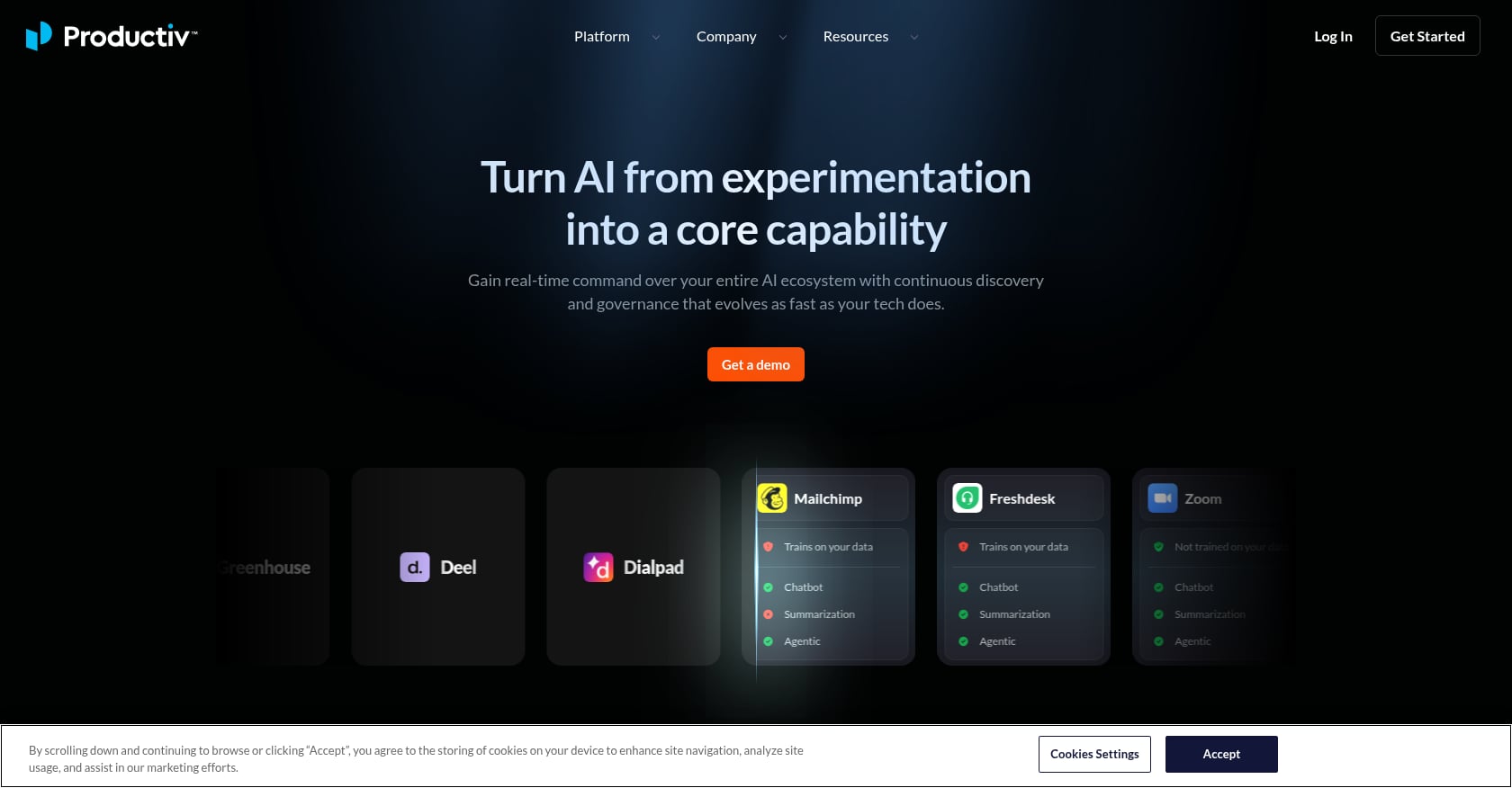
Best for: Enterprise IT and security teams needing feature-level SaaS usage analytics and AI governance capabilities.
Pricing: Custom, enterprise-only. No public pricing available. Tiered based on users, modules, and enterprise requirements.
Key features:
- Goes beyond basic login tracking to show how features are used, which teams are adopting specific tools, and where licenses are underutilized
- Strong AI and shadow AI detection capabilities
- Deep integration with IT service management and security workflows
- Useful for forecasting and cash expenditure planning
Trade-offs to consider:
- Limited to SaaS contracts only
- No built-in negotiation or procurement services
- Approach is centered on usage analytics rather than pricing benchmarks or negotiation support
- Lacks pricing transparency
- Support concerns: a Gartner reviewer flagged that “majority of our problems with the tool were not solved or took 6+ months to solve” with “constant rep changes on the account”
What users say: G2 reviewers (4.6/5, 75 reviews) praise the depth of analytics. One user said Productiv was “instrumental in improving our cash expenditure and outflow forecasting.” But if you need actual savings execution, you’ll need to pair Productiv with a negotiation service or a broader vendor savings program.
Honorable Mention: SpendHound
Best for: Budget-conscious teams wanting free SaaS visibility and benchmarking.
SpendHound offers a free SaaS spend management tool, but the trade-off is explicit. Per their Terms of Service, your spend data is de-identified and aggregated to power their benchmarking database. If you’re comfortable with that exchange, it’s a reasonable starting point for small teams with no budget for SaaS management tooling. Just know that the “free” model has a cost that isn’t measured in dollars.
How to Choose the Right SaaS Spend Management Tool
The right tool depends on three factors: who owns the problem internally, how broad your spend challenge is, and how much capacity your team has for self-serve management.
Start with who’s driving the initiative.
If IT owns the project and the primary pain is shadow IT, ungoverned applications, and license waste, a SaaS management platform like Zylo, Torii, or Productiv makes sense. These tools excel at discovery and ongoing governance but won’t negotiate your contracts.
If procurement or finance owns the project and the goal is reducing SaaS renewal costs, a negotiation-focused platform like Vertice, Tropic, or Vendr fits better. These tools deliver measurable savings but don’t provide deep usage analytics.
If the CFO or CEO is looking at total vendor spend (not just software), the scope is bigger than any SaaS-only tool can address. That’s where a program covering all indirect spend categories becomes relevant.
Consider the “service vs. software” divide. Practitioners on G2 and Gartner consistently report a pattern: tools with managed negotiation services get higher satisfaction scores on cost savings, while self-serve platforms score higher on ongoing visibility. The implication is that organizations often need both capabilities, or they need a program that combines service with AI.
Budget reality matters. The range is enormous:
- Free (SpendHound, with data trade-offs)
- $2.50/employee/month (Torii Basic)
- $14,500 to $22,000/year (Tropic)
- $30,000 to $120,000/year (Vertice, Vendr)
- $50,000+/year (Zylo)
- No upfront cost, shared savings (Varisource)
For organizations facing implementation fatigue (a barrier that multiple G2 reviewers flag across tools, citing weeks or months to full deployment), time to value should weigh heavily in the decision. A spend management strategy that delivers results in weeks rather than quarters has obvious appeal, particularly when budget pressures are immediate.
Don’t forget what SaaS-only tools miss. The 2026 trend is consumption-based pricing across SaaS, cloud, and infrastructure. Organizations managing AWS, Azure, GCP, telecom, and hardware alongside SaaS can’t solve the full problem with a SaaS-only tool. AI spend alone rose 108% year over year, much of it outside traditional SaaS licensing models.
See how Varisource helps finance teams reduce vendor costs across every indirect spend category with no upfront investment.
Frequently Asked Questions
What is SaaS spend management?
SaaS spend management is the process of tracking, analyzing, and optimizing everything an organization spends on software-as-a-service applications. It includes discovering which tools are in use, monitoring license utilization, benchmarking prices against market rates, managing renewals, and negotiating better contracts. The goal is to eliminate waste from unused licenses, redundant tools, and above-market pricing.
How much do companies waste on SaaS?
Analysts estimate that 25% of every SaaS dollar is wasted on unused or underused resources. With global enterprise SaaS spending exceeding $300 billion, that translates to roughly $45 billion in annual waste. At the individual company level, organizations leave an average of 36% of their SaaS licenses unused, according to the Zylo 2026 SaaS Management Index. Proper license optimization can recover 23 to 30% of total SaaS spending.
What’s the difference between SaaS management and SaaS spend management?
SaaS management is the broader discipline of governing your entire SaaS portfolio, including discovery, security, compliance, user provisioning, and lifecycle management. SaaS spend management specifically focuses on the cost dimension: how much you’re paying, whether you’re overpaying, and how to reduce waste. Many tools overlap across both areas, but platforms like Torii and Productiv lean toward management, while Vertice and Vendr lean toward spend optimization.
Can AI help reduce SaaS costs?
Yes, but AI is also causing new cost challenges. On the reduction side, AI-powered tools now automate benchmark analysis, contract extraction, and even vendor negotiation. On the cost side, AI-native applications are the fastest-growing spend category, up 108% year over year. And 78% of IT leaders report unexpected charges from consumption-based AI pricing models. Effective SaaS spend management in 2026 requires tools that can handle both traditional seat-based licensing and newer consumption-based AI pricing.
What does a SaaS spend management tool cost?
Prices range dramatically. Free options like SpendHound exist (with data trade-offs). Entry-level platforms like Torii start around $2.50 per employee per month. Mid-range tools like Tropic begin at $14,500 per year. Enterprise platforms like Zylo, Vertice, and Vendr range from $30,000 to $120,000+ annually. Varisource takes a different approach with no upfront cost and a shared-savings model where you pay only when savings are realized.
Do I need a SaaS spend management tool if I have a small team?
It depends on your total SaaS spend, not your team size. Small teams at growing companies often have surprisingly large SaaS footprints because individual employees sign up for tools independently. If your organization spends more than $250,000 annually on SaaS, the savings from a dedicated tool or service will likely exceed the cost. For organizations looking to start with practical tips to improve SaaS spend management, manual processes can work at smaller scales before investing in a platform.
Why is SaaS-only spend management sometimes not enough?
Because SaaS is just one category of indirect spend. Organizations also overpay on cloud infrastructure, telecom, hardware, payments, insurance, and professional services. A tool that optimizes your Salesforce contract but ignores your AWS bill, telecom agreements, and payment processing fees captures only a fraction of the available savings. The trend in 2026 is toward broader indirect spend management that treats all vendor costs as optimization opportunities.
About the Author

Victor Hou
Victor Hou is the founder of Varisource, the first ever Savings Automation Platform that automates Savings for Your Business. Victor helps companies access discounts, rebates, benchmark data, savings for renewals and new purchases across 100+ spend categories automatically to increase your company's margins and equity value by at least 15-20%. Victor is active and passionate about using AI + automation to help your business save time, money and run more efficiently.
%201.svg)

Varisource’s Savings Automation Platform guarantees savings and maximized leverage on every dollar spend across 100+ spend categories


