How to Find IT Vendor Savings Opportunities Without Switching

A customer of ours was quoted $1.1 million for Cisco UCS blades, and Cisco said it had already given the biggest discount it could. We went out to the market and got HP, Dell and several other vendors to compete for the business. Once Cisco saw that competition, and saw the customer potentially looking at other products, they were very quick to negotiate further. The quote came down to around $825,000.
I think there are vendor savings opportunities in every category, no matter the vendor. Most of the savings we generate at Varisource come this way: the customer stays with the same vendor, and competition moves the price. That matters because the effort of switching is one of the things that kills savings inside a company. We've found 20 to 30% telecom savings that never happened because the people involved didn't want to change IP addresses or reinstall internet service, and sometimes they just stopped responding.

Key Takeaways
- Internal resistance to changing IP addresses or reinstalling internet service prevents 20 to 30% of potential corporate telecommunications savings.
- Software vendors typically strategize contract renewals 90 days in advance while customers prepare only 30 days prior, contributing to average initial overcharges of 10 to 15%.
- Presenting alternative quotes from Adobe Sign, HelloSign, and Dropbox Sign forced DocuSign to eliminate an 18% overcharge without requiring the customer to switch platforms.
- Generating competing bids from alternative channel partners allowed one company to reduce a 3 million dollar Microsoft Enterprise Agreement through CDW by 12%.
- Shifting general software spending into the AWS marketplace satisfies vendor revenue goals and provides negotiation leverage to reduce Amazon Elastic Compute Cloud costs by over 30%.
- Analyzing end-user software utilization enabled procurement teams to eliminate an unused Workato premium support fee that accounted for 15% of the total contract spend.
Why Do IT Vendor Churn Threats Fail Without Competitive Market Leverage?

The standard advice for getting a vendor to move on price is to threaten to leave. For a CIO with no plan to switch, I think it's a poor tactic. The vendor can see your usage and how deep the product sits in your workflows, and so the vendor knows you are stuck. Asking for a better price with nothing behind it doesn't work either, because if you don't have leverage, they're not going to do anything.
Leverage is information and competition. You need to know what the market charges for what you're buying, you need like-for-like vendors who want the business, and you need enough time before the renewal to use both. A market benchmark or a quick RFP opens the opportunity up to the market, and the market will fight for your business. So even if the CIO doesn't plan to change, we still have to create the competition to create that leverage.
On the first call of one Datadog renewal, the rep kept telling us they couldn't reduce the price, because it was a usage product and they'd already given the best discount they could. Over several calls we built leverage through competition, through optimization options and through talking it through with the customer. The discount went from 5% all the way to 20%.
How Do SaaS Vendors Strategize 90 Days Before IT Contract Renewals?
I spent 15 years on the vendor side, and so I know what happens before a big renewal. The sales team gets together months ahead, because to them the renewal is revenue, whereas the customer looks at it as a cost. They go through your spend, usage and support history and build a story about the value they've created. They've obviously set up the notice periods. They also pick the reasons and the timing for reaching out so you don't have time to negotiate, find alternatives or switch.
The story is selective. It features SLA uptime and the discounts you've had in the past, and it leaves out how many support tickets you opened and how slow delivery was. The renewal line I remember from those years was always some version of the same thing: the service has been great, the team put in a lot of effort, and the pricing you have is really, really good. All of it is there to give you enough comfort and confidence that you don't go out to market.
Vendors strategize for 90 days while customers deal with it 30 days in advance, and that's a big part of why customers overpay. On average, I think vendors overcharge by at least 10 to 15% on the first contract. That overcharge accumulates with every renewal, new service and multi-year term once the vendor knows you're not leaving.

That's how SaaS vendors normalized 8 to 20% annual increases, because software that sits inside your workflow is much harder to replace than office supplies. Those increases tend to land on the roadmap. Among IT leaders in Zylo's 2026 SaaS Management Index, 61% had cut projects because of unplanned SaaS cost increases.
Annual SaaS price increases are only one of the IT vendor savings opportunities where technology spend leaks, and each can be recovered without switching vendors.
Where IT spend leaks | Typical size or frequency | How to recover it without switching vendors |
|---|---|---|
SaaS price increases at renewal | 8-20% price increase per year | Benchmark against last year's invoice and market prices 90-120 days out |
Unused SaaS licenses and support fees | 36% of SaaS licenses unused vs recommended utilization (2026 index) | Cut unused seats and support fees based on users' input |
Duplicate SaaS tools (e.g., several CRMs after acquisitions) | Average 10 project-management apps per organization (2026 index) | Keep one tool you already own and cancel the duplicates |
Wasted cloud spend (AWS, Azure, GCP) | Respondents estimate 29% of IaaS/PaaS spend wasted (2025 survey) | Three-year savings plan rates on month-to-month terms, idle resources shut off |
Telecom contracts not re-priced | 20-30% savings found on the same service | Competing carrier quotes for the same service in the same building |
Missed renewal dates, auto-renewals and poor contract management | Almost 9% of contract value lost on average, where measured (2026) | Track every contract end date from the AP file, 90-120 days ahead |
Unmonitored AI and usage-based tool spend | 78% of IT leaders reported unexpected AI or usage-based charges in a year (2026 index) | Usage monitoring, model-use policies, AI routers and wholesale aggregators |
How Do Renewal Dates and Duplicate SaaS Tools Impact IT Procurement Negotiations?
When you inherit a few hundred vendors and no contract list, I'd spend the first month on two things: tools that overlap, and the date every contract renews. WorldCC's research found contract data scattered across an average of 24 systems, so I'd begin with the AP file, which shows who you're actually paying. Then you map a contract end date to every single vendor and pull out the renewals due in the next 30 to 50 days. From there you rank vendors by which ones probably have the biggest return.
Duplicates are one of the first things I look for. We find multiple e-signature tools, multiple CRMs, and productivity tools like Monday.com, ClickUp and Smartsheet all paid for at once. One company had four different CRMs doing the same thing, picked up through acquisitions and never consolidated. When you consolidate, you keep a tool you already own and stop paying for the others, and there's still no new vendor to bring in.
The dates decide how much leverage you'll have. We've had customers come to us with two weeks left on a vendor deeply integrated into their systems. The vendor knew they weren't going to switch in two weeks, and that's very, very hard to negotiate against. Most of the negotiations we lose come down to time like that, and we learned from it to track renewals way ahead, 90 to 120 days out.
A missed date can also cost money with no negotiation at all. We found one customer spending $1.1 million on services for an office and a project that had already closed, because the contract auto-renewed and no one noticed. Another customer we'd reminded several times responded too late and got auto-renewed for three years.
How Does End-User Software Utilization Data Reduce IT Vendor Renewal Costs?
Before we benchmark anything or call the vendor, we line up last year's invoice and contract against this year's. If the price went up, I want to know whether features changed, licenses or services grew, or the increase is just coming from the vendor. Then we sit down with the people who use the product. We ask how they use it, which parts get used and which don't, and whether they expect growth or reductions. We also ask how the tool has helped them reach their goals. Sometimes they realize it isn't a good fit, or isn't really being used.
Those answers point to money in parts of the contract the team doesn't use. On a Workato renewal, a premium support fee made up 15% of the total spend. The customer rarely used that support and the vendor couldn't validate the usage, so we negotiated the fee out. On a NetSuite renewal, the customer wasn't using NetSuite support and hadn't heard from their sales rep until renewal time. With that and the benchmarks, we helped the finance leader secure an additional 12 to 13% with the same software scope.
That NetSuite renewal came with fear tactics. Software vendors often use them when they're pushed on price, threatening to remove features or warning that support may not be as good. I think it backfires, because it makes the customer uncomfortable and less willing to partner. If you understand how software works, it's built already and usually costs the vendor the same on the back end. Paying less simply means less margin for the vendor, with no downgrade for the customer at all.
How Do Vendor and Competitive Market Benchmarks Reduce IT Procurement Costs?
Every vendor charges every customer a different price because they can. On the vendor side, I saw services bought at a low cost sometimes marked up over 200% because the customer could afford it. All the customer ever sees is a price and a discount.
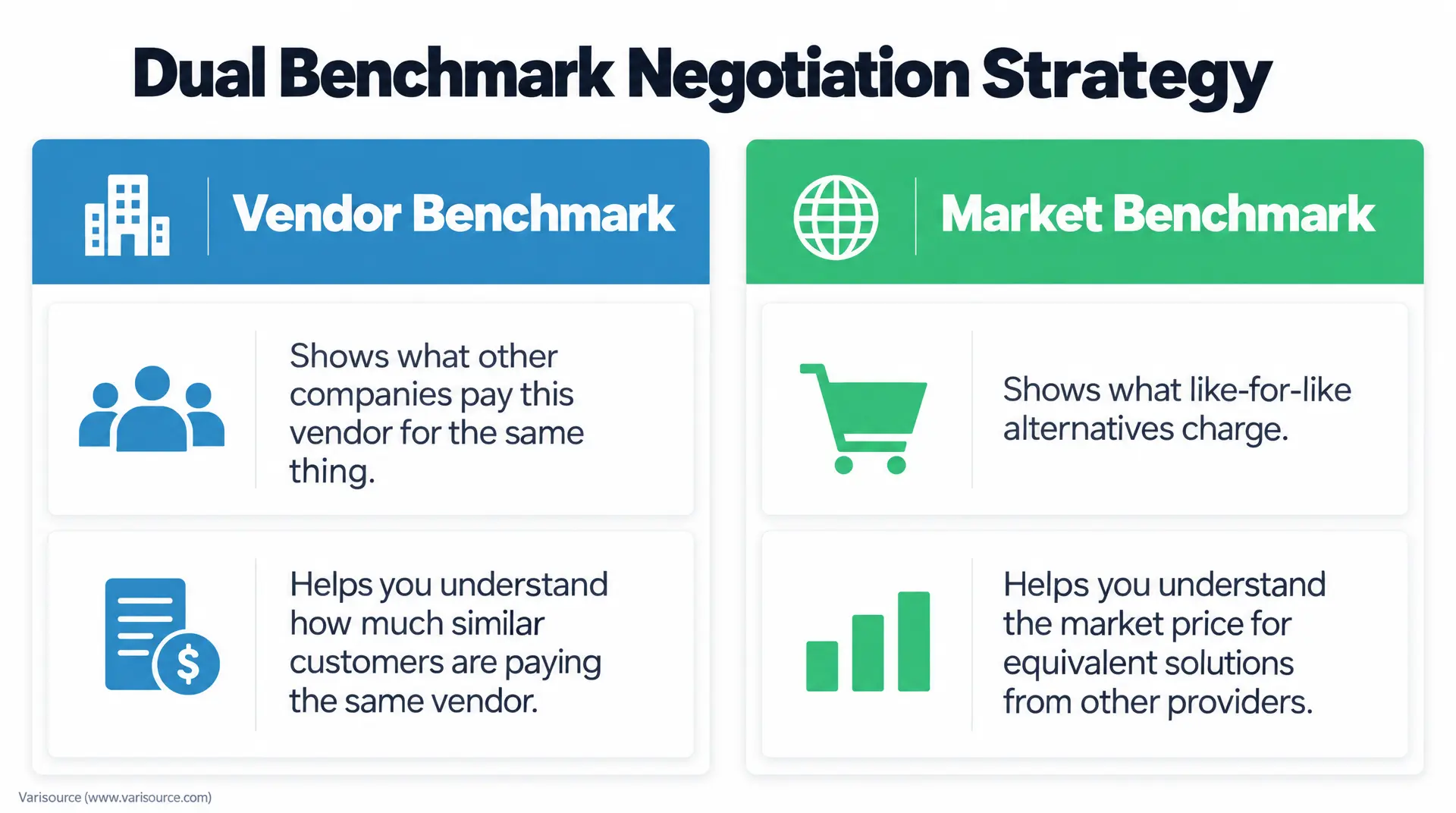
On a renewal we build two benchmarks. A vendor benchmark shows what other companies pay this vendor for the same thing, and a market benchmark shows what like-for-like alternatives charge. We build the market benchmark even on something like an ERP, where the customer may never switch, so the current vendor knows what the market offers. Five methodologies go into it, including anonymized spend data from thousands of customers and distributor and wholesale pricing that shows the vendor's costs and margins. They also include quotes from alternative vendors, which are the truest benchmark because competition shows the real market rate.
Discounts are sometimes very tricky, because a discount is off whatever list price the vendor picked. AT&T quoted one customer 100-meg internet at $8,000, presented as 20% off a $10,000 list price. Verizon and Vayo offered $5,000 for the exact same service in the exact same building. Increases need the same check, because last year's price may already be high. One DocuSign renewal for 30,000 envelopes came with an automatic 15% increase on a price already over 40% above market, and with the benchmark the finance team successfully pushed back.
How Should Procurement Executives Structure Initial IT Vendor Contract Renewal Calls?

When we call a vendor on a customer's behalf, we explain that we've been hired by the finance and procurement executives to re-evaluate budgets and vendor renewals. We tell them the vendor needs to meet certain benchmarks to continue the business, and that we're not just going to renew automatically with no due diligence and insight. If the rep treats that as a bluff, we commit right there to coming back with market benchmarks and running a competitive RFP.
The rep's defense is predictable: yes, we are not the cheapest, but we provide a lot of value, our support is great, and the customer has been with us for many years. When you show them benchmarks, keep it professional and look for a win-win, they're usually very willing to help.
Whether you switch or not, you can decide, but at least you put the vendor in a competitive situation. For one customer, DocuSign was overcharging by 18%. We brought in like-for-like quotes from Adobe Sign, HelloSign and Dropbox Sign that were at least 60% cheaper, and DocuSign reduced its pricing without the customer's CFO putting in any effort.
With Microsoft, the competition can come from the channel. A customer spending $3 million on a Microsoft Enterprise Agreement was being overcharged 12% by their reseller, CDW. The competing bids we secured let them move to another reseller and capture the savings, still on Microsoft. Comparing CSPs and resellers is like shopping for flights and hotels on Expedia or Booking.com.
How Can Procurement Teams Optimize Usage-Based Cloud Computing and AI Bills?
Cloud savings for our customers average 25 to 35%, and the main levers keep you on AWS, Azure or GCP. AWS lists Compute Savings Plans at up to 66% off, but only with a one- or three-year commitment that can't be cancelled during the term. So customers who want flexibility usually stay on demand or on one-year terms and give up the three-year pricing. We're able to get customers three-year term discounts on month-to-month flexibility, usually on EC2 and compute, savings plans and RIs.
Benchmark and leverage all depend on understanding what the other salesperson is looking for. We helped one customer move a large portion of their software spend into the AWS marketplace. That raised their overall AWS spend and satisfied AWS's revenue goals, and it gave us the leverage to bring their compute costs down by over 30%.
Usage-based bills also creep. Developers spin up modules and forget to turn them off. Cloud vendors change pricing models, add unrequested modules and hold back the right SKU-level discounts as usage scales. Vendors are never going to tell you these details, because they expect the technical stakeholders to watch usage while the CFO just pays the bill. That leaves your team in the best position to catch it.
AI spend has the same problem, and a lot of companies don't have monitoring or visibility into how it even works. Without policies on which models people use, prompts and agents quietly rack up charges before management notices. Asking for a better price usually gets you told to use less. The leverage comes from understanding the billing components and setting internal controls. It also comes from AI routers that send queries to different tools and from aggregators that offer wholesale rates on the underlying engines.
How Do Benchmarks and Competitive Data Help CFOs Validate IT Vendor ROI?

I think CFOs roll over on technology vendors because it's hard to negotiate something you don't understand, a lot like telling the mechanic how to fix your car. You know which tools get used, which renewals are coming and how deep each integration goes. When every renewal gets a baseline, two benchmarks and real competition 90 days out, you can show the CFO that every spend dollar with a vendor has an ROI. The money that comes back can fund your roadmap.
If you have a big renewal three to six months out, or an AP file that hasn't had a close look, I'd be glad to go through it with you. Vendor names and the last 18 months of spend are enough for our team at Varisource to show you where the savings are.
Frequently Asked Questions
How can IT leaders combat aggressive SaaS inflation during renewals?
Vendors rely on lock-in to push double-digit increases. With SaaS inflation hitting 14.3%, according to Vertice's spend data, you must decouple price from dependency. Demand SKU-level usage data, introduce competing quotes even if you won't switch, and force vendors to defend their margins 90 days out.
What causes the highest unexpected costs in AI and usage-based billing?
Lack of visibility is the primary driver. Zylo's index notes that 78% of IT leaders report unexpected charges from AI features or consumption pricing. Developers spin up tools without central monitoring, allowing vendors to scale charges quietly. You must implement strict routing controls and SKU-level monitoring before negotiating.
How does poor contract flexibility impact long-term vendor savings opportunities?
Locking into rigid terms destroys leverage when business needs shift. WorldCC research shows 83% of executives find contracts too rigid to adapt. To protect your roadmap, demand downside elasticity in agreements, allowing you to scale down licenses without penalties if infrastructure requirements suddenly decrease.
Why must FinOps practices extend beyond AWS and Azure to include SaaS?
Cloud and SaaS are converging into a single consumption problem. The FinOps Foundation notes 90% of practitioners now manage or plan to manage SaaS. Applying FinOps unit-cost analysis to your software portfolio prevents vendors from hiding premium support fees and unused licenses within complex, auto-renewing enterprise agreements.
How much public cloud spend is typically wasted by engineering teams?
Without proper controls, waste is massive. In Flexera's 2026 survey, respondents estimated 29% of IaaS and PaaS spend was completely wasted. Engineering teams optimize for speed, leaving orphaned instances behind. Capturing these vendor savings opportunities requires automated usage monitoring paired with aggressive architectural reviews, not just contract discounts.
About the Author

Victor Hou
Victor Hou is the founder of Varisource, the first ever Savings Automation Platform that automates Savings for Your Business. Victor helps companies access discounts, rebates, benchmark data, savings for renewals and new purchases across 100+ spend categories automatically to increase your company's margins and equity value by at least 15-20%. Victor is active and passionate about using AI + automation to help your business save time, money and run more efficiently.


Varisource’s Savings Automation Platform guarantees savings and maximized leverage on every dollar spend across 100+ spend categories


