How to Negotiate Discounts With Vendors Using IT Benchmarks

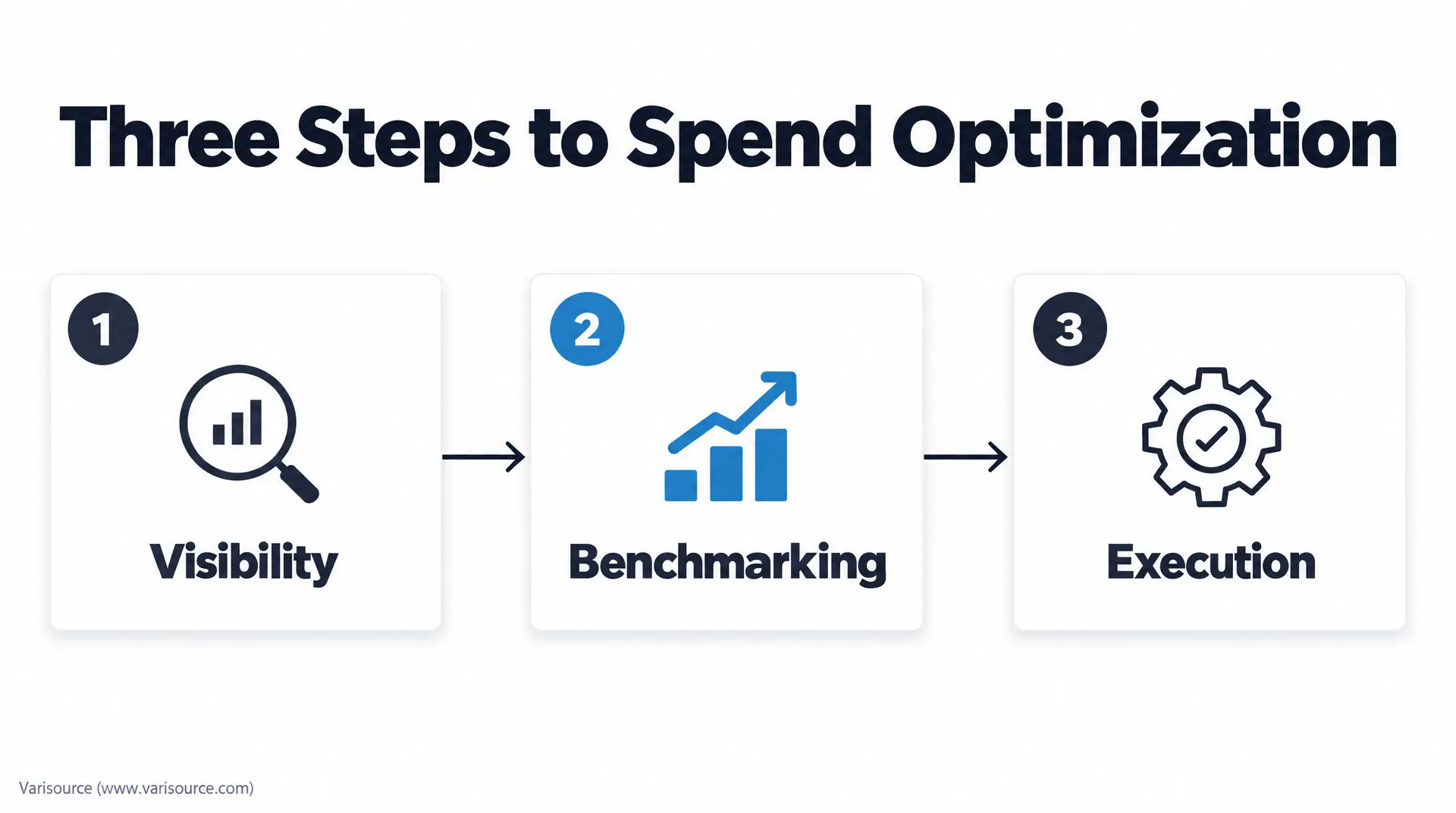
You can't optimize what you can't see, so visibility comes first. Your spend tool can show that you spent $2 million on Microsoft last year, but it can't tell you whether that was a good price, because benchmarking is totally separate from visibility. I look at spend optimization as three steps: visibility, benchmarking and execution.
A customer of ours was spending about $3 million on a Microsoft Enterprise Agreement for E5 licenses, bought through the reseller CDW. With the renewal coming up, our benchmark showed CDW was overcharging by 12% on the exact same licenses. For execution, we got bids from multiple resellers to compete with CDW, and the customer captured the savings with another vendor.

How Are IT Pricing Benchmarks Sourced for Vendor Negotiations?
Our benchmarks at Varisource are built at the SKU level from three sources. The first is anonymized spend data from thousands of customers, which shows what everybody is actually paying. That matters because every vendor charges every customer a different price, simply because they can. The second is distributor and wholesale pricing, which shows the vendor's costs and margins on the back end. The third is like-for-like quotes from alternative vendors. I spent 15 years on the vendor side, and there were times we bought a service at a low cost and marked it up more than 200% because the customer could afford it.

Why Should You Benchmark Baseline IT Contracts Before Vendor Renewals?
Before benchmarking, we match last year's invoice and contract against this year's to see what changed. Then we benchmark the baseline too, because the overcharge is usually already in it. On average, vendors overcharge by 10 to 15% on a first contract. That compounds through renewals, add-ons and multi-year terms once the vendor knows you are stuck. Even federal price-analysis rules say prices previously paid should be adjusted for material differences in terms, quantities and market conditions.
One customer's DocuSign renewal for 30,000 envelopes came with an automated 15% increase. Before that increase, they were already paying over 40% above market, and the benchmark let the finance team push back successfully.
What Are Common IT Vendor Tactics for Resisting Pricing Negotiations?
When I was selling and a customer pushed back on price, we had a playbook. You built an ROI case that was hard to argue with, showed how difficult it would be to get similar service elsewhere and pointed out where other vendors fell short. The renewal pitch was that the service has been great, the team put in a lot of effort, and the pricing they have is really, really good. All of it was meant to give the customer enough comfort that they never went out to market.
Vendors will tell you they've already given 30% off list, or that they got the best pricing from the manufacturer. Discounts are tricky, because business buyers have no Zillow or Expedia showing what others pay. That lets vendors invent the list price and then discount off it.
One customer got an AT&T quote for 100-meg internet at $8,000, presented as 20% off a $10,000 list price. Verizon and Vayo both quoted $5,000 for the exact same service in the exact same building.
How Do IT Vendors React When Presented with Pricing Benchmarks?
Once the benchmark is on the table, the answer changes to "Yes, we are not the cheapest, but we provide a lot of value, our support is great, and the customer has been with us for many years." When you show reps the market in a professional way and still create a win-win, they're usually very willing to help.
Push harder and vendors usually warn that you might get fewer features. Licensed software is built already, and it usually costs the vendor about the same on the back end however many people use it, so there's still a lot of room to move. That argument is weaker for usage products such as Datadog, which prices on units like hosts and gigabytes of log ingestion. Datadog's first answer to us was that they'd already given the best discount they could. Over several calls we built leverage through competition and optimization options, and the discount went from 5% to 20%.
Support is worth checking item by item. A lot of customers never use it, and some pay for support components other customers get for free. One Workato customer was paying a premium support fee that made up 15% of their Workato spend. They rarely used it, the vendor couldn't validate the usage, and we got the fee removed.
How Can Procurement Teams Turn IT Benchmarks Into Vendor Negotiation Leverage?

A benchmark is information, and leverage also needs competition and the time to use both. Competition drives fear into the current vendor, so we build a market benchmark from alternatives even for an ERP the customer probably won't leave.
When my team calls a vendor, we explain that finance and procurement executives hired us to re-evaluate budgets and renewals. We tell them budgets are being cut and there's due diligence to do now. Then we name the benchmarks the vendor has to reach to keep the business.
Most of our savings come from customers staying with the vendor they already have. That matters when stakeholders don't want the work of switching. We've seen stakeholders kill 20 to 30% telecom savings because they knew the vendor or didn't want to switch IP addresses and reinstall internet service. In the end they sabotaged it, or just stopped responding.
Why Is a 90-Day Timeline Critical for IT Vendor Renewal Negotiations?

When we lose a negotiation, it's usually because there wasn't enough time to build leverage. Vendor sales teams start planning a big renewal 90 days out, while customers usually deal with it 30 days in advance. Customers have come to us with two weeks left on a deeply integrated vendor, and the vendor knew they weren't going to switch in two weeks. We learned to track renewals way ahead of time. Even then, one customer we'd reminded several times responded too late and got auto-renewed for three years, at significant cost.
How Can Procurement Teams Benchmark the Unmanaged 80% of IT Vendor Spend?
A few procurement people can't run this process on hundreds of vendors. Even if you cover 15 or 20% of your vendors yourself, the other 80% still renews, and there are savings with every vendor, no matter the category.
A procurement leader once told us that if we did what we said, his boss would question what they needed him for. He gave us a chance anyway, found that we complement him and make him look good, and he's still a customer. We handle the benchmarks, analysis and vendor calls for the vendors you can't reach, and the decisions stay with you. I'm happy to take the renewals you won't get to in the next few months and show you where each quote sits against the market.
About the Author

Victor Hou
Victor Hou is the founder of Varisource, the first ever Savings Automation Platform that automates Savings for Your Business. Victor helps companies access discounts, rebates, benchmark data, savings for renewals and new purchases across 100+ spend categories automatically to increase your company's margins and equity value by at least 15-20%. Victor is active and passionate about using AI + automation to help your business save time, money and run more efficiently.


Varisource’s Savings Automation Platform guarantees savings and maximized leverage on every dollar spend across 100+ spend categories


