SaaS Cost Reduction Strategies: Save 20% Without Switching Tools

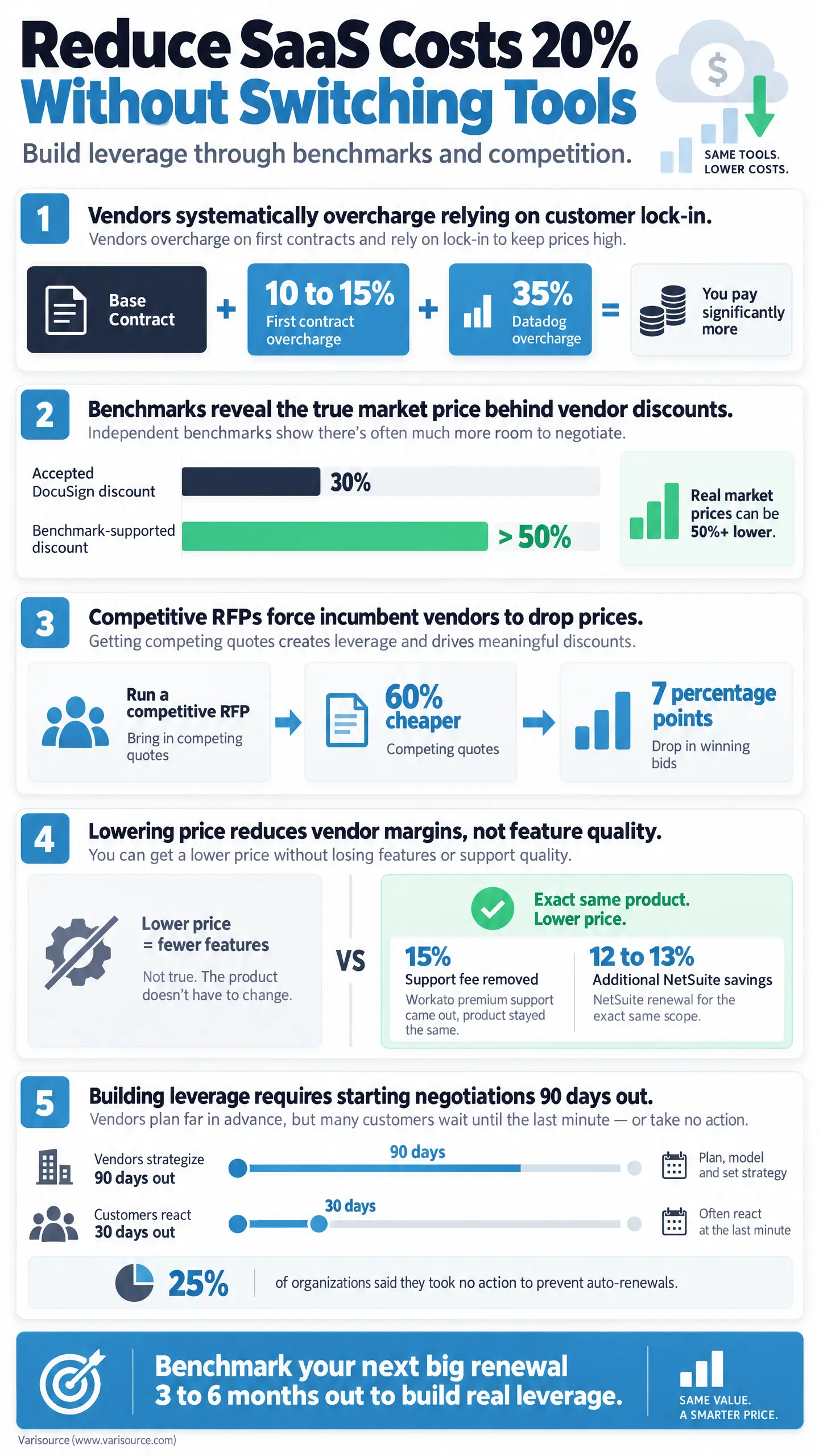
About 90 days before a big renewal, the vendor's sales team is already getting together, strategizing and putting a plan and a playbook in place. When I was on the vendor side, the goal of that playbook was to give the customer enough comfort and confidence that they never went out to market. You'd remind them the service had been great and the team had put in a lot of effort, and that the pricing they had was really, really good. If they pushed back on price, you built an ROI case that would be very difficult for them to argue with, and you showed them how hard it would be to get similar service anywhere else. The customer, meanwhile, usually started dealing with that renewal about 30 days before it was due.
Now I work on the customer's side of that conversation at Varisource. Most of the savings we deliver through SaaS cost reduction strategies come from customers who stay with the exact same vendor. The tool, the scope and your engineers' workflows stay the same, and only the price changes. Software savings across our own customers average 15 to 25%, and so from where I sit, 20% on a tool you're keeping is a realistic target. I think there are savings with every vendor, no matter the category. They come out when the vendor believes you know the market and might act on it. That takes two kinds of benchmark, an alternative the vendor can see, and the time to put them to work.
Key Takeaways
- Varisource data shows that organizations achieve average software cost reductions of 15 to 25% by negotiating pricing benchmarks while maintaining their existing SaaS vendors.
- Presenting competitive quotes from HelloSign and Adobe Sign that were 60% cheaper successfully forced DocuSign to eliminate an 18% overcharge for an enterprise customer.
- Organizations can reduce licensing costs without changing platforms by switching resellers, demonstrated by a customer saving 12% on a 3 million dollar Microsoft Enterprise Agreement by replacing CDW.
- Consolidating external software purchases into the AWS Marketplace increases total platform spend, providing the negotiation leverage needed to secure discounts exceeding 30% on AWS compute costs.
- Tropic's 2025 software buying report reveals that SaaS contracts of a year or less average a 31.9% discount, outperforming the 26.3% discount typical of one-to-two-year terms.
- Auditing specific billing components allowed a Datadog customer to identify and eliminate a 35% overcharge caused by unrequested modules and double-counted usage metrics.
How Can Companies Identify Cost Reduction Opportunities in SaaS Contract Renewals?

From what we see, vendors overcharge by at least 10 to 15% on a first contract, on average. Every renewal, every added module and every multi-year term then adds on top of that, because now the vendor knows you are stuck. Annual increases on software renewals have become normal for the same reason. Software gets built into your workflow, which makes it much harder to replace than office supplies or chairs. The vendor also knows your team doesn't have the time or resources to make a switch.
And so before we benchmark anything, we put last year's invoice and contract next to this year's quote. Then we ask the people who use the tool what needs to be added, changed or removed. That tells you whether an increase came from the vendor or from your own growth in licenses and usage. With usage-based products, asking for a better price usually just gets you told to use less. The leverage comes from understanding the billing components well enough to put proper controls around them. One Datadog customer was being overcharged by about 35%. Datadog had added modules nobody requested and put price increases down to inflation and R&D, and the customer's usage was being counted twice.
On a 30,000-envelope DocuSign renewal we analyzed, the automatic 15% increase was the smaller problem, because the base price was already more than 40% above market. The finance team used that to push back on the increase successfully.
What Are Vendor Benchmarks and Market Benchmarks in SaaS Pricing?
A vendor benchmark shows what this exact vendor charges other customers for similar scope and similar services. Every vendor is charging every customer a different price because they can, and because you would pay for it, so you need to know where you sit. A market benchmark shows what like-for-like vendors charge for the same thing. It matters even if you'd never buy the cheapest option, because it lets you ask the vendor a fair question: if all your competitors are offering the same thing 30 or 40% cheaper, why is your pricing so much higher?
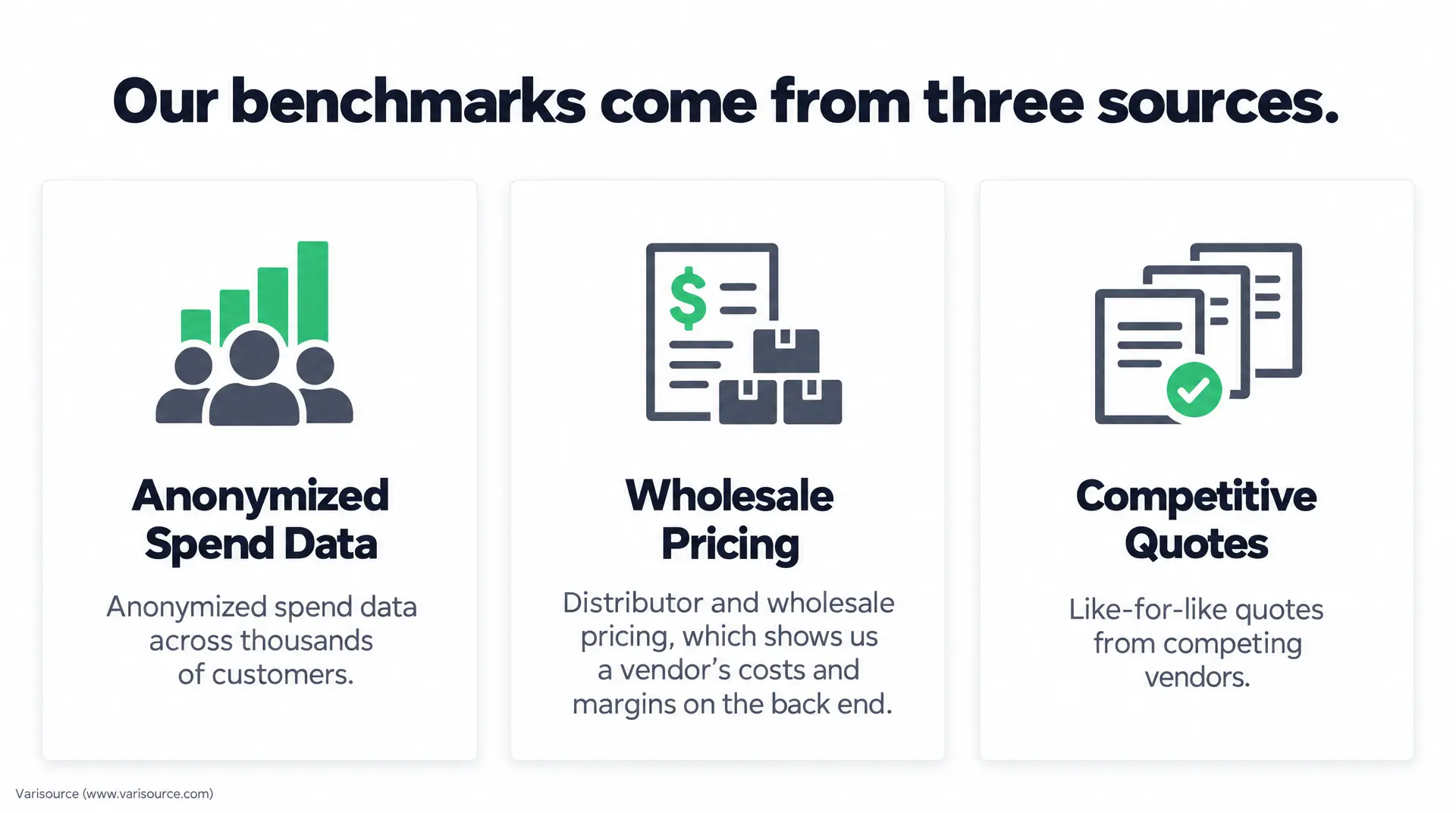
Our benchmarks come from three sources. The first is anonymized spend data across thousands of customers. The second is distributor and wholesale pricing, which shows us a vendor's costs and margins on the back end. The third is like-for-like quotes from competing vendors. Benchmarking is totally separate from visibility. Your spend reports can tell you that you spend $100,000 with a vendor and how many seats are active, and that's the first step toward optimization. They won't tell you whether $100,000 is a fair price.
Discounts are sometimes very, very tricky, because the discount is off of whatever list price the vendor decided on. Business buyers also don't have a Zillow or an Expedia to see what everyone else is paying. A 3,000-employee global company accepted a 30% discount on a $125,000 DocuSign renewal because they only had 30 days to renew. They didn't know the market benchmark supported a discount of over 50%.
How Do Competitive RFPs Create Leverage for SaaS Renewal Negotiations?

Leverage is information and competition, and a benchmark only gives you the information. To create pressure, we open the renewal up to the market with a quick RFP 90 to 120 days out so competitors actually bid, because the market will fight for your business. Whether you switch or not, you can decide, but at least you put the vendor in a competitive situation. Most teams don't have the time, resources or expertise to run that on every renewal, and that's the part our savings program takes on.
On the first call, we explain that finance and procurement executives have brought us in to re-evaluate budgets and renewals. Nothing renews automatically anymore without due diligence, and there are benchmarks the vendor has to meet to keep the business. If the rep treats that as a bluff, we commit right away to coming back with market benchmarks and a competitive RFP. Simply asking for a better price is pretty useless, because if you don't have leverage, they're not going to do anything. Threatening to leave doesn't work with software either, because the vendor knows how integrated it is in your systems.
Competition lowers the price even from the vendor who ends up winning, and that shows up well outside software. A CESifo working paper looked at a Czech reform that required at least two bids on public contracts. Winning bids fell about 7 percentage points against engineering cost estimates. The author put most of the drop down to the same firms bidding lower once they faced competition.
When we work a DocuSign renewal, it's a combination of emails, calls and information. We show DocuSign where HelloSign, Dropbox Sign and Adobe Sign sit for similar e-signature services. We also make clear that if DocuSign can't bring its pricing down, the customer has the right to find an alternative that's more fair to the market. DocuSign was overcharging one customer by 18%, and the like-for-like quotes we brought were at least 60% cheaper. DocuSign reduced its price, and the customer's CFO didn't have to put any effort into it.
One of the reps who fought us hardest was at Datadog. On the first call they kept saying it's a usage product and they'd already given the best discount they could. Over several calls we built leverage through competition, through optimization options and by talking it through with the customer. The discount went from 5% to 20%.
Do Price Negotiations Degrade SaaS Features and Customer Support Quality?
When you push a software vendor on price, you'll often hear that they'd have to remove features, or that support may not be as good. If you understand how software works, software is built already, and it usually costs the vendor the same on the back end because that cost has been built. Paying less simply means less margin for the vendor, and for the customer there is no downgrade or degradation at all.
I think you're in a better position than your CFO to test those warnings, because it's hard for a CFO to negotiate something they don't understand. It's like trying to tell a mechanic how to fix your car when they're the expert. You know which features your teams use and how many support tickets they open. At renewal time, vendors highlight SLA uptime and past discounts and leave the ticket counts and slow delivery times out.
We helped a finance leader get an additional 12 to 13% on a NetSuite renewal for the exact same scope. We showed that the customer wasn't using NetSuite support and hadn't heard from their sales rep until renewal time. On a Workato renewal, premium support was 15% of the customer's total spend. They rarely used it and Workato couldn't validate the usage, and so the fee came out and the product stayed exactly the same.
Once a rep sees the benchmarks, the defense is usually some version of "Yes, we are not the cheapest, but we provide a lot of value, our support is great, and the customer has been with us for many years." If we keep it professional and there's still a win-win on the table, reps are usually very willing to help from there. When a rep keeps leaning on the warnings, we escalate higher up inside the vendor, using our market benchmarks and the context data we have across other businesses.
Some vendors tie a bigger discount to a longer term. I wouldn't give up flexibility for that until the offer has been benchmarked. In Tropic's 2025 software buying report, contracts of a year or less averaged a 31.9% discount, against 26.3% for one-to-two-year terms. In cloud, customers usually buy AWS, Azure and GCP on demand or on one-year terms because they want flexibility, which means giving up the three-year discount. We get them three-year term discounts on month-to-month flexibility, usually on EC2 and compute, savings plans and reserved instances.

How Does Switching Software Resellers Reduce SaaS Licensing Costs?

Sometimes the software never changes and the pressure goes on whoever you buy it through. A customer with a $3 million Microsoft Enterprise Agreement for E5 licenses was being overcharged by 12% through their reseller, CDW. We brought in competing bids from other resellers. The customer moved to a different reseller and captured the savings on the same Microsoft licenses. Another customer spent about a million dollars a year with Microsoft. For them, we benchmarked other CSPs and resellers against their current reseller for the exact same services and scope. It works a lot like checking the same flight on Expedia and Booking.com.
Benchmark and leverage all depend on understanding what the other salesperson is looking for. We helped one customer move a large part of their software spend into the AWS marketplace. That raised their total AWS spend and gave us the leverage to get over 30% off their compute costs. AWS met its revenue goals, and the customer's overall costs went down.
How Do Lead Times and Internal Stakeholders Impact SaaS Renewal Negotiations?
Vendors strategize for 90 days and customers deal with it 30 days in advance. That gap is a big part of why customers overpay, because leverage takes time to build. Most of the negotiations we lose come down to the calendar. Customers have come to us with two weeks left on a vendor that's deeply integrated into their systems, and the vendor knew they weren't going to switch in two weeks.
We were tracking contracts for one customer and reminded them several times about a renewal. By the time they responded, they'd been auto-renewed for three years at significant cost. In BetterCloud's 2025 survey of IT professionals, a quarter of organizations said they took no action to prevent auto-renewals, which leaves the vendor's terms in place by default. We track renewals 90 to 120 days ahead. With a new customer, the first job is mapping a contract end date to every vendor in the AP file and pulling out anything due in the next 30 to 50 days.
The people decide a lot of these renewals too. In telecom, we've seen stakeholders walk away from 20 to 30% savings because they didn't want to change IP addresses or reinstall internet service. Sometimes the vendor was a friend. Those deals died with people going quiet. A same-tool software renewal asks very little of your engineers, because there's no migration and nothing to reinstall. What's left comes down to people's agendas, and whether the company has given them the goals and incentives to help it save money.
A PE operating partner would ask for the ROI of every vendor and every spend, the who, what, when, why and how. If technology can show the negotiated number next to the vendor's first quote on every renewal, it has that answer ready for the CFO. The money recovered can then fund the roadmap without a new budget request.

You might have a big renewal three to six months out, or you might have inherited a vendor estate in the last year. Either way, there's still enough runway to build real leverage. I'm happy to have my team benchmark your next big renewal with you. We only get paid when we save you money, so seeing where you stand costs you nothing.
Frequently Asked Questions
How should we address aggressive AI-related price increases during renewals?
Vendor AI uplifts are frequently disproportionate. Market data shows AI-related price increases often hit 20 to 37%, compared to standard 3 to 9% uplifts. Demand itemized usage reports to prove AI adoption. If your engineers aren't actively consuming those features, strip the modules out before renegotiating.
What is the most effective way to audit SaaS license utilization?
Stop surveying managers manually. Data shows 46% of SaaS licenses go unused. You need automated SSO telemetry to track active logins, not assigned seats. Granular visibility prevents renewing dead weight and forces vendors to price based on actual consumption.
How can we rapidly consolidate duplicate SaaS tools post-acquisition?
Post-M&A, you will inevitably inherit redundant stacks paying in parallel. First, map overlapping tools against contract end dates in your AP file. Cancel redundant month-to-month contracts immediately, then leverage the combined entity's increased headcount to force early, heavily discounted renegotiations with the surviving enterprise vendors.
Is it actually cheaper to switch SaaS vendors rather than renegotiate?
Rarely. The friction of ripping and replacing usually eclipses the savings. Research estimates IT switching costs average one-third of annual expenditure. That is lost engineering time. The most profitable strategy is staying with your incumbent vendor but using market benchmarks and competitive RFPs to force their pricing down.
How do we prevent auto-renewals from destroying our negotiation leverage?
Leverage requires time, yet 25% of organizations take no action to prevent auto-renewals. You must build a centralized vendor inventory and set hard alerts 90 to 120 days out. If a vendor auto-renews at an inflated rate because you missed a 30-day notice window, they hold all the cards.
About the Author

Victor Hou
Victor Hou is the founder of Varisource, the first ever Savings Automation Platform that automates Savings for Your Business. Victor helps companies access discounts, rebates, benchmark data, savings for renewals and new purchases across 100+ spend categories automatically to increase your company's margins and equity value by at least 15-20%. Victor is active and passionate about using AI + automation to help your business save time, money and run more efficiently.


Varisource’s Savings Automation Platform guarantees savings and maximized leverage on every dollar spend across 100+ spend categories


