The Ultimate 2026 Guide to Vendor Benchmarking & Spend Analytics

Every discount you have ever celebrated was measured against a number your vendor invented. There is no Zillow for what companies pay for software, so the savings was anchored to nothing, and that was the point.
I spent 15 years on the vendor side, sitting in the renewal meetings you were never invited to and writing the line that ended them: the service was great, the team worked hard, your pricing is really, really good. Every word was placed to keep you comfortable enough that you never go out to market.
Another company your size got 50% off the same product, and the entire arrangement exists so you never find out.
Key Takeaways
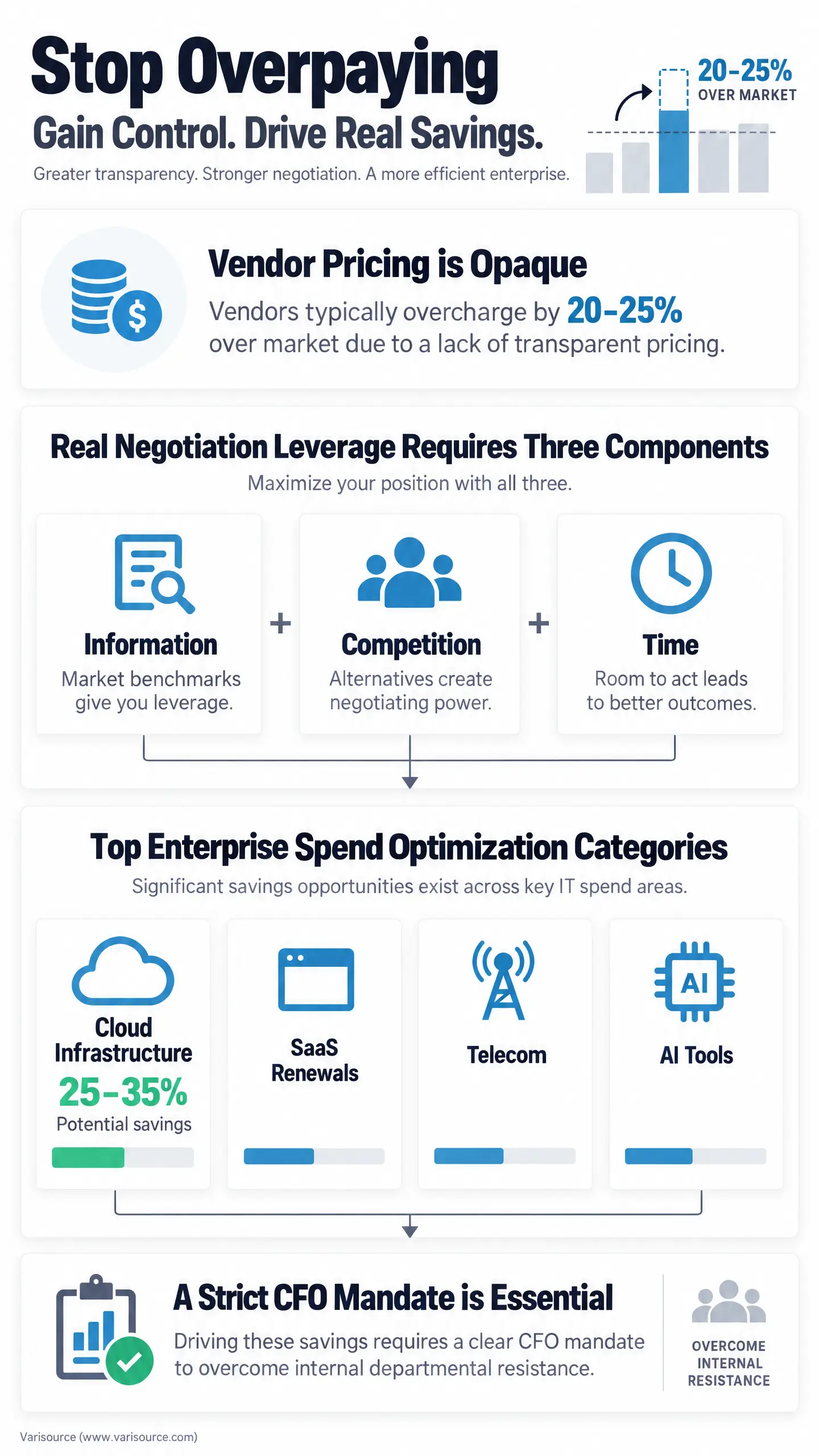
- Enterprise software vendors routinely overcharge customers by compounding a 10 to 15% markup on initial contracts into a 20 to 25% premium over fair market value by the third renewal cycle.
- Accurate enterprise vendor pricing benchmarks require combining anonymized peer spend data, hidden distributor wholesale margins, and like-for-like competitive quotes to determine fair market value.
- Applying pricing benchmarks, competitive alternatives, and direct usage analysis to an enterprise vendor negotiation successfully increased a Datadog software renewal discount from 5% to 20%.
- Sorting 18 months of Accounts Payable data by total spend can identify costly duplicate subscriptions, such as discovering nearly $1 million in Microsoft licenses mistakenly purchased at list price on corporate credit cards.
- Cloud infrastructure platforms like AWS, Azure, and Google Cloud yield 25 to 35% cost savings when organizations transition from flexible on-demand pricing to multi-year commitment structures.
- Enterprise telecom contracts consistently remain 20 to 30% overpriced year-over-year because three-year agreements obscure dropping market rates beneath complex invoices filled with hidden reseller margins and taxes.
- Internal departmental silos prevent finalized vendor cost savings when finance leaders lack a strict mandate to overrule IT stakeholders who refuse to implement required technical transitions like IP address migrations.
Why Do Enterprise Software Vendors Overcharge Customers Without Transparent Pricing Anchors?
You have Zillow for houses and Expedia for flights. Enterprise buying has nothing like that. There is no place where a CFO can look up what other companies pay for the same software, the same circuits, the same cloud compute.
And so the vendor gets to charge pretty much anything they want. A rep says "here is our list price, and here is the 30% discount we're giving you," and it sounds like a lot. But another customer got 50%, and you would never know. A discount means nothing when you can't tell what it was anchored to, and a lot of times it was anchored to nothing.
The dirty secret of the vendor world is simple. Every vendor is overcharging you and charging every customer different prices, because they can, and because you would pay for it. It usually starts at 10 to 15% on the first contract, then compounds through renewals and add-ons and multi-year terms, because by then the vendor knows you are stuck. By the third or fourth cycle a company is 20 to 25% over fair market, and nobody can point to the moment it happened.
Why Is Spend Visibility Insufficient for Enterprise Vendor Price Optimization?
The instinct, once a CFO sees this, is to buy a spend dashboard. I understand that. You cannot optimize what you can't see, and visibility is the first step towards optimization.
But visibility tells you that you spend $100,000 with Microsoft. It does not tell you whether $100,000 is a good price. Is there a provider that is cheaper, better, faster than what I have today? A dashboard can't answer that, and neither can the big procurement suites. They give you spend control, which is real value, but visibility is not leverage. You can have every invoice categorized perfectly and still be paying 30% too much for telecom, because nobody in the building knows what telecom should cost.
How Is an Accurate Enterprise Vendor Pricing Benchmark Actually Built?
Take a DocuSign renewal. When we benchmark it, the number comes from three places, and only one of them is something a CFO could get on their own.
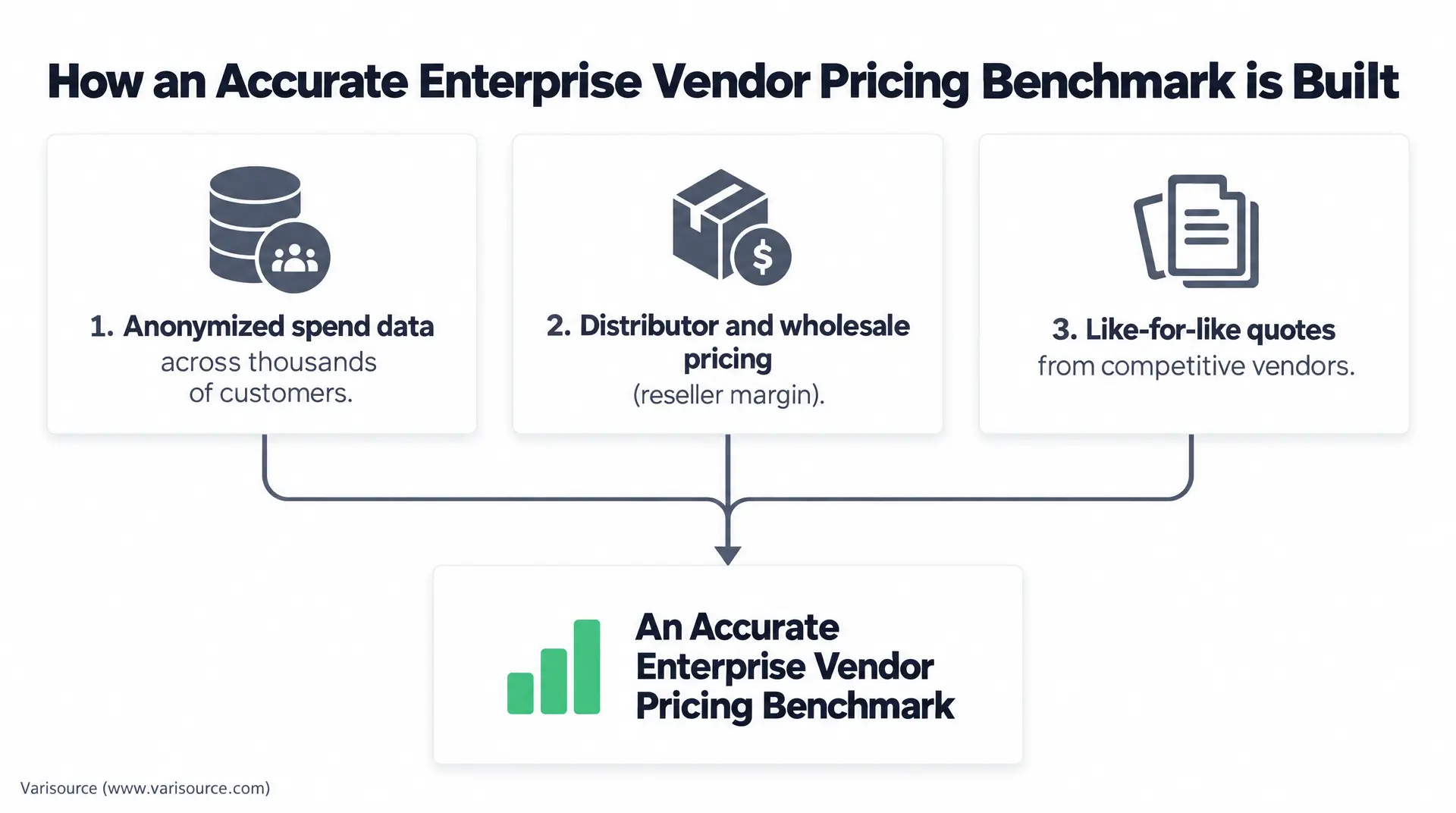
The first is anonymized spend data across thousands of customers. We know what companies your size are renewing, buying, and paying for DocuSign, down to the SKU. The second is distributor and wholesale pricing. This is the part nobody talks about. On the back end we can see what a lot of these products cost the people reselling them and what the margin is. Once you know the margin, you know what the customer should be paying, and you know how much room the rep has when they say they have none. The third is like-for-like quotes from competitive vendors, which tells the current vendor what the market will do before you ever have to walk away.
Compare that to uploading your top 20 contracts into ChatGPT. It will summarize terms and flag auto-renewals, which is useful. But its pricing data comes from the internet, and so does Google's. Neither has seen a distributor price sheet. And even a perfect benchmark is only one portion of leverage.
What Are the Three Essential Components of Vendor Negotiation Leverage?
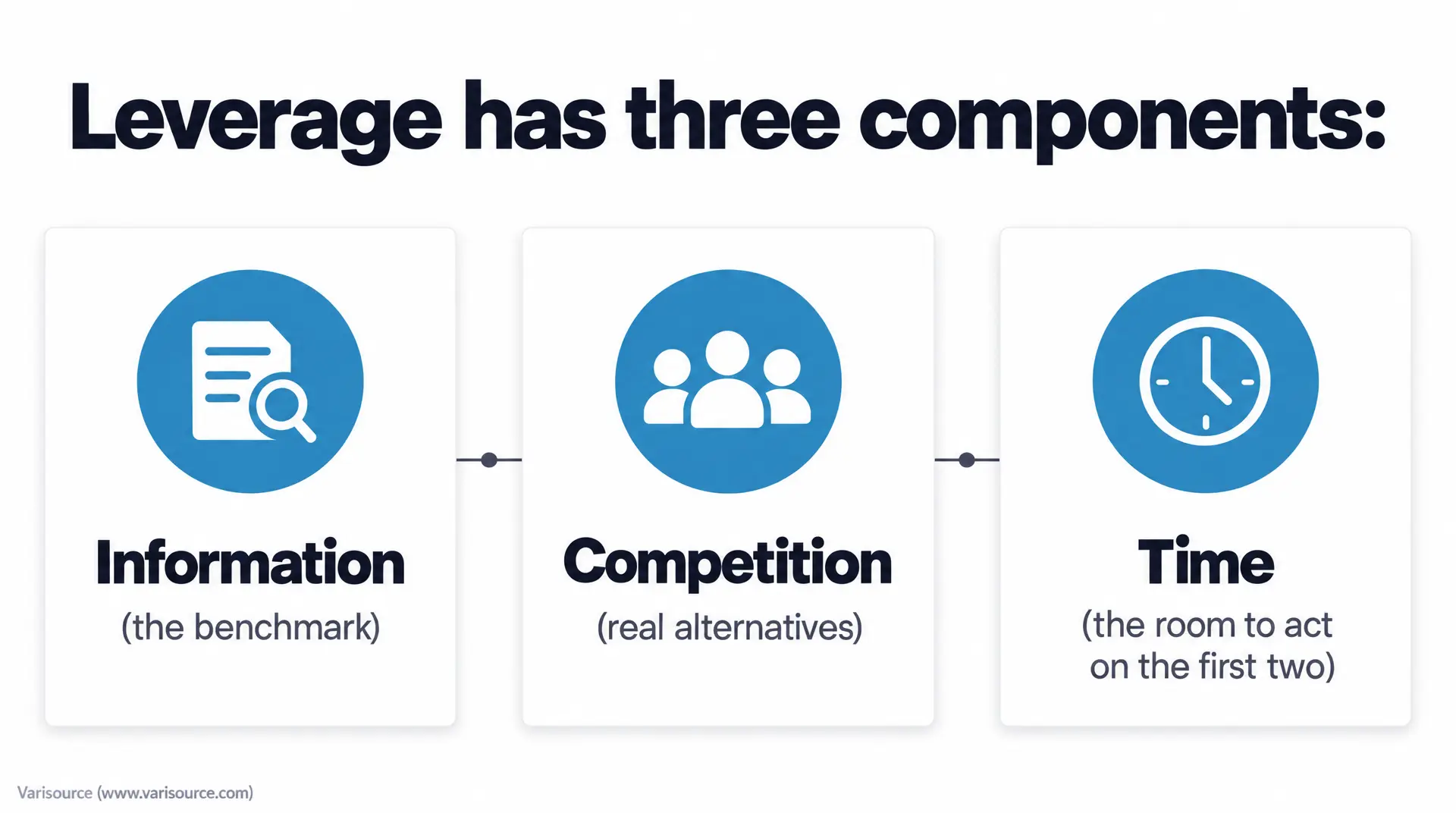
I think of leverage as three components. Information is the benchmark. Competition is real alternatives that make the vendor believe you might leave. Time is the room to do something with the first two. Take any one away and you are left with asking the vendor for a better price, and if you don't have leverage, they're not going to do anything.
Datadog is a good example of the three working together. On the first call for one of our customers, the rep was clear: it's a usage product, we've already given the best discount possible, there is nothing more we can do. Over several calls we built competition, put optimization options on the table, and went through actual usage with the customer. The discount went from 5% to 20%. Same vendor, same product.
The defense you'll hear from a rep is nearly always the same. "Yes, we are not the cheapest, but we provide a lot of value, our support is great, and the customer has been with us for many years." I ran a version of that script for 15 years. Answer it with benchmarks, keep it professional, leave room for a win-win, and in my experience most reps are very willing to help.
When we lose, it's almost always time. A customer comes to us two weeks before a renewal with a vendor wired into their systems. The vendor knows they can't switch in two weeks, so there is no leverage left to build. Most companies can't even say when their renewals hit. World Commerce & Contracting found contract data spread across an average of 24 systems in a typical company, so nobody owns the calendar. We built Vendor Cloud to fix that, one place for every contract, SKU, renewal date, and benchmark, with reminders months out. It's the vendor brain, and it means the second negotiation with a vendor starts from history instead of from zero.
How Should Accounts Payable Files Be Analyzed for Vendor Cost Savings?
You do not need a platform to start. Pull your AP spend for the last 18 months, vendor name and dollar amount, and sort it top to bottom. That is the only input we ask for.
The first thing I look at is total spend against total vendor count, because 200 vendors is a very different job from 1,000. Then I look at where the top categories fall. Cloud, software, telecom, and insurance carry the biggest overcharge, so when they sit near the top there is money. Then I scan for duplicates, several vendors doing the same job, which usually traces back to an acquisition nobody finished cleaning up.
Doing exactly this, we've found $1.1 million going to services for an office and a project that had already closed down. It kept auto-renewing, and no one noticed. We've found a company running four separate CRMs that all did the same thing. We've found close to $1 million of Microsoft purchases on a corporate credit card, which means someone was paying full list price for Microsoft. We sorted the file and there it was.
What Are the Top Enterprise Vendor Spend Categories for Cost Savings in 2026?
How Does Cloud Infrastructure Commitment Drive Enterprise Vendor Cost Savings?
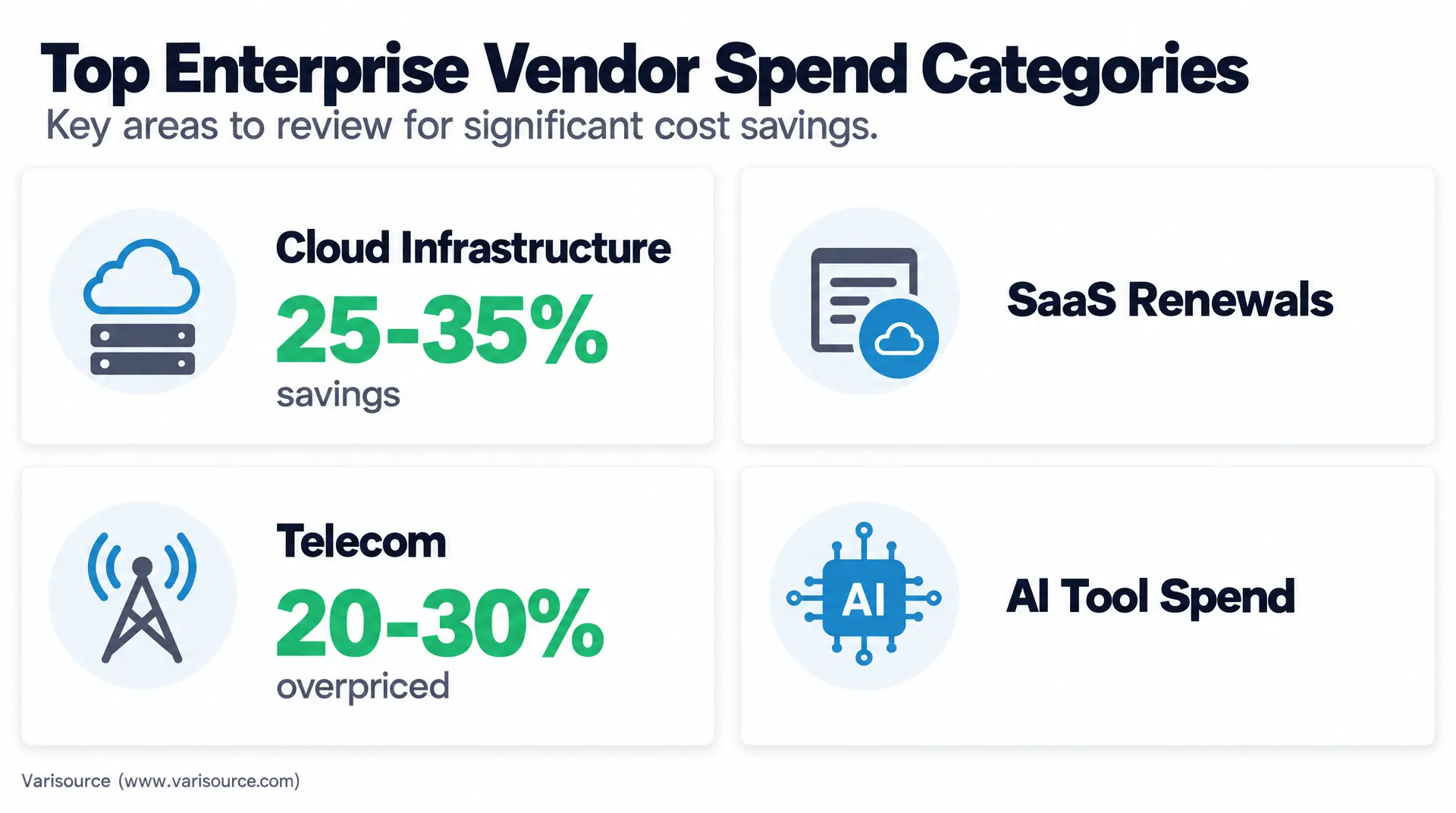
Most companies buy AWS, Azure, or GCP on demand or on one-year terms because they want flexibility. AWS itself says Savings Plans can cut compute costs by up to 72% versus On-Demand, which shows what gets left on the table when a company won't commit. Our savings program gets customers three-year term discounts on month-to-month flexibility, usually on EC2, compute, savings plans, and reserved instances. That's why cloud is our richest category at 25 to 35%.
How Can Companies Optimize SaaS and Enterprise Software Renewal Costs?

SaaS vendors have normalized 8 to 20% annual increases because the product is wired into your workflow and they know you won't take the time to rip it out. Our very first shared-savings deal was a Microsoft M365 renewal, hundreds of licenses, around $300,000 a year. We got it to $260,000 in about a week.
Why Does Enterprise Telecom Spend Require Consistent Cost Optimization and Benchmarking?
Telecom is infrastructure, and infrastructure gets resold, so the customer never sees the underlying cost. Invoices run 80 to hundreds of pages with taxes and fees buried inside. Contracts run three years while market pricing drops the whole time, and nobody revisits it because it's plumbing. Put those together and telecom sits 20 to 30% overpriced year after year.
How Should Finance Teams Track and Optimize Enterprise AI Tool Spend?
Most finance teams are not tracking AI costs at all. By the time they see it, it's too late because the money has been spent. Zylo found 78% of IT leaders hit unexpected charges tied to AI features or consumption pricing last year. Set up tracking first. Optimizing it is a separate skill, and most companies have neither still.
How Can Finance Teams Validate and Defend Vendor Cost Savings to the Board?

A savings number only counts if it holds up when a department head or an auditor pushes on it. So before we touch anything we document a baseline, usually the previous quote or the previous year's spend, and validate it with the customer. Then we match this year's invoice and quote against it to find what changed and why, talk to the people who actually use the tool about moves, adds, and changes, and only then benchmark. The gaps become the negotiation playbook, and every saving gets validated with the customer before we claim it. That discipline is how a $1.1 million Cisco UCS blades quote became about $825,000 for one customer.
When the rep warns that a discount means lower quality, ask what you're buying. If it's an installation crew, a deep cut might mean a less senior tech on site, and that's fair. If it's software or cloud, the software is built. You get the same product no matter what you pay. That warning is a scare tactic, and it works on CFOs who believe the more you pay, the better quality you get, which is often wrong.
Why Is a CFO Mandate Required to Overcome Internal Resistance in Vendor Negotiations?

Every failed savings effort I've watched came down to data and people. The CFO is the only one who can fix the people part.
We've found 20 to 30% telecom savings and watched a stakeholder kill it because they didn't want to change IP addresses or reinstall internet service. Sometimes the vendor is a friend. Sometimes it's just work they don't feel like doing. They don't argue with the number. They stop responding to emails, and the renewal date passes. It's the company's money, not the stakeholders' money. We reminded one customer about a renewal several times, nobody replied, and they were auto-renewed for three years at a significant cost.
Most CFOs don't overrule that, and I understand why. You negotiate payroll and real estate hard and then roll over on cloud, because you can't negotiate what you don't understand. It's like telling the mechanic how to fix your car. So when IT says no, the uncertainty wins and nothing happens. Deloitte's 2025 CPO survey found siloed ways of working was the top barrier to procurement delivering value, at 57%. Five departments have to line up for a saving to happen, and you're the only person who can line them up.
You do not need to become a cloud expert. You need a mandate: every spend dollar with a vendor has an ROI. PE operating partners ask for the who, what, when, why, how of every vendor and every spend. Corporate CFOs almost never do.
The politics get easier once people see how this works. The majority of what we find keeps the same vendor and the same service, and the decision stays with the tool owner. One procurement leader told us his real worry was that if we did what we said, his boss would ask what he was still needed for. He gave it a chance, it made him look good, and he's still a customer.
What Is the Best Strategy for Starting Enterprise Vendor Cost Optimization Initiatives?
Don't try to attack several hundred vendors at once. Start with the one renewal three to six months out that's carrying an increase. Build the baseline, benchmark it, negotiate it, and take that number to the board. Then send the AP file and open up everything else.
At Varisource we are paid based on performance, so we have to perform. The customer keeps 80 to 85% of the savings, and the AP file gets you a Savings Estimate Report in about 48 hours.
There are savings with every vendor, no matter the category. The only question is whether you go looking 90 days out, like the vendor already is, or 30.
Frequently Asked Questions
What is a healthy benchmark for technology spend as a percentage of revenue?
It depends on how you measure it, but operational IT averages about 3%. However, Deloitte found broader tech spending hit 5.49% of revenue and is climbing. If your total tech spend is drifting toward 10% or 15%, you are bleeding EBITDA. You need a baseline immediately.
How do we benchmark decentralized vendor spend when department heads buy their own tools?
You start with the AP file, not department heads. Business leaders now control around 40% of tech budgets, leading to massive duplication. We pull the raw payment data, map every supplier, and benchmark the shadow IT your teams bought on corporate credit cards without central approval.
If we have an internal procurement team, do we still need external vendor benchmarking?
Yes. Internal procurement should focus on your strategic top 20% of vendors. External benchmarking handles the unmanaged 80%. Even great procurement teams lack distributor-level pricing data for niche SaaS. We complement your team by providing the raw market intelligence they need to negotiate the long tail effectively.
How do you benchmark consumption-based pricing models like AI or cloud infrastructure?
You cannot benchmark consumption without first baselining usage. 78% of IT leaders reported unexpected charges from AI and usage-based pricing last year. We map your exact utilization rates against anonymized market data for identical compute tiers, proving exactly where your per-unit costs exceed fair market value.
At what stage before a contract expires should we begin vendor benchmarking?
You must start building your benchmark at least 90 to 120 days out. Vendor sales teams strategize a full quarter before a renewal. If you wait until 30 days out, you forfeit all leverage because the vendor knows you lack the time to switch. Leverage requires runway.
About the Author
.jpeg)
Victor Hou
Victor Hou is the founder of Varisource, the first ever Savings Automation Platform that automates Savings for Your Business. Victor helps companies access discounts, rebates, benchmark data, savings for renewals and new purchases across 100+ spend categories automatically to increase your company's margins and equity value by at least 15-20%. Victor is active and passionate about using AI + automation to help your business save time, money and run more efficiently.
%201.svg)

Varisource’s Savings Automation Platform guarantees savings and maximized leverage on every dollar spend across 100+ spend categories


